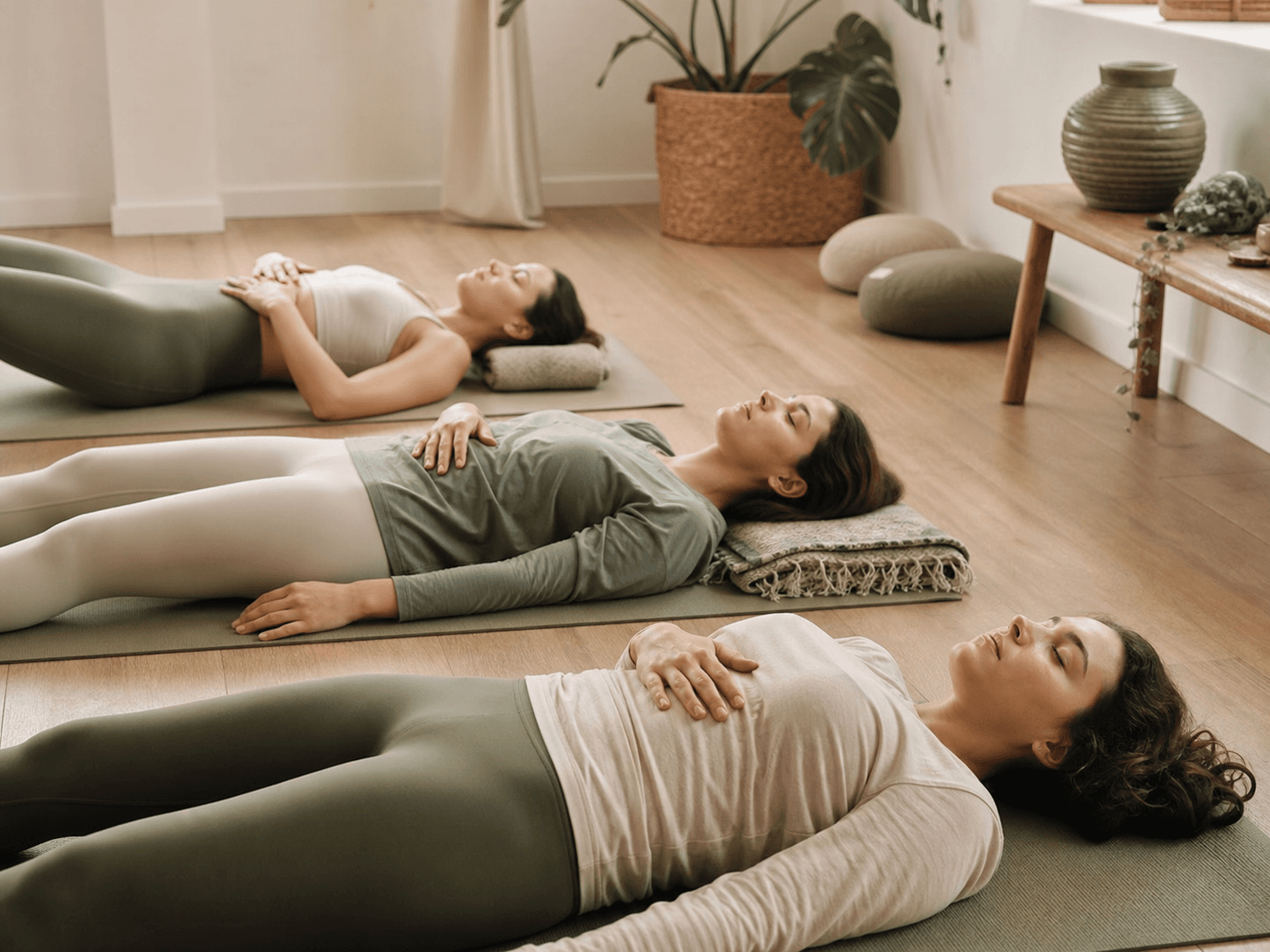
Breathing for Stress: A Gentle 5-Minute Reset
Stress changes the breath.
Sometimes before we even notice.
The shoulders rise. The jaw tightens. The breath becomes shallow. The chest feels busy. The body starts preparing for something, even if the only thing in front of us is an email, a decision, a difficult conversation, or a mind that will not stop running.
This is not weakness.
It is biology.
When the nervous system senses pressure, the breath often follows. It may become faster, shorter, tighter, or uneven. Some people hold their breath without realizing it. Others feel like they cannot get a full breath, so they try to breathe harder, which can sometimes make things feel worse.
Breathing for stress is not about forcing a deep breath.
It is not about controlling the body.
It is not about becoming calm on command like a well-trained houseplant.
It is about creating one small signal of safety.
A slower exhale. A softer belly. A relaxed jaw. Feet feeling support. Attention returning to now.
This is a gentle 5-minute reset you can use when stress rises, thoughts speed up, or the body feels tense and overloaded.
No equipment is needed.
No perfect silence is needed.
No experience is needed.
Just five minutes, a little attention, and a willingness to begin softly.
Why Breathing Helps During Stress
Breath is one of the few body systems that is both automatic and voluntary.
You do not need to remember to breathe. The body handles that.
But you can also influence the breath.
You can slow it down. You can soften the exhale. You can breathe through the nose. You can bring attention lower into the ribs and belly. You can notice when you are holding tension.
That makes breathing a useful doorway into the nervous system.
When stress pulls the mind into prediction, worry, or pressure, the breath can help bring attention back to the body.
Not because one breath solves everything.
Because one breath can interrupt the spiral.
And sometimes interrupting the spiral is the first real step.
The Most Important Rule: Do Not Force It
A lot of people hear "take a deep breath" and immediately try to pull in a huge breath.
That is not always helpful.
When the body is already stressed, forcing big breaths can sometimes increase tension, dizziness, or discomfort.
So for this practice, the rule is simple:
Gentle first.
Let the breath move as deep as is comfortable.
If the belly moves, good. If only the ribs move, okay. If the breath feels small at first, let it be small. If counting makes you tense, do not count.
You are not trying to impress your lungs.
You are trying to give your body a steadier rhythm.
When to Use This Reset
Use this practice when:
- your thoughts are racing
- your shoulders are tense
- you feel emotionally overloaded
- you are about to react too quickly
- you are preparing for a difficult conversation
- you feel scattered at work
- you are overstimulated by screens
- you notice shallow breathing
- you feel pressure in your chest from stress
- you need a pause before the next step
- you want to wind down gently
You can also use it when nothing is wrong.
That may be the best time to practice.
The body learns better when it is not always in crisis mode.
The 5-Minute Breathing Reset
Find a comfortable position.
Sit, stand, or lie down.
If you are sitting, let your feet or body feel supported.
If you are lying down, let the body feel supported.
If closing your eyes feels good, close them.
If that feels uncomfortable, keep your eyes open and soften your gaze.
Set a timer for five minutes if that helps.
Then begin.
Minute 1: Arrive in the Body
Do not change your breathing yet.
Just notice it.
Feel your feet, legs, seat, back, or hands.
Notice where your body touches support.
The chair. The bed. The earth. The steady surface beneath you.
Now notice your natural breath.
Where do you feel it most?
Nose. Throat. Chest. Ribs. Belly. Back.
Do not judge it.
Fast is information. Shallow is information. Tight is information. Uneven is information.
Start with awareness.
Say quietly:
"This is how my body is breathing right now."
That is enough.
Minute 2: Soften the Edges
Now begin to soften the body around the breath.
Relax your jaw slightly.
Let the tongue rest.
Drop the shoulders one small amount.
Unclench the hands.
Let the belly be less guarded.
Do not force relaxation.
Just remove a little effort.
Now let the breath move as low as is comfortable.
You are not pushing the belly out.
You are not trying to breathe perfectly.
You are simply allowing more space.
Inhale gently.
Exhale gently.
Let the body know it does not have to perform.
Minute 3: Lengthen the Exhale
Now give the breath a simple shape.
Inhale softly.
Exhale a little slower.
Try this rhythm if it feels comfortable:
Inhale for 3. Exhale for 5.
Repeat.
If 3 and 5 feels too long, try:
Inhale for 2. Exhale for 4.
If counting feels stressful, drop the numbers and simply make the exhale slightly longer than the inhale.
The exhale is the key.
Do not hold the breath.
Do not strain.
Do not chase a dramatic feeling.
Just let the out-breath become a little slower, smoother, and easier.
Think of the exhale as a quiet signal:
We can soften now.
Minute 4: Add Grounding
Bring attention to the lower body.
Feel your feet.
Feel your legs.
Feel the weight of your body.
If you are sitting, let your feet meet the support beneath them.
If you are lying down, feel the surface holding you.
Keep breathing gently.
Inhale softly.
Exhale slowly.
Now add the senses.
Name:
One thing you can see. One thing you can hear. One thing you can feel.
Simple.
A wall. A sound outside. Your feet. Your hands. The air. The chair. The room.
This helps the mind return to the present moment.
The body is not in tomorrow.
The feet are not in yesterday.
The breath is happening now.
Minute 5: Choose the Next Small Step
For the final minute, let the breath become natural again.
No forcing.
No counting unless it helps.
Ask yourself:
What is the next small thing I need?
Not the whole solution.
One small thing.
Water. Food. A walk. A message. A boundary. A stretch. A shower. A pause. A written list. A few more breaths. A real conversation. Five minutes away from the screen.
Choose one next step that your body can actually do.
Stress often wants a full life plan immediately.
The nervous system usually trusts one honest step more.
When the practice ends, do that one thing slowly.
That is the reset.
The 30-Second Version
If you do not have five minutes, use this:
Feel your feet. Relax your jaw. Inhale gently. Exhale slowly. Name one thing you can see. Name one thing you can feel. Ask: "What is the next small thing?"
That is enough to interrupt the pattern.
Not always completely.
But enough to create a doorway.
And a doorway is better than another loop.
Why the Longer Exhale Helps
When people are stressed, the breath often becomes faster and more shallow.
A longer, softer exhale can help shift the body away from urgency.
It gives the system a slower rhythm to follow.
This does not mean you need to breathe perfectly.
The body is not a machine that needs the exact right code typed into it.
It is more like a living instrument.
You tune it gently.
Too much force creates more tension.
A softer signal often works better.
Belly Breathing Without Forcing
You may hear this called belly breathing or diaphragmatic breathing.
The diaphragm is a major breathing muscle below the lungs. When breathing becomes tense, many people breathe mostly into the upper chest. Diaphragmatic breathing helps bring attention lower and encourages a fuller, more relaxed breathing pattern.
But the phrase "belly breathing" can be misunderstood.
You do not need to shove the belly outward.
You do not need to inhale as much air as possible.
You do not need to look like a balloon being inflated at a strange wellness birthday party.
Try this instead:
Place one hand on your chest.
Place one hand on your belly or lower ribs.
Let the breath arrive gently.
Notice whether the lower hand moves even slightly.
If it does, good.
If not, stay soft and patient.
The goal is not to force movement.
The goal is to invite the breath lower over time.
What If Breathing Makes Stress Worse?
For some people, focusing on the breath can feel uncomfortable.
This can happen if you are very anxious, panicked, trauma-activated, short of breath, or sensitive to body sensations.
If breath focus makes you feel worse, stop trying to control the breath.
Try grounding first.
Look around the room. Name five things you can see. Feel your feet. Touch a solid object. Listen to sounds nearby. Walk slowly. Open a window. Place a hand on your chest or leg.
Then let breathing be natural.
You do not have to use breathwork as your first tool.
Sometimes the safest doorway is touch, sight, sound, or movement.
That still counts.
Signs You Should Stop
Stop the practice if you feel:
- dizzy
- faint
- chest pain
- severe shortness of breath
- tingling that feels frightening
- panic increasing
- loss of control
- confusion
- emotional overwhelm that feels unsafe
Do not push through.
The breath is not a battlefield.
If symptoms are intense, unusual, persistent, or frightening, seek medical support.
If you may harm yourself or someone else, or you are in immediate danger, contact emergency services or a crisis line in your country right away.
A Workday Version
Use this between meetings, messages, or tasks.
Sit with your body supported.
Place one hand on your leg or desk.
Look away from the screen.
Take five slow exhales.
Then ask:
"What is the next real task?"
Not the imaginary mountain.
The next real task.
Write it down.
Begin there.
This version is especially useful when stress comes from too much input, too many tabs, too many decisions, or too much pressure to respond immediately.
The breath creates a small border between stimulus and response.
That border is where choice returns.
A Before-Conversation Version
Use this before a difficult conversation.
Stand or sit still.
Feel your feet.
Inhale gently.
Exhale slowly.
Relax your jaw.
Let your shoulders drop.
Ask:
"What do I want to bring into this conversation?"
Maybe the answer is honesty.
Maybe patience.
Maybe courage.
Maybe boundaries.
Maybe listening.
Take three more slow exhales.
Then enter the conversation from your body, not only from the argument in your head.
A Bedtime Version
Use this when the day is still buzzing in your system.
Sit or lie down in a way that feels steady.
Let your hands rest on your body.
Inhale gently.
Exhale slowly.
Repeat for five minutes.
On each exhale, silently say:
"Not now."
Not because your concerns do not matter.
Because sleep is not the place to solve all of them.
If "not now" feels too strong, try:
"I can return tomorrow."
Then rest.
Let the breath become ordinary again.
Ordinary is good.
Ordinary is where rest begins.
A Nature Version
If you can go outside, combine breathing with contact.
Stand or sit somewhere safe.
Feel your feet on the ground.
If barefoot contact is safe, use it.
If not, keep your shoes on and still feel the ground beneath you.
Inhale gently.
Exhale slowly.
Notice the air.
Notice temperature.
Notice sound.
Notice light.
Let the exhale belong to the landscape.
You do not need a perfect forest.
A tree outside an apartment counts.
A small garden counts.
A patch of sky counts.
A plant by the window counts.
The nervous system often responds well to real-world signals: air, texture, light, rhythm, birds, wind, water, space.
Nature does not need to be dramatic to help you return.
Common Mistakes
Mistake 1: Trying Too Hard
If your breathing practice feels like effort, reduce it by half.
Make it softer.
Mistake 2: Taking Huge Breaths
Bigger is not always better.
Gentle breathing is usually better for stress.
Mistake 3: Holding the Breath Too Long
Breath holds can be useful in some practices, but they are not needed here.
For stress, start without holds.
Mistake 4: Chasing Calm
Calm may come.
But the real goal is presence.
You can be present and still feel emotion.
Mistake 5: Practicing Only in Crisis
Practice when you are okay.
Then the body knows the path when stress rises.
How Often Should You Practice?
Start small.
Five minutes once a day is enough.
Or 30 seconds several times a day.
Try linking it to something you already do:
Before checking your phone. Before opening your laptop. After brushing your teeth. Before lunch. After work. Before sleep. Before sending a difficult message.
Do not build a routine so large that it collapses under its own dramatic self-importance.
Small and repeatable wins.
Roots grow by repetition.
The WholeRoot Practice
At WholeRootLabs, breathing for stress is not about escaping life.
It is about returning with more presence.
The practice is simple:
Notice. Soften. Exhale. Ground. Choose one small step.
Again and again.
Stress may still come.
Hard days may still happen.
The mind may still run.
But the breath gives you a way to begin again without needing the whole world to become quiet first.
That matters.
Try It Now
Take one gentle breath.
Let the exhale be a little slower.
Feel your feet.
Relax your jaw.
Look around.
Name one thing you can see.
Ask:
"What is the next small thing?"
Then start there.
Not perfectly.
Honestly.
One breath.
One return.
One root.
Keep Exploring
New to breathwork? Start with Breathwork Hub: Start Here.
Not sure what to choose next? Use The Breathwork Map: Calm, Balance, Energy and Deep Work.
Before trying intense methods, read Breathwork Safety: When to Go Slow or Skip It.
If breath focus feels like too much today, try Grounding for Stress: A 5-Minute Nervous System Reset.
For a simple nature-based rhythm, try The WholeRoot 7-Day Grounding Challenge.