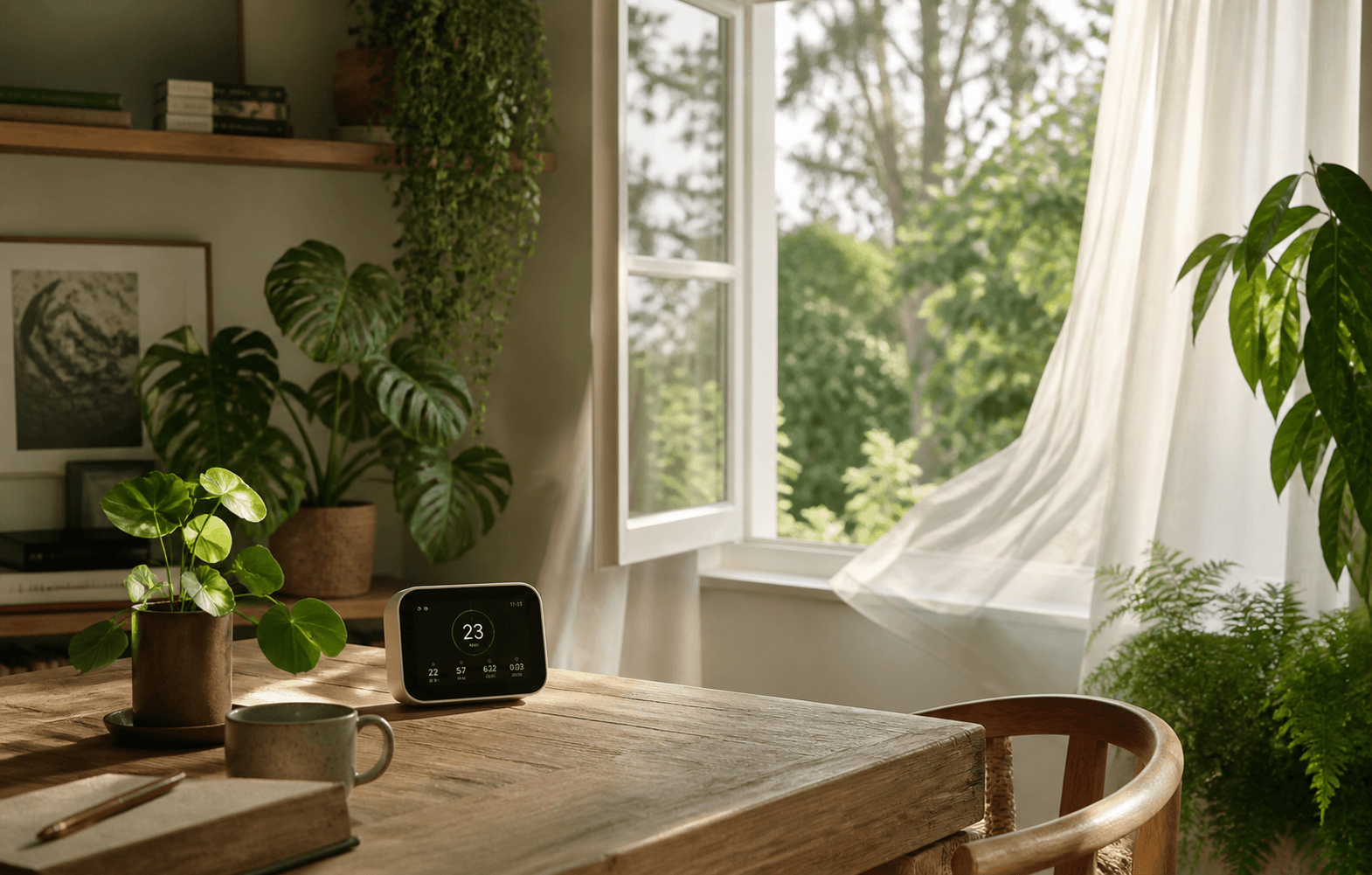
The Air You Live In
What CO₂, humidity, temperature and ventilation can reveal about your home.
Indoor air is easy to ignore because it does not sit on a shelf, and you cannot always see when it changes.
But you live inside it every day.
The air in a room carries breath, moisture, heat, particles, smells, combustion by-products, cooking traces, outdoor air and the history of what has just happened there.
This article is not here to make the home feel dangerous.
It is here to make the invisible more readable.
Before buying a monitor, purifier, dehumidifier or expensive system, WholeRootLabs begins with a simpler question:
What is the air already telling us?
The Air Indoors Is Always Changing
Indoor air is not a fixed condition.
It changes when:
- people enter or leave a room
- windows open or close
- doors stay shut
- cooking begins
- showers run
- laundry dries indoors
- candles, incense or fireplaces are used
- cleaning products are sprayed
- outdoor smoke, pollen, humidity or pollution enters
- heating, cooling or ventilation systems turn on
- moisture gets trapped in walls, carpets, fabrics or corners
A bedroom at 10 p.m. is not the same room at 6 a.m.
A bathroom immediately after a shower is not the same bathroom one hour later.
A kitchen during cooking is not the same kitchen after the window has been open, the extractor has run and the surfaces have dried.
Indoor air is a pattern.
The goal is not to become afraid of every change.
The goal is to notice which changes repeat, which ones linger and which ones ask for practical attention.
Three Different Ways to Improve Indoor Air
The most useful indoor-air framework is simple:
- Reduce the source.
- Exchange the air.
- Remove specific pollutants.
These are related, but they are not the same.
Reduce the source means asking what is creating the problem in the first place: a leak, wet material, smoke, strong products, combustion, cooking residue or something repeatedly irritating the space.
Source control often matters most because it does not ask the room to keep coping with the same input forever.
Exchange the air means bringing in outdoor air or moving stale indoor air out when conditions make that appropriate. This may involve windows, exhaust fans, mechanical ventilation, cross-flow or better movement between rooms.
Ventilation is especially relevant when people are breathing in a closed room, moisture is rising, cooking is happening, or odors and stuffiness linger.
But outdoor air is not automatically better in every moment. Smoke, wildfire events, high outdoor pollution, pollen, extreme humidity, cold, heat, security, noise and local conditions all matter.
Remove specific pollutants means using filtration or air cleaning for particular problems. A filter may help with particles. A dehumidifier may help reduce moisture. A range hood may capture cooking pollutants near the source.
But an air cleaner is not a replacement for ventilation, and ventilation is not a replacement for fixing moisture damage.
Each tool has a job.
The better question is:
What kind of issue am I looking at: source, air exchange or specific pollutant removal?
CO₂: A Signal, Not a Complete Diagnosis
Carbon dioxide, or CO₂, is part of normal exhaled breath. When people spend time in a closed room, CO₂ often rises because breathing is adding it faster than fresh air is removing or diluting it.
That makes CO₂ useful as a ventilation clue. It can suggest that a room is not receiving enough outdoor air for the number of people using it, or that air exchange is slower than expected.
But CO₂ is not a complete indoor-air diagnosis.
It does not tell you whether the room has:
- fine particles from cooking or smoke
- volatile organic compounds from products or materials
- carbon monoxide from combustion
- radon
- mould behind a wall
- formaldehyde
- outdoor pollutants
- allergens
- bacteria or viruses
CO₂ can be useful because it follows occupancy and ventilation. It becomes misleading when it gets treated as the whole truth.
A low CO₂ reading does not mean the room is automatically healthy.
A high reading does not identify every problem or prove harm by itself.
At WholeRootLabs, CO₂ is best understood as a signal:
How much breath is accumulating in this space, and how well is the room exchanging air under current conditions?
Why One ppm Number Cannot Tell the Whole Story
CO₂ is usually displayed in parts per million, or ppm.
The temptation is to turn that number into a simple moral code: below this number, good; above this number, bad.
Reality is less tidy.
The meaning of a CO₂ reading depends on:
- outdoor CO₂ at the time
- how many people are in the room
- room size
- how long the room has been occupied
- whether doors and windows are open
- ventilation system behavior
- sensor placement
- whether the reading is stable, rising or falling
- whether other sources of indoor-air concern are present
A small closed room with several people may rise quickly. A bedroom may look acceptable at bedtime and climb overnight. A reading near an open window may not describe the whole room.
This is why trends matter.
Ask:
- Does the number rise whenever the door is closed?
- Does it fall when the window opens or ventilation improves?
- Does it stay elevated long after people leave?
- Does one room behave differently from the rest of the home?
- Is the pattern seasonal?
CO₂ is most useful when it helps you see a room's rhythm, not when it becomes a single score.
Humidity: Invisible Until It Leaves a Mark
Humidity is the amount of water vapor in the air.
You may not notice it directly until it shows up as:
- condensation on windows
- musty smells
- damp towels that do not dry
- swollen wood
- peeling paint
- mold growth
- a heavy feeling in the room
- static, dryness or irritation when air is very dry
The EPA often points to indoor relative humidity below 60 percent, and ideally between about 30 and 50 percent, as a general moisture-control range.
That is useful guidance, but humidity is still a relationship between air, temperature, surfaces and water sources.
A bathroom may spike after a shower. That is not automatically a crisis. The question is whether the moisture leaves.
Does the mirror clear?
Do towels dry?
Does the ceiling stay marked?
Does the room smell musty the next morning?
Does condensation repeatedly form in the same place?
Moisture that appears and leaves is one thing.
Moisture that lingers, hides or feeds growth is another.
Temperature Changes the Meaning of Humidity
Relative humidity changes with temperature.
Warm air can hold more moisture.
Cooler surfaces can cause moisture to condense even when the room does not feel obviously wet.
This is why a window, corner, exterior wall or poorly insulated surface can become the place where the room tells the truth.
The whole room may feel normal.
The corner may still be damp.
Temperature also changes how people experience the same humidity. Warm and humid may feel heavy. Cold and damp may feel clammy. Very dry heated air may feel irritating in winter.
The practical question is:
Where does moisture go when temperature changes?
Look for repeated patterns:
- condensation on the same window
- dampness behind furniture on exterior walls
- musty smell in closed wardrobes
- bathroom moisture that remains overnight
- basement or ground-floor dampness after rain
- rooms that feel dry only when heat runs hard
Humidity and temperature belong together.
Read them as a pair.
What You Can Notice Without Buying Anything
You can learn a lot before measuring anything.
Walk through the home slowly and ask:
- Which rooms feel stuffy after being closed?
- Which rooms clear quickly when a window opens?
- Where does condensation appear?
- What smells return even after cleaning?
- Which fabrics, towels or surfaces stay damp?
- Where do people feel most foggy, tense or irritated?
- Which rooms are hardest to ventilate?
- Does cooking smell remain for hours?
- Does the bathroom dry between uses?
- Does the bedroom feel different in the morning than at night?
- Are air vents blocked by furniture, dust or storage?
- Are windows easy enough to open when outdoor air is suitable?
- Is there visible mold, water staining or damage?
- Are combustion appliances, fireplaces or gas equipment present?
Do not turn this into fear. Turn it into a map.
Write down:
- room
- time of day
- what you noticed
- likely source
- what changed when air moved
- what needs repair, cleaning, ventilation or professional support
This is the beginning of an indoor-air practice: not buying a device, not optimizing every room, just noticing what repeats.
Changes You Can Make Today
Start with low-cost changes that match the actual room.
Bedroom
The bedroom is a long-duration room.
People spend many hours there with doors and windows often closed.
Try:
- opening the door earlier in the evening if privacy allows
- ventilating before sleep when outdoor conditions are suitable
- keeping vents unblocked
- reducing stored clutter that traps dust near the bed
- drying laundry outside the bedroom where possible
- noticing whether the room feels stale in the morning
- checking for condensation on windows after sleep
- keeping strong scents, sprays or candles out of the sleep space if they irritate the room
For sleep, do not jump straight to products. First ask whether the room can breathe, dry and cool appropriately.
This connects naturally with the Sleep Hub, but the air itself deserves its own attention.
Bathroom
Bathrooms are moisture rooms.
The goal is not zero humidity. The goal is moisture that leaves before it becomes a pattern.
Try:
- running the exhaust fan during and after showers if one exists
- opening a window when safe and suitable
- spreading towels so they can dry
- clearing blocked fan grilles
- checking whether the fan actually pulls air
- wiping standing water where it repeatedly collects
- investigating leaks, stains, swelling or persistent musty smell
- keeping wet laundry from accumulating in a closed bathroom
If visible mold or persistent dampness appears, do not hide it with fragrance. Find the moisture.
Kitchen
Cooking changes indoor air quickly.
Moisture, particles, heat and odors can all rise at once.
Try:
- using a range hood or extractor if it vents effectively
- opening a window when outdoor conditions allow
- using lids where useful
- reducing smoke and overheated oils
- cleaning filters if the system has them
- moving strong cooking air out before it travels into bedrooms
- noticing which cooking methods leave the longest residue in the room
A purifier across the room may not solve a source problem at the stove. Capture and ventilation near the source often matter.
Whole Home
Look for air pathways.
Try:
- keeping vents clear
- replacing HVAC filters on a realistic schedule
- noticing which doors trap air when closed
- checking whether supply and return vents have obvious obstructions
- using fans to support airflow without blowing pollutants from one room into another
- avoiding unnecessary indoor combustion
- storing chemicals, solvents and fragranced products carefully
- fixing water intrusion rather than repeatedly drying symptoms
The forthcoming 7-Day Indoor Air Check will turn this into a simple week-long walkthrough. For now, choose one room.
When Measurement Becomes Useful
Measurement is useful when a question becomes specific.
Examples: Does this bedroom accumulate CO₂ overnight? Does the bathroom return to a normal humidity range after showers? Does opening the door change the trend? Does one room stay humid while others do not?
A monitor can reveal patterns that the senses miss and calm guesswork. But it should serve the question, not replace it.
If you measure, track trends rather than panic over isolated readings. Useful notes include:
- room
- number of people
- door open or closed
- window open or closed
- cooking, showering or sleeping
- outdoor conditions if relevant
- what changed the reading
- whether the pattern repeated
You are not trying to become a building scientist overnight. You are trying to understand the room you actually live in.
Optional Tool: Aranet4 HOME
If you want a dedicated CO₂ monitor, one option to investigate is Aranet4 HOME.
Based on official product specifications, Aranet4 HOME measures actual CO₂ with an NDIR sensor. It also displays temperature, relative humidity and atmospheric pressure.
That combination is useful for this specific WholeRootLabs question:
How does this room's air change over time, especially when people are inside it?
It is important to keep the limits clear.
Aranet4 HOME does not measure:
- PM2.5
- VOCs
- carbon monoxide
- radon
- mould
- formaldehyde
- allergens
It is not a complete indoor-air testing system.
It is not a mold detector.
It is not a carbon monoxide alarm.
It is not a radon test.
It is not a medical device.
It is a CO₂, temperature, humidity and pressure monitor. That can be valuable when the question is ventilation pattern. It is not enough when the question is combustion safety, water damage, radon, persistent symptoms, visible mold or hidden contamination.
We have not yet independently tested this device. The recommendation here is based on the fit between its published specifications and this article's focus on CO₂, humidity, temperature and ventilation patterns.
When a Monitor Is Not the Solution
A monitor can show a pattern. It cannot repair the pattern. Do not start with a monitor when the issue is already obvious.
If there is visible water damage, fix or investigate the water source.
If there is a persistent gas smell, follow local safety guidance immediately.
If carbon monoxide is a concern, use proper carbon monoxide alarms and qualified help.
If radon is a concern, use appropriate radon testing.
If visible mold is spreading or hidden moisture is suspected, follow reliable mold and moisture guidance and get qualified support when the scale or cause is beyond simple cleaning.
If outdoor air is unsafe because of smoke or pollution, opening windows may make conditions worse.
If someone repeatedly feels unwell in a specific building or room, do not explain everything away as mindset, stress or sensitivity.
The room may be asking for attention. The body may be asking for support. Both can be true.
Closing
The air you live in is not separate from the rest of life.
It belongs to sleep, focus, recovery, mood, energy, home maintenance, cooking, cleaning, weather, seasons and the design of daily routines.
It is one of the quietest roots.
But it is not passive.
It changes as you live.
It responds when sources are reduced.
It clears when air exchange is appropriate.
It improves when specific problems are named accurately.
WholeRootLabs begins here:
Not with panic.
Not with perfect numbers.
Not with a device as the first answer.
With attention.
With the room.
With the breath already in the air.
Sources and Further Reading
- ASHRAE Position Document on Indoor Carbon Dioxide
- CDC/NIOSH Ventilation FAQs
- EPA: Improving Indoor Air Quality
- EPA: A Brief Guide to Mold, Moisture and Your Home
- WHO Guidelines for Indoor Air Quality: Dampness and Mould
- EPA: Carbon Monoxide's Impact on Indoor Air Quality
- EPA: Radon
- Aranet Help Center: What Does the Aranet4 Do?
- Aranet4 HOME Official Product Page