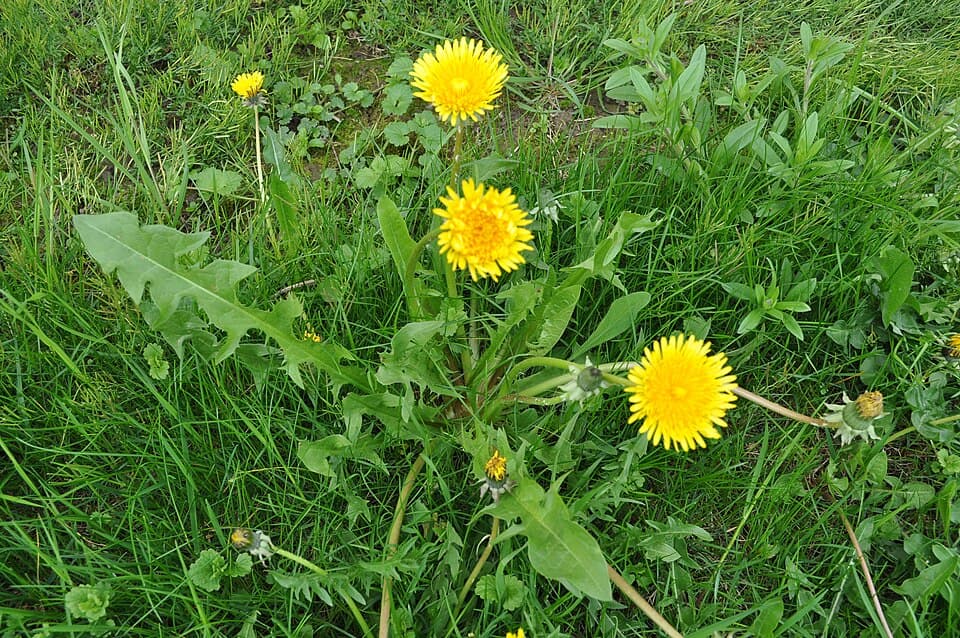
Dandelion
Taraxacum officinale F.H.Wigg., used here in the broad sense
Dandelion is the whole plant hiding in plain sight.
It rises through disturbed soil, settles into lawn edges and appears in cracks where nobody planned a garden. Its yellow heads are familiar enough to become background. Its persistence is familiar enough to be treated as failure.
But commonness is not uselessness.
A plant does not become worthless because it grows where nobody invited it.
Dandelion can be food, seasonal material, a roasted beverage ingredient and a source of several distinct traditional herbal preparations. Nearly the whole plant has entered human use.
That does not make every part interchangeable.
The flower head is not the leaf.
The leaf is not the root.
The root is not the same as root collected with herb.
And a roasted drink does not become a medicinal extract merely because both began underground.
Responsible study starts with four questions:
- Which plant or taxonomic group?
- Which plant part?
- Which preparation?
- What level of evidence supports this particular use?
Quick Identity
Practical botanical name: Taraxacum officinale F.H.Wigg., used broadly or as an aggregate
Icelandic name: Túnfífill
Other Icelandic names recorded: ætifífill, vallarfífill and húsfreyjuhrellir
Mature seed head: biðukolla
Family: Asteraceae, the daisy family
Distinct medicinal materials: leaf; root; root with herb
Other useful parts: flower heads and buds; flowering scapes containing white latex
The practical identity is clear enough for a reference page. The taxonomy behind it is not simple.
One Familiar Name, a Difficult Botanical Group
Taraxacum is a famously difficult genus. Many dandelions reproduce through apomixis, producing seeds without the usual sexual recombination. This can preserve small genetic and morphological lineages over time, leading botanists to recognize numerous microspecies.
For that reason, the familiar name Taraxacum officinale is often used in a broad or aggregate sense in herbal medicine and everyday botany. Icelandic sources may use Taraxacum spp. for túnfífill because the exact boundaries and distribution of the local microspecies remain difficult to resolve. An Icelandic vascular-plant checklist notes that the country's dandelion taxonomy needs modern revision. (Icelandic Institute of Natural History, Annotated Checklist of Vascular Plants of Iceland)
Regulatory herbal documents still define medicinal materials under Taraxacum officinale names. That naming is useful for products and monographs, but it does not settle every modern botanical question.
The practical lesson is not that identification is impossible.
It is that a familiar yellow head is not enough.
How to Recognize Dandelion
Look for a combination of features:
- leaves forming a basal rosette
- leaves that are variably toothed or deeply lobed
- a substantial taproot
- white latex in cut tissues
- hollow, leafless and unbranched flowering scapes
- one composite flower head on each scape
- a head composed entirely of strap-shaped yellow florets
- a mature seed head made from individual fruits, each carried by a pappus
The yellow "flower" is not one flower. It is a flower head containing many small florets.
Leaf shape varies. Growing conditions, mowing, age and the taxonomic complexity of the group can change the appearance. A single photograph, a common name or the presence of white latex does not establish identity on its own.
Other yellow-flowered members of the daisy family can occupy similar ground. Depending on region, these may include cat's-ear, hawkbits, hawksbeards, sow-thistles and hawkweeds. Their stems, branching, hairs, leaves and flower-head arrangement differ, but no short internet list works as a universal foraging key.
Use a current local flora, examine the whole plant and seek experienced confirmation when the identification matters.
The Whole-Plant Map
Flower heads and buds
- Common context
- Seasonal food, syrups, preserves and fermented drinks
- Regulatory status
- Not the core medicinal material in the EMA dandelion monographs
- Preparation boundary
- Food, sweet syrup and alcoholic drink are different preparations
- Main caution
- Check identity, insects and collection site; sugar and alcohol remain part of the finished product
Leaves
- Common context
- Food and traditional urinary support
- Regulatory status
- Separate EMA leaf monograph
- Preparation boundary
- Fresh food, cooked leaf, infusion, juice and hydroethanolic extract are not equivalent
- Main caution
- Adequate fluid intake and urinary red flags matter; this is not treatment for infection, stones or edema
Flowering scapes and latex
- Common context
- Identification and limited folk topical use
- Regulatory status
- No established EMA medicinal role
- Preparation boundary
- Fresh latex is not a standardized wart treatment
- Main caution
- It can irritate or sensitize skin; avoid eyes, damaged skin and any lesion that has not been identified
Root
- Common context
- Food, roasted beverage and traditional appetite, digestive and urinary use
- Regulatory status
- Separate final 2022 EMA root monograph
- Preparation boundary
- Raw, dried, decocted, tinctured, extracted and roasted root differ
- Main caution
- Biliary disorders, allergy, medicine context, digestive response and evidence limits all matter
Root with herb
- Common context
- A defined combined traditional medicinal material
- Regulatory status
- Separate older EMA monograph under a 2026 review cycle
- Preparation boundary
- Not shorthand for an unspecified mixture of the entire plant
- Main caution
- Confirm the exact product, preparation and current monograph wording
| Plant part | Common context | Regulatory status | Preparation boundary | Main caution |
|---|---|---|---|---|
| Flower heads and buds | Seasonal food, syrups, preserves and fermented drinks | Not the core medicinal material in the EMA dandelion monographs | Food, sweet syrup and alcoholic drink are different preparations | Check identity, insects and collection site; sugar and alcohol remain part of the finished product |
| Leaves | Food and traditional urinary support | Separate EMA leaf monograph | Fresh food, cooked leaf, infusion, juice and hydroethanolic extract are not equivalent | Adequate fluid intake and urinary red flags matter; this is not treatment for infection, stones or edema |
| Flowering scapes and latex | Identification and limited folk topical use | No established EMA medicinal role | Fresh latex is not a standardized wart treatment | It can irritate or sensitize skin; avoid eyes, damaged skin and any lesion that has not been identified |
| Root | Food, roasted beverage and traditional appetite, digestive and urinary use | Separate final 2022 EMA root monograph | Raw, dried, decocted, tinctured, extracted and roasted root differ | Biliary disorders, allergy, medicine context, digestive response and evidence limits all matter |
| Root with herb | A defined combined traditional medicinal material | Separate older EMA monograph under a 2026 review cycle | Not shorthand for an unspecified mixture of the entire plant | Confirm the exact product, preparation and current monograph wording |
This map is not a dosing chart.
It is a reminder that the phrase "dandelion product" is incomplete.
Flower Heads and Buds: Food, Season and Relationship
Dandelion flower heads and unopened buds have long appeared in seasonal food traditions. They may be cooked, preserved in sugar, infused into syrups or used in fermented drinks. Icelandic records also describe flowers used for wine and frying. (Icelandic Institute of Natural History)
Preparation changes the result.
Green bracts can contribute bitterness. Flower heads can hold insects and debris. Washing, sorting and removing damaged material are ordinary food preparation, not optional decoration.
A dandelion syrup is a sweet plant preparation. It is not honey in composition, even when a recipe calls it "dandelion honey." A fermented dandelion wine is an alcoholic beverage. Neither becomes a proven medicine through a traditional name.
Dandelion also participates in the local food web. Its heads can provide pollen and nectar to insects, especially in places or seasons where flowering choices are limited. That does not mean one species or one unmown lawn can save pollinators on its own.
Harvest with proportion:
- take only from a confidently identified population
- leave many open heads for insects and seed production
- avoid land exposed to traffic residue, spraying, animal waste or other contamination
- remember that permission and local rules still apply to a common plant
Abundance does not remove relationship.
Leaves: Food and Traditional Urinary Use
Young dandelion leaves are commonly eaten raw or cooked. They often taste less bitter than older leaves, although age alone does not make every leaf chemically identical. Clean-site collection, correct identity and ordinary food hygiene still matter.
The leaf also has a separate European herbal monograph.
The published EMA monograph recognizes defined dandelion-leaf preparations for traditional use to increase the amount of urine in order to achieve flushing of the urinary tract as an adjunct in minor urinary complaints. The wording is narrow. Adequate fluid intake is required, and this use is not appropriate when reduced fluid intake has been advised. (EMA: Taraxaci folium document hub, EMA leaf monograph)
This is not the same as treating:
- a urinary tract infection
- kidney stones
- edema
- hypertension
- heart failure
- kidney disease
- rapid changes in body weight
Fever, painful urination, spasms, blood in the urine, urinary retention, flank pain or worsening symptoms need timely assessment.
The 17-Person Pilot
A frequently repeated modern claim comes from a 2009 exploratory study.
Seventeen adults took 8 mL of a fresh dandelion-leaf hydroethanolic extract three times during one day. Participants recorded fluid intake and urinary frequency and volume. Urinary frequency increased in the five hours after the first dose, and one urinary-excretion ratio changed after the second. The third dose did not produce the same signal. There was no placebo group, the study lasted one day and the outcomes relied heavily on self-recording. (Clare et al., 2009)
The responsible conclusion is small:
One short, uncontrolled pilot suggested a possible short-term diuretic signal for one fresh-leaf extract.
It did not establish clinical effectiveness, long-term safety, edema treatment, weight loss or equivalence to tea.
At the time of this profile, the older leaf monograph remains publicly available while EMA's revision process is active. A 2026 consultation has closed, but a review process is not permission to predict the final text. The current document hub is the place to check before relying on regulatory wording. (EMA: Taraxaci folium)
Root: Bitterness, Appetite and Mild Digestion
Dandelion root is a different medicinal material with a newer final European Union herbal monograph, published in 2022.
The EMA recognizes defined root preparations for traditional use in:
- temporary loss of appetite
- symptomatic relief of mild digestive complaints, such as a feeling of fullness, flatulence and slow digestion
- increasing urine amount to support urinary-tract flushing as an adjunct in minor urinary complaints
These are traditional-use indications. They rest on longstanding use and plausible activity under specified conditions, not on robust modern confirmation from large clinical trials. (EMA: Taraxaci officinalis radix, final EU root monograph, 2022)
Dandelion root belongs to the tradition of bitter herbs. Bitter taste can start sensory and digestive responses before food reaches the stomach. That is a useful physiological context, but it does not justify a chain of automatic promises.
Tasting dandelion does not prove that it:
- empties the gallbladder safely
- clears a blocked bile duct
- repairs the liver
- cures reflux or gastritis
- improves nutrient absorption in every person
- treats ulcers, gallstones, hepatitis or fatty liver disease
Tradition can guide a question.
It cannot answer every diagnosis.
Root with Herb Is Its Own Material
EMA translates Taraxaci radix cum herba as "dandelion root with herb." Here, herb means defined aerial plant material, not flowers alone. Depending on the pharmacopoeial definition, the material may include aerial parts with the roots and rhizome, the entire plant, or roots and rhizome with leaves and flower buds. Flowers or buds may therefore be present, but "root with herb" should not be read simply as "root and flowers."
It is a specified medicinal material, not an arbitrary mixture of whichever plant parts happen to be available.
The root-with-herb monograph has covered traditional use for temporary loss of appetite, mild digestive complaints and urinary flushing. Its preparations and wording are not identical to the separate leaf or root documents. (EMA: Taraxaci radix cum herba document hub, EMA assessment report)
At publication, the older monograph remains available while a 2026 revision process continues. That status belongs on the page because regulatory documents can change.
When a label says "dandelion," ask:
- leaf, root or root with herb?
- fresh or dried?
- food, tea, tincture, juice, powder or defined extract?
- what ratio, solvent and serving amount?
- single plant or blend?
If the label cannot answer the first question, the evidence cannot find the product.
Roasted Root: A Beverage, Not the Same Preparation
Cleaned, dried, roasted and ground dandelion root has a history as a dark, coffee-like beverage ingredient and coffee substitute. Icelandic records mention the roasted root in this context. (Icelandic Institute of Natural History)
Roasted dandelion root is naturally caffeine-free. A commercial product may still contain coffee, tea, cacao or another caffeinated ingredient, so the ingredient list decides the finished drink.
Roasting changes aroma, colour, taste, moisture and chemistry. Roast intensity, particle size, extraction and blending all shape the cup.
This is why a roasted-root beverage cannot automatically inherit the indications, doses or composition of an unroasted medicinal root preparation.
Call it dandelion-root coffee if the cultural shorthand is useful.
Then make the distinction clear: it is not coffee, unless coffee is actually in the blend.
Inulin and the Prebiotic Shortcut
Dandelion root can contain fructans, including inulin. The amount can vary substantially with season, plant material, cultivation, storage, processing and analytical method. Research has mapped seasonal changes in root carbohydrates, but those measurements do not tell us the exact amount in every tea or roasted product. (Schütz et al., 2005, EMA root assessment report)
The shortcut sounds like this:
Dandelion contains inulin. Inulin is called prebiotic. Therefore any dandelion drink heals the gut.
Each step loses information.
Isolated or characterized inulin is not the same intervention as a root decoction. A decoction is not a roasted beverage. A branded powder is not automatically equivalent to either.
It is reasonable to say that dandelion root can contain a prebiotic fibre.
It is not reasonable to claim that every serving treats the microbiome, repairs the gut, causes weight loss or manages diabetes.
Fructans can also increase gas, bloating or discomfort in some people at sufficient amounts. That does not make every dandelion product universally unsuitable. It makes quantity, preparation and individual response relevant.
What "Detox" Can and Cannot Mean
The body continuously processes and removes substances through the liver, kidneys, lungs, gut, skin and other systems. Food, hydration, sleep, movement and medical care can support normal physiology.
The word "detox" often skips the details.
It rarely identifies:
- the substance being removed
- the organ or pathway involved
- the measurement used
- the dose and preparation
- the time course
- the comparison group
- the clinical outcome
Dandelion has a long traditional association with digestion, urine flow, liver and gallbladder language. Laboratory and animal studies have also explored antioxidant, metabolic, inflammatory, hepatic and other mechanisms. ROLV preserves much of this wider traditional record. (ROLV: Taraxacum officinale)
That record is not direct evidence that dandelion removes unspecified toxins or treats liver disease.
The WholeRoot standard is simple:
Name the substance, preparation, population and measured outcome, or keep the claim modest.
Urination is not proof of detoxification.
Bitterness is not proof of liver repair.
A change in a cell culture is not proof of benefit in a human body.
Liver and Gallbladder Claims Need More Care
Dandelion is often marketed for "liver support" or "bile flow." Traditional bitter use and preclinical findings help explain why these ideas persist. They do not establish treatment of gallstones, biliary obstruction, hepatitis, cirrhosis or fatty liver disease.
This distinction matters because the final EMA root monograph lists obstruction of the bile duct, cholangitis, liver disease, gallstones and other biliary diseases among conditions in which use is not recommended. (EMA root monograph, 2022)
The same marketing phrase can therefore point toward a traditional story and away from a safe personal decision.
Jaundice, pale stool, dark urine, persistent upper-abdominal pain, fever, vomiting or known biliary disease deserve qualified assessment, not a stronger bitter.
Latex and Warts: Folk Practice Is Not a Finished Treatment
Break a fresh flowering scape and white latex appears. That latex helps with field recognition, although latex alone is not enough to identify the plant.
Folk traditions have applied dandelion latex to warts and corns. Icelandic records mention this use. It remains a folk practice, not a standardized or well-confirmed wart treatment. (Icelandic Institute of Natural History)
Fresh latex can irritate skin or contribute to contact allergy. A published dermatitis investigation documented allergic and photoallergic reactions involving plants in the daisy family, including dandelion in some tested patients. It does not tell us how often ordinary contact causes a reaction, but it is enough to reject the idea that natural latex is automatically gentle. (Mark et al., 1999)
Do not apply it to:
- eyes or mucous membranes
- broken or inflamed skin
- a mole or pigmented lesion
- an uncertain growth
- a lesion that bleeds, changes or does not heal
Identity belongs to the plant and the skin finding.
Chemistry Without One Magic Molecule
Dandelion contains a changing mixture of compounds. Depending on the taxon, plant part and preparation, literature discusses:
- sesquiterpene lactones
- phenolic acids and flavonoids
- triterpenes and sterols
- potassium and other minerals
- fructans including inulin in the root
- latex constituents
This list is not a benefit list.
Chemistry helps explain bitterness, colour, storage behaviour, extraction and research questions. It does not allow one isolated compound to stand in for the whole plant, or the whole plant to stand in for a standardized compound.
The composition also changes with:
- plant part
- season
- soil and growing conditions
- taxonomic material
- drying and storage
- roasting
- solvent and extraction method
A label that says only "dandelion extract" has left most of the intervention unnamed.
The Human-Evidence Reality
Dandelion has an enormous traditional and experimental literature. Human outcome evidence is much smaller.
The best-known direct human urinary study involved 17 people for one day. Regulatory recognition of root, leaf and root-with-herb uses is based on traditional use, not well-established clinical efficacy. Many broad claims circulating online come from cells, animals, isolated compounds, multi-herb products or reviews that combine unlike materials.
That means the evidence is not empty.
It means the evidence has lanes.
Leaves as food
- Main evidence
- Long culinary use and botanical food references
- WholeRoot reading
- A reasonable food context after confident identification and clean-site collection; not evidence of a medical effect
Leaf and urine flow
- Main evidence
- EMA traditional-use recognition plus one uncontrolled, one-day pilot in 17 adults using fresh-leaf hydroethanolic extract
- WholeRoot reading
- A plausible traditional role with a small exploratory human signal. Not confirmed treatment and not transferable to every tea or product
Root for temporary appetite loss and mild digestive complaints
- Main evidence
- Final 2022 EMA traditional-use monograph and assessment
- WholeRoot reading
- A defined traditional-use role for mild, temporary complaints. It is not modern proof of treating diagnosed digestive or liver disease
Root with herb
- Main evidence
- A separate EMA traditional-use monograph and assessment, currently within a review cycle
- WholeRoot reading
- Recognized as its own material. Results or directions cannot be borrowed automatically from leaf-only or root-only preparations
Inulin and the microbiome
- Main evidence
- Root chemistry and broader research on characterized inulin
- WholeRoot reading
- Dandelion root contains variable fructans. Generic inulin evidence does not establish a clinical benefit from a cup of root beverage
Liver, gallbladder and detox claims
- Main evidence
- Traditional records and substantial laboratory or animal research, but little robust direct human evidence
- WholeRoot reading
- Do not claim treatment, cleansing or toxin removal. Biliary disease is a reason for extra caution, not an indication to self-treat
Latex for warts
- Main evidence
- Folk use and limited experimental interest, without a standardized clinical preparation
- WholeRoot reading
- Not an established wart treatment. Fresh latex can irritate skin, and an uncertain lesion needs assessment rather than experimentation
Broad metabolic, cancer or weight-loss claims
- Main evidence
- Mostly cell, animal, extract-specific or mechanistic research
- WholeRoot reading
- Interesting research questions, not demonstrated human outcomes and not responsible marketing claims
| Use or claim | Main evidence | WholeRoot reading |
|---|---|---|
| Leaves as food | Long culinary use and botanical food references | A reasonable food context after confident identification and clean-site collection; not evidence of a medical effect |
| Leaf and urine flow | EMA traditional-use recognition plus one uncontrolled, one-day pilot in 17 adults using fresh-leaf hydroethanolic extract | A plausible traditional role with a small exploratory human signal. Not confirmed treatment and not transferable to every tea or product |
| Root for temporary appetite loss and mild digestive complaints | Final 2022 EMA traditional-use monograph and assessment | A defined traditional-use role for mild, temporary complaints. It is not modern proof of treating diagnosed digestive or liver disease |
| Root with herb | A separate EMA traditional-use monograph and assessment, currently within a review cycle | Recognized as its own material. Results or directions cannot be borrowed automatically from leaf-only or root-only preparations |
| Inulin and the microbiome | Root chemistry and broader research on characterized inulin | Dandelion root contains variable fructans. Generic inulin evidence does not establish a clinical benefit from a cup of root beverage |
| Liver, gallbladder and detox claims | Traditional records and substantial laboratory or animal research, but little robust direct human evidence | Do not claim treatment, cleansing or toxin removal. Biliary disease is a reason for extra caution, not an indication to self-treat |
| Latex for warts | Folk use and limited experimental interest, without a standardized clinical preparation | Not an established wart treatment. Fresh latex can irritate skin, and an uncertain lesion needs assessment rather than experimentation |
| Broad metabolic, cancer or weight-loss claims | Mostly cell, animal, extract-specific or mechanistic research | Interesting research questions, not demonstrated human outcomes and not responsible marketing claims |
Avoid claims that dandelion:
- cures or treats cancer
- reverses diabetes
- causes meaningful fat loss
- cleanses the liver
- dissolves gallstones
- treats edema or hypertension
- replaces antibiotics for urinary infection
- repairs the microbiome
- removes unspecified toxins
Those are larger claims than the human evidence can carry.
Safety, Medicines and Who Needs More Care
The formal contraindication includes hypersensitivity to dandelion or other plants in the Asteraceae family. Contact reactions can occur, and oral products can also contain excipients or additional herbs that change the safety question.
Medicinal use is not recommended during pregnancy or breastfeeding because adequate safety has not been established. Use in children under 12 is not established in the relevant EMA monographs. Product-specific age guidance still matters. (EMA root monograph, 2022, EMA leaf monograph)
Seek preparation-specific professional guidance when any of these apply:
- gallstones, bile-duct obstruction, cholangitis, liver disease or another biliary condition
- kidney, heart or other disease requiring fluid restriction
- lithium, diuretics or medicines affected by fluid and electrolyte balance
- multiple medicines or a narrow-therapeutic-index medicine
- pregnancy or breastfeeding
- the product is intended for a child
- significant allergy to plants in the daisy family
- persistent appetite loss, urinary symptoms or digestive symptoms
The older EMA leaf assessment discusses a theoretical concern around lithium because changes in urine flow and sodium balance may affect lithium handling. Direct interaction evidence is limited, which is a reason for professional review rather than a reason to invent certainty. (EMA leaf assessment report)
For urinary use, stop and seek assessment for fever, painful urination, spasms, blood in urine, retention or worsening symptoms.
For appetite or digestive use, seek care for persistent appetite loss, unexplained weight loss, severe pain, repeated vomiting, jaundice, blood or black stool, or symptoms that keep returning.
"No interactions reported" does not mean "no interaction is possible."
Foraging and Cultivation
Dandelion is often abundant, but abundance is not a purity certificate.
Avoid collecting from:
- roadsides and parking edges
- sprayed lawns or agricultural margins
- contaminated urban soil
- land exposed to industrial residue
- areas heavily used by pets or livestock
- protected sites or land where permission has not been given
For cultivated plants, know the soil history and avoid pesticides or fertilizers not intended for edible crops.
Root harvest changes the relationship more than gathering a few leaves or heads. Removing the taproot removes or seriously damages the plant. In a garden where dandelion is deliberately managed, that may be part of cultivation. In a wild population, it deserves a more conservative decision.
Harvest only after confident identification. Keep plant parts separate and label:
- botanical name used
- location or source
- date
- plant part
- fresh or dried state
- any processing, including roasting
The label is part of the medicine cabinet.
Harvest and Storage Reality
Leaves and flowers are water-rich and deteriorate quickly. Use food material promptly or dry it with adequate airflow according to a reliable method.
Roots hold soil in crevices and require careful cleaning. Thick roots dry unevenly if left whole. Cut material allows drying and later inspection, but the exact method should fit the intended preparation.
Discard material showing:
- visible mould
- persistent dampness
- insect infestation
- unusual fermentation
- contamination
- an identity you can no longer verify
Store dried material cool, dark and dry in a clearly labelled container. Roasted root belongs under its own label because roasting has changed it.
A jar should not ask memory to perform quality control.
A Practical Study Sequence
To study dandelion without turning it into a list of promises:
- Observe the living plant through flower and seed.
- Learn the combination of rosette, scape, head, latex and taproot.
- Compare leaves, flowers, scapes and roots side by side.
- Taste a small, correctly identified culinary preparation if it is appropriate for you.
- Read the leaf, root and root-with-herb monographs separately.
- Choose one claim and trace the exact part and preparation behind it.
- Record uncertainty rather than filling it with enthusiasm.
The Single-Plant Method offers a reusable notebook structure. Which Part of the Plant? goes deeper into why plant-part precision matters.
Closing Thought
Dandelion is easy to overlook because it succeeds without permission.
Its lesson is not that every weed is medicine.
It is not that an old use proves a modern cure.
It is that attention can recover value from what habit has flattened.
Flower head.
Leaf.
Latex.
Taproot.
Food, tradition, chemistry, evidence and caution.
The whole plant becomes more interesting when we stop asking it to be one thing.
Common does not mean simple. Useful does not mean universal.
Sources and Further Reading
- Icelandic Institute of Natural History: Túnfífill
- Annotated Checklist of Vascular Plants of Iceland
- GBIF: Taraxacum officinale
- EMA: Taraxaci officinalis radix document hub
- EMA: final European Union herbal monograph on dandelion root, 2022
- EMA: assessment report on dandelion root
- EMA: Taraxaci folium document hub
- EMA: dandelion leaf monograph
- EMA: dandelion leaf assessment report
- EMA: Taraxaci radix cum herba document hub
- EMA: dandelion root-with-herb assessment report
- Clare et al.: fresh-leaf extract urinary pilot, 2009
- Schütz et al.: seasonal carbohydrate change in dandelion root, 2005
- Mark et al.: allergic and photoallergic contact dermatitis, 1999
- ROLV: Løvetann
- Wikimedia Commons image source, NY State IPM Program at Cornell University, CC BY 2.0