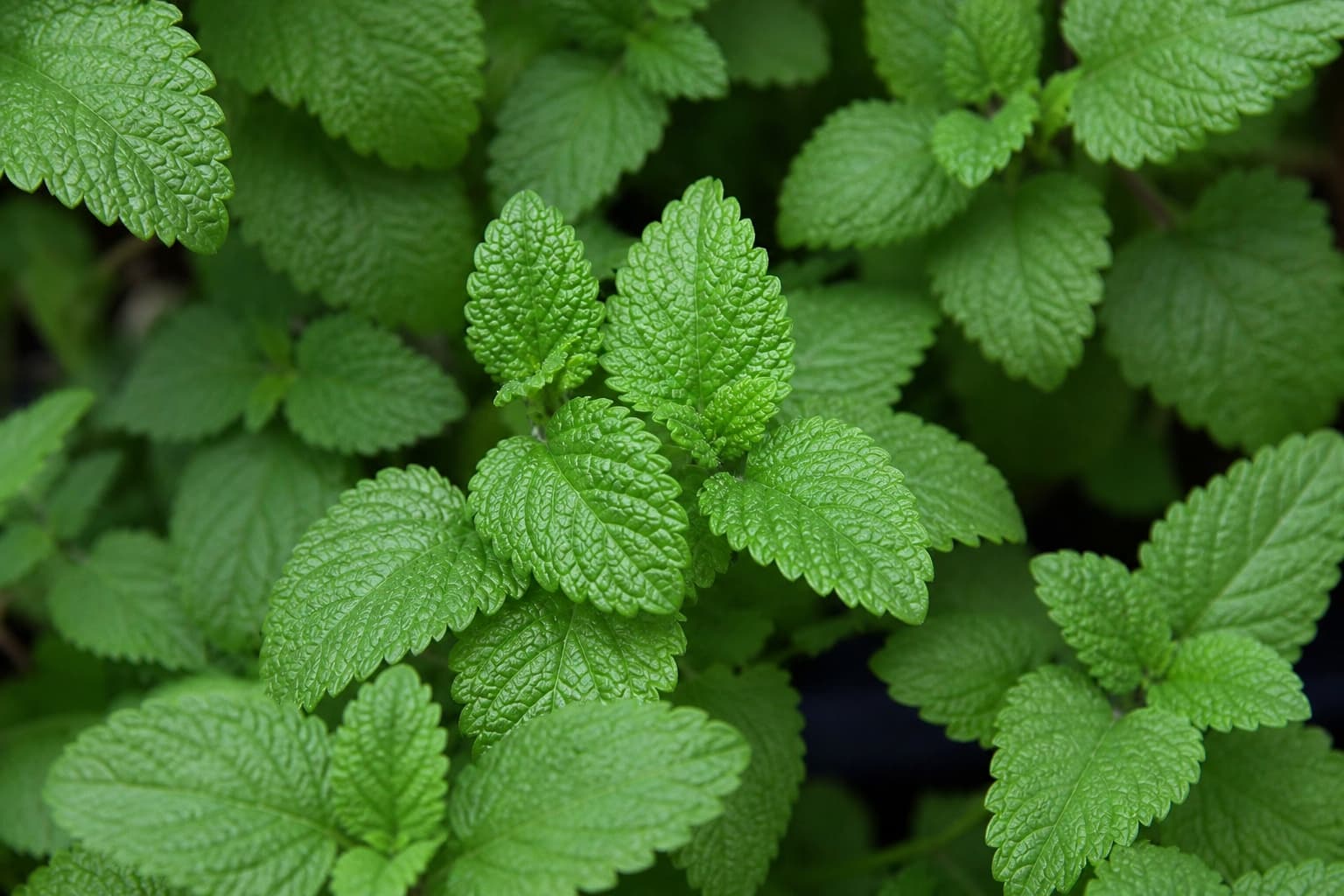
Lemon Balm
Melissa officinalis L.
Lemon balm is the bright leaf where tension, sleep, and digestion meet.
Brush it with a hand and the plant answers immediately. The scent is recognizably lemon-like, but softer and greener than lemon peel. Crush a fresh leaf and the aroma becomes clearer. Leave that same leaf to dry, extract it in alcohol or separate its volatile oil, and the material changes.
That simple observation is the beginning of responsible materia medica.
The name on the label matters.
The plant part matters.
The preparation matters.
And the kind of evidence matters.
Lemon balm has a long European history around mild tension, sleep and digestive discomfort. Modern research has produced several interesting signals, including small studies of mood, a proprietary sleep product and a standardized cream for recurrent cold sores. None of those findings turns every lemon balm product into the same intervention.
Calm is not always the absence of feeling. Sometimes calm means having enough inner space to feel without being overwhelmed.
Botanical Identity and Icelandic Context
The accepted species is Melissa officinalis L., a perennial member of the mint family, Lamiaceae. Kew records its native range from the Mediterranean into Central Asia, with the plant now cultivated and naturalized much more widely. (Kew Plants of the World Online)
The Icelandic name used here is hjartafró. Íðorðabankinn also records harmabót and sítrónumelissa. These names carry cultural and linguistic history, but a common name alone is not enough for identification. (Íðorðabankinn)
Look for the whole botanical picture:
- opposite leaves on a square stem
- broadly oval to heart-shaped leaves
- a softly wrinkled surface
- rounded, toothed margins
- fine hairs on the leaf and stem
- small pale flowers held in the leaf axils
- a lemon-like scent released when fresh leaves are rubbed
Scent helps, but scent is not identity. Lemon-scented plants occur across several unrelated groups.
Lemon balm is not:
- lemon verbena, Aloysia citrodora
- lemongrass, species of Cymbopogon
- citronella grass, also within Cymbopogon
- bee balm, species of Monarda
Those plants differ in family, form, chemistry and use. A product labelled only "lemon herb" has not told you enough.
What Melissae folium Means
The medicinal material assessed in the European monograph is lemon balm leaf, written in pharmaceutical Latin as Melissae folium.
It is not the root.
It is not every above-ground part gathered without distinction.
It is not the essential oil.
The 2013 EMA monograph remains the current adopted public monograph while a formal revision is ongoing. It describes traditional use of defined leaf preparations rather than one universal lemon balm product. (EMA: Melissae folium document hub)
The leaf may appear as:
- fresh culinary material
- dried cut leaf for tea
- tincture
- powdered leaf
- aqueous or hydroalcoholic extract
- standardized dry extract
- proprietary delivery system
- distilled essential oil
- a defined topical preparation
They may share a botanical origin without sharing a dose, chemical profile, route of use or evidence base.
Preparation Changes the Question
Fresh leaf
- Material and form
- Fresh Melissa officinalis leaf, commonly used as food or a freshly prepared infusion
- What changes
- Retains the immediate lemon aroma well, while water extracts a different profile from alcohol or oil.
- Important boundary
- Fresh culinary use is not equivalent to a defined medicinal extract or a shelf-stable product.
Dried-leaf tea
- Material and form
- Cut or comminuted Melissae folium infused in hot water
- What changes
- Produces the familiar water-based preparation used in European traditional practice.
- Important boundary
- Leaf quality, amount, time and storage change the cup. Tea evidence does not transfer from proprietary extracts.
Tincture
- Material and form
- A liquid extract made with a stated ethanol concentration and plant-to-liquid ratio
- What changes
- Alcohol and water select a broader chemical profile than water alone.
- Important boundary
- Alcohol content, ratio and serving size matter. A tincture is not simply concentrated tea.
Powder or capsule
- Material and form
- Dried whole-leaf powder or a dry preparation placed in a capsule
- What changes
- Offers a convenient format without creating a single standardized composition.
- Important boundary
- Powder, dried extract and proprietary capsule are different interventions even when the front label says lemon balm.
Defined extract
- Material and form
- Aqueous or hydroalcoholic extract with a stated solvent, ratio or marker profile
- What changes
- Allows a repeatable preparation to be investigated and manufactured.
- Important boundary
- A result belongs first to the exact extract studied. It does not establish the same effect for every tea or tincture.
Specially formulated extract
- Material and form
- A named, standardized lemon balm extract combined with phospholipids to influence how its compounds are absorbed
- What changes
- May alter absorption, dose and composition in ways that make the finished product distinct.
- Important boundary
- Product-specific sleep findings cannot be used as evidence for ordinary dried leaf or every lemon balm supplement.
Essential oil
- Material and form
- Highly concentrated volatile fraction distilled from plant material
- What changes
- Concentrates volatile compounds while leaving much of the non-volatile leaf chemistry behind.
- Important boundary
- Not interchangeable with tea, tincture or cream. Do not swallow it or apply it undiluted without qualified guidance.
Defined topical cream
- Material and form
- A manufactured cream containing a specified standardized leaf extract
- What changes
- Creates a local, dosage-form-specific intervention at the skin surface.
- Important boundary
- Cold-sore evidence for a 1% standardized cream does not support homemade tea compresses or neat essential oil.
| Preparation | Material and form | What changes | Important boundary |
|---|---|---|---|
| Fresh leaf | Fresh Melissa officinalis leaf, commonly used as food or a freshly prepared infusion | Retains the immediate lemon aroma well, while water extracts a different profile from alcohol or oil. | Fresh culinary use is not equivalent to a defined medicinal extract or a shelf-stable product. |
| Dried-leaf tea | Cut or comminuted Melissae folium infused in hot water | Produces the familiar water-based preparation used in European traditional practice. | Leaf quality, amount, time and storage change the cup. Tea evidence does not transfer from proprietary extracts. |
| Tincture | A liquid extract made with a stated ethanol concentration and plant-to-liquid ratio | Alcohol and water select a broader chemical profile than water alone. | Alcohol content, ratio and serving size matter. A tincture is not simply concentrated tea. |
| Powder or capsule | Dried whole-leaf powder or a dry preparation placed in a capsule | Offers a convenient format without creating a single standardized composition. | Powder, dried extract and proprietary capsule are different interventions even when the front label says lemon balm. |
| Defined extract | Aqueous or hydroalcoholic extract with a stated solvent, ratio or marker profile | Allows a repeatable preparation to be investigated and manufactured. | A result belongs first to the exact extract studied. It does not establish the same effect for every tea or tincture. |
| Specially formulated extract | A named, standardized lemon balm extract combined with phospholipids to influence how its compounds are absorbed | May alter absorption, dose and composition in ways that make the finished product distinct. | Product-specific sleep findings cannot be used as evidence for ordinary dried leaf or every lemon balm supplement. |
| Essential oil | Highly concentrated volatile fraction distilled from plant material | Concentrates volatile compounds while leaving much of the non-volatile leaf chemistry behind. | Not interchangeable with tea, tincture or cream. Do not swallow it or apply it undiluted without qualified guidance. |
| Defined topical cream | A manufactured cream containing a specified standardized leaf extract | Creates a local, dosage-form-specific intervention at the skin surface. | Cold-sore evidence for a 1% standardized cream does not support homemade tea compresses or neat essential oil. |
Before borrowing a study for a label, ask:
- Was the species confirmed as Melissa officinalis?
- Was leaf the material studied?
- Was it tea, tincture, powder, extract, essential oil or cream?
- What solvent, ratio and daily amount were used?
- Was the product standardized or proprietary?
- Was lemon balm used alone or in a mixture?
- Did the study examine symptoms, a diagnosis, a laboratory marker or a self-reported experience?
If those details do not match, the evidence has already started to drift.
What the EMA Traditional-Use Monograph Says
EMA recognizes lemon balm leaf preparations for three traditional-use purposes:
- relief of mild symptoms of mental stress
- support for sleep
- symptomatic relief of mild gastrointestinal complaints, including bloating and flatulence
Traditional use is a regulatory category built on long-standing use and plausible safety under specified conditions. It is not the same as well-established clinical effectiveness.
The current monograph covers adults and adolescents over 12. It does not recommend medicinal use under 12 because adequate data are lacking. It advises professional consultation when symptoms persist beyond two weeks. Hypersensitivity is the formal contraindication. Use during pregnancy and breastfeeding is not recommended because safety has not been established. It also warns that the medicine may impair the ability to drive or use machines. (EMA herbal monograph, 2013)
The public EMA page currently marks the monograph as being under review. In May 2025, the Herbal Medicinal Products Committee reported that newly submitted material justified beginning a revision. Until a revised monograph is adopted, an active review is not permission to guess its conclusion. (EMA: Melissae folium document hub)
Tradition Without Inflation
The Nordic herbal reference ROLV records lemon balm as a long-used aromatic plant associated with unease, sleep and digestive discomfort. It also gathers a much wider range of historical applications. (ROLV: Melissa officinalis)
That wider record belongs to history.
It does not create modern clinical proof for heart disease, depression, migraine, thyroid disease, dementia, infection or every digestive condition mentioned in older texts.
WholeRootLabs keeps the tradition and narrows the claim.
Lemon balm has a credible traditional place around mild tension, support for sleep and mild bloating or flatulence. More specific medical questions require more specific evidence.
Tension and Mood: A Promising but Uneven Signal
A 2021 systematic review and meta-analysis identified six sufficiently rigorous studies involving 435 participants. Pooled results suggested improvements in anxiety and depressive symptom scores, but the studies differed substantially in population, preparation, comparison and method. The authors explicitly called for better research. (Ghazizadeh et al., 2021)
Six studies are not nothing.
They are also not a stable foundation for saying lemon balm treats anxiety or depression.
The practical reading is:
- lemon balm has been studied for tension- and mood-related outcomes
- some trials report a favourable signal
- the evidence is small and heterogeneous
- an extract result does not automatically transfer to tea
- symptom improvement in a study is not proof of treating a diagnosed disorder
Anyone facing persistent anxiety, panic, severe low mood, suicidal thoughts, trauma symptoms or marked impairment needs appropriate support. A plant can be part of a wider routine without becoming a reason to delay care.
Sleep: Keep the Product Name Attached
The EMA traditional-use indication says lemon balm may be used to aid sleep. That is a modest statement grounded in long use.
A 2024 randomized crossover study added a more modern signal, but it tested a specific proprietary lemon balm phytosome product, not loose-leaf tea. Thirty adults completed two weeks of the product and two weeks of placebo, separated by a washout. Insomnia Severity Index scores were lower during the active period. Anxiety scores did not clearly change. (Lopresti et al., 2024)
Preparation
- What the study did
- A named lemon balm phytosome product, taken as two tablets in the evening
- What it means
- This was not ordinary tea, loose leaf, tincture or generic lemon balm powder.
Participants and design
- What the study did
- Thirty adults completed a randomized, double-blind, placebo-controlled crossover study
- What it means
- A crossover design is useful, but the sample was small and the population narrow.
Timing
- What the study did
- Two weeks on each condition, separated by a seven-day washout
- What it means
- The study tested short repeated use, not a one-night tea and not long-term treatment.
Main signal
- What the study did
- Insomnia Severity Index scores were lower during the active-product period than during placebo
- What it means
- This is promising product-specific evidence, not proof that lemon balm treats chronic insomnia.
Important limits
- What the study did
- Self-reported outcomes were central; the authors reported no adverse events, and several authors had commercial relationships with the product company
- What it means
- The result deserves attention and independent replication, with preparation and conflicts kept visible.
| Study feature | What the study did | What it means |
|---|---|---|
| Preparation | A named lemon balm phytosome product, taken as two tablets in the evening | This was not ordinary tea, loose leaf, tincture or generic lemon balm powder. |
| Participants and design | Thirty adults completed a randomized, double-blind, placebo-controlled crossover study | A crossover design is useful, but the sample was small and the population narrow. |
| Timing | Two weeks on each condition, separated by a seven-day washout | The study tested short repeated use, not a one-night tea and not long-term treatment. |
| Main signal | Insomnia Severity Index scores were lower during the active-product period than during placebo | This is promising product-specific evidence, not proof that lemon balm treats chronic insomnia. |
| Important limits | Self-reported outcomes were central; the authors reported no adverse events, and several authors had commercial relationships with the product company | The result deserves attention and independent replication, with preparation and conflicts kept visible. |
This makes the study worth following.
It does not justify these broader claims:
- lemon balm treats chronic insomnia
- every lemon balm capsule improves sleep
- tea reproduces the phytosome result
- one evening dose will produce the same effect
- the product is proven safe for long-term use
Persistent sleep problems can reflect stress, pain, breathing disorders, medicines, substance use, hormonal change, circadian disruption or other conditions. The Sleep Hub keeps those roots visible.
The Stress-Gut Connection, Kept Modest
Tension and digestion meet in ordinary life. Stress can change appetite, gut sensation, eating pace, swallowing and the experience of fullness. An aromatic tea can also function as warmth, hydration and a pause.
EMA's wording remains deliberately narrow: mild gastrointestinal complaints, including bloating and flatulence.
It does not establish lemon balm as a treatment for:
- irritable bowel syndrome
- reflux disease
- peptic ulcers
- inflammatory bowel disease
- gallbladder disease
- food intolerance
- bacterial or parasitic infection
- persistent unexplained abdominal pain
Combination products create another layer of uncertainty. If lemon balm appears with peppermint, chamomile, fennel or other herbs, a result belongs to the combination unless the study can separate the contribution of each ingredient.
Seek timely assessment for severe or worsening pain, repeated vomiting, blood or black stool, fever, dehydration, difficulty swallowing, unexplained weight loss, jaundice or persistent change in bowel habits.
Mild does not mean imaginary.
It means the claim has a boundary.
A Separate Topical Story: Recurrent Cold Sores
Topical lemon balm is often discussed as though it were the same intervention as drinking tea. It is not.
A 1999 randomized, double-blind, placebo-controlled trial studied 66 people with recurrent herpes labialis. Participants used a cream containing 1% of a standardized dried lemon balm leaf extract four times daily for five days. The main signal appeared in the combined symptom score on day two. (Koytchev et al., 1999)
A 2025 systematic review assessed seven randomized trials of several topical herbal interventions for herpes labialis. Lemon balm showed possible benefit for some pain, swelling or lesion outcomes, but the review found methodological concerns and substantial differences between interventions. (Sosai et al., 2025)
The honest conclusion is specific:
A defined topical lemon balm extract has a limited clinical signal for recurrent cold-sore symptoms. That evidence does not apply to tea, homemade tincture, a crushed leaf or undiluted essential oil.
Cold sores are caused by herpes simplex virus. A topical herbal product does not eradicate the virus. Eye involvement, severe pain, extensive lesions, immune suppression, frequent recurrence or uncertainty about the diagnosis deserves professional care.
Never place undiluted lemon balm essential oil on a cold sore. Concentrated volatile oil can irritate skin and mucous membranes, and a damaged lip is not a sensible place for an improvised experiment.
Chemistry: More Than a Lemon Scent
Lemon balm leaf contains several groups of constituents, including:
- hydroxycinnamic acids, especially rosmarinic acid
- flavonoids
- tannins
- triterpenes such as ursolic and oleanolic acids
- a small and variable volatile-oil fraction
The volatile fraction can include citral-related compounds, citronellal and other aroma molecules. The exact profile changes with genetics, growing conditions, harvest time, drying, storage and extraction. The EMA assessment reports substantial variation in essential-oil content and identifies rosmarinic acid as an important leaf constituent. (EMA assessment report, 2013)
This complexity blocks several easy stories.
Rosmarinic acid is not the whole plant.
Citral is not proof of calm.
A stronger lemon scent is not a clinical potency test.
And essential oil is not a concentrated version of every useful leaf constituent.
Chemistry can explain why preparations differ. It cannot, by itself, establish what a person will experience.
Thyroid Questions Need More Precision
Lemon balm is frequently described online as either a thyroid treatment or a thyroid threat.
The evidence supports neither simple version.
Cell experiments have found that lemon balm extracts can interfere with signalling at the human thyroid-stimulating hormone receptor. That work was performed in engineered cells, not in people taking ordinary lemon balm tea. Animal findings are inconsistent, and the EMA assessment says the clinical relevance of the laboratory observations is unknown. (Santini et al., 2003, EMA assessment report, 2013)
Case reports and multi-herb formulas cannot establish what lemon balm alone did. There is no robust human monotherapy evidence showing that it treats Graves' disease, lowers thyroid hormone predictably or causes hypothyroidism at an ordinary medicinal amount.
That uncertainty is not a reason for panic.
It is a reason to keep dose and context visible.
If you have thyroid disease, use thyroid medicine or are undergoing thyroid evaluation, discuss regular medicinal use of concentrated lemon balm products with a qualified professional. Do not change prescribed medicine based on an in-vitro study or a supplement claim.
Safety, Medicines and Who Needs More Care
Lemon balm is widely consumed as food and tea, but familiar does not mean context-free.
The current EMA monograph provides these practical boundaries:
- do not use with known hypersensitivity to lemon balm or product ingredients
- medicinal use under age 12 is not recommended because data are inadequate
- pregnancy and breastfeeding use is not recommended because safety has not been established
- seek advice when symptoms persist beyond two weeks
- the preparation may impair driving or the use of machines
The monograph reports no interaction data. That is not the same as proving no interactions are possible.
Use extra care with alcohol, sedatives, sleep medicines or other products that reduce alertness. The concern is possible additive impairment, not proof of a specific interaction with every medicine. If a product causes unusual drowsiness, dizziness, agitation, rash, digestive upset or another concerning response, stop and reassess it.
LiverTox has not identified convincing cases of clinically apparent liver injury caused by lemon balm alone and rates it as an unlikely cause. Published human studies remain limited, and multi-ingredient products make attribution difficult. This is reassuring, not a guarantee that every formula, extract or dose is harmless. (LiverTox: Lemon Balm)
Essential oil requires a separate safety decision. Do not swallow it or apply it undiluted based on advice intended for tea. Keep all concentrated products away from children and follow product-specific instructions.
Seek appropriate care rather than relying on lemon balm for:
- severe or persistent anxiety or low mood
- chronic insomnia or dangerous daytime sleepiness
- chest pain, fainting or breathing difficulty
- severe or persistent abdominal symptoms
- suspected thyroid disease
- spreading skin infection or lesions near the eye
- an allergic reaction
Growing, Harvesting, Drying and Storage
Lemon balm is a generous perennial in a suitable garden. It prefers a reasonably moist, well-drained site and can spread by seed and division. In Nordic conditions it benefits from sun and shelter, though the best site depends on local summer, soil and winter exposure. (NordGen cultivation manual)
For a garden-grown plant:
- confirm the species before medicinal use
- know whether the soil or water may contain contaminants
- avoid plants exposed to sprays, roadside pollution or animal waste
- harvest in dry weather after surface moisture has lifted
- take healthy leaves without stripping the whole plant
- keep the plant name, part and harvest date with the material
Harvest timing changes the material. Leaves gathered before or around flowering are commonly preferred for aromatic quality, but no single date guarantees one chemical profile. Research shows that growth stage and drying method can alter volatile composition and other measured constituents. (Nurzyńska-Wierdak et al., 2014)
Dry the leaves promptly in moving air, away from direct sun and excessive heat. The goal is not laboratory perfection. It is to prevent damp clumping, browning, mould and avoidable loss of aroma.
Store dried leaf:
- fully dry
- protected from light and moisture
- in a clean, clearly labelled container
- away from strong odours
- with harvest or purchase date visible
A faded aroma may signal age or storage loss. It cannot tell you the complete chemical profile or whether a clinical dose is present.
Evidence Snapshot
Mild mental stress and support for sleep
- Main evidence
- EMA traditional-use recognition for defined leaf preparations, plus small and heterogeneous human studies
- WholeRoot reading
- A credible traditional role. It is not well-established use and does not establish treatment of anxiety disorders or insomnia.
Anxiety or low-mood symptom scores
- Main evidence
- A 2021 meta-analysis of six rigorous studies involving 435 participants, with substantial differences between studies
- WholeRoot reading
- The pooled signal is promising but too heterogeneous and preparation-specific for a treatment claim.
Sleep quality
- Main evidence
- Traditional use plus a small 2024 crossover trial of a proprietary phytosome product
- WholeRoot reading
- The modern signal belongs to the named product and short study. It cannot be generalized to all lemon balm.
Mild bloating and flatulence
- Main evidence
- EMA traditional-use recognition for mild gastrointestinal complaints
- WholeRoot reading
- A modest symptom-level role. It does not establish treatment of IBS, reflux, ulcers, infection or inflammatory bowel disease.
Recurrent cold sores
- Main evidence
- A small randomized trial of a standardized 1% cream and a 2025 systematic review of topical herbal trials
- WholeRoot reading
- A limited topical signal. It applies neither to tea nor to undiluted essential oil, and it does not eradicate herpes virus.
Thyroid effects
- Main evidence
- Cell studies, inconsistent animal findings and clinical uncertainty; no robust human monotherapy evidence
- WholeRoot reading
- Do not claim that lemon balm treats or causes thyroid disease. Regular concentrated use deserves professional review when thyroid disease or medicines are involved.
Liver safety
- Main evidence
- No convincing published cases of clinically apparent liver injury attributed to lemon balm alone in LiverTox
- WholeRoot reading
- Reassuring but not proof that every product or multi-herb formula is risk-free.
| Question or claim | Main evidence | WholeRoot reading |
|---|---|---|
| Mild mental stress and support for sleep | EMA traditional-use recognition for defined leaf preparations, plus small and heterogeneous human studies | A credible traditional role. It is not well-established use and does not establish treatment of anxiety disorders or insomnia. |
| Anxiety or low-mood symptom scores | A 2021 meta-analysis of six rigorous studies involving 435 participants, with substantial differences between studies | The pooled signal is promising but too heterogeneous and preparation-specific for a treatment claim. |
| Sleep quality | Traditional use plus a small 2024 crossover trial of a proprietary phytosome product | The modern signal belongs to the named product and short study. It cannot be generalized to all lemon balm. |
| Mild bloating and flatulence | EMA traditional-use recognition for mild gastrointestinal complaints | A modest symptom-level role. It does not establish treatment of IBS, reflux, ulcers, infection or inflammatory bowel disease. |
| Recurrent cold sores | A small randomized trial of a standardized 1% cream and a 2025 systematic review of topical herbal trials | A limited topical signal. It applies neither to tea nor to undiluted essential oil, and it does not eradicate herpes virus. |
| Thyroid effects | Cell studies, inconsistent animal findings and clinical uncertainty; no robust human monotherapy evidence | Do not claim that lemon balm treats or causes thyroid disease. Regular concentrated use deserves professional review when thyroid disease or medicines are involved. |
| Liver safety | No convincing published cases of clinically apparent liver injury attributed to lemon balm alone in LiverTox | Reassuring but not proof that every product or multi-herb formula is risk-free. |
The pattern is clear.
Lemon balm has a coherent traditional role and several interesting modern signals. Confidence falls when a named extract becomes "lemon balm" in general, a topical cream becomes tea, or a laboratory mechanism becomes a human outcome.
Keep the preparation attached to the claim.
Closing: Enough Space to Return
Lemon balm is easy to romanticize.
Its scent arrives quickly. Its traditional language is gentle. Its modern research touches several places where people want relief: tension, sleep, digestion and recurrent cold sores.
The plant becomes more useful, not less, when those stories stay separate.
Tea can be tea.
A proprietary extract can remain a proprietary extract.
A topical cream can carry its own evidence.
An uncertain thyroid question can remain uncertain.
Calm does not have to mean numbness, cure or control.
Sometimes it is simply enough room to notice what is here, what has changed and what kind of support the moment actually needs.
Continue Through WholeRootLabs
- Plant Lab: Start Here
- Materia Medica Library
- The Single-Plant Method
- Herbal Medicine Without the Hype
- Tea, Infusion and Decoction
- Tinctures Without the Mystery
- Sleep Hub: Start Here
- Nervous System Hub: Start Here
Sources and Further Reading
- Kew Science, Plants of the World Online: Melissa officinalis L.
- Íðorðabankinn: hjartafró, harmabót and sítrónumelissa
- European Medicines Agency: Melissae folium overview and current document hub
- EMA: Community herbal monograph on Melissa officinalis L., folium (2013)
- EMA: Assessment report on Melissa officinalis L., folium (2013)
- ROLV: sitronmelisse (Melissa officinalis)
- NordGen: cultivation manual for Melissa officinalis
- Ghazizadeh et al. (2021): lemon balm and anxiety or depression symptoms — systematic review and meta-analysis
- Lopresti et al. (2024): proprietary lemon balm phytosome and sleep — randomized crossover study
- Koytchev et al. (1999): standardized lemon balm cream for recurrent herpes labialis
- Sosai et al. (2025): topical herbal therapies for herpes labialis — systematic review
- Santini et al. (2003): lemon balm extract and human TSH-receptor signalling in vitro
- Nurzyńska-Wierdak et al. (2014): harvest stage and lemon balm essential-oil composition
- LiverTox: Lemon Balm