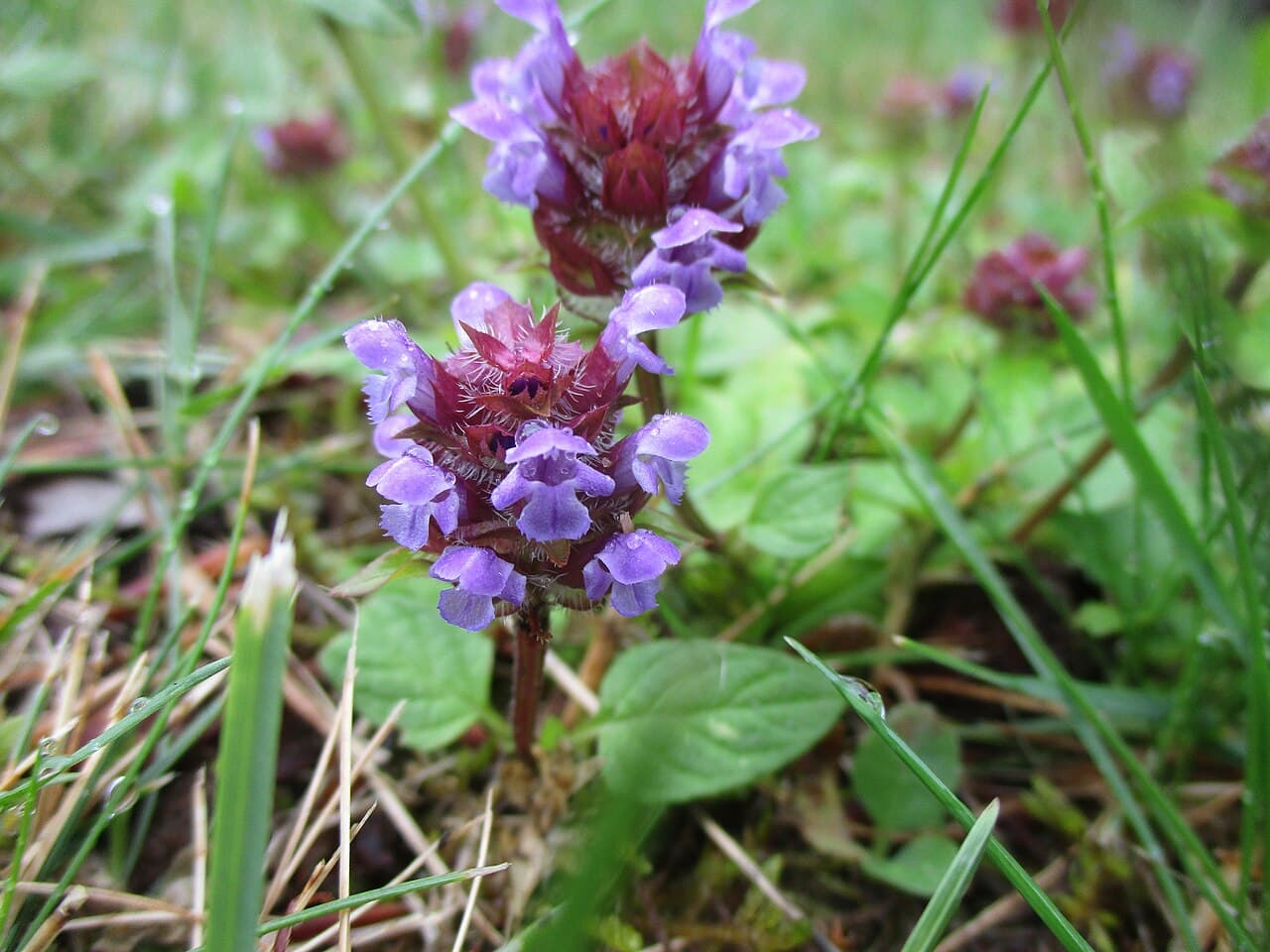
Self-Heal / Heal-All
Prunella vulgaris L.
Self-heal grows close to the ground.
It rarely arrives looking powerful.
Its stems creep through grass, its flower heads are small, and its taste is quieter than many members of the mint family.
Its names are less restrained:
- Self-heal
- Heal-all
- Woundwort
- Carpenter’s herb
- Blákolla
Those names preserve a long reputation as a practical plant for wounds, irritated tissues, the mouth and throat.
They do not mean it heals everything.
A better summary is:
A widespread, mildly astringent herb with a strong wound-and-tissue tradition, interesting laboratory research and much less clinical certainty than its name suggests.
At a Glance
| Botanical name | Prunella vulgaris L. |
|---|---|
| Family | Lamiaceae |
| English names | Self-heal, heal-all, woundwort |
| Icelandic name | Blákolla |
| Life cycle | Perennial |
| Western material | Usually flowering aerial parts |
| Chinese material | Primarily dried fruiting flower spike: Prunellae Spica |
| Taste | Mildly bitter and astringent |
| Aroma | Weak compared with many mint-family herbs |
| Common traditional preparations | Infusion, gargle, wash, compress, fresh juice, tincture |
| Main traditional themes | Minor wounds, irritated mouth and throat, astringent tissue support |
| Human evidence | Limited and mainly tied to Chinese thyroid preparations |
| Preclinical research | Extensive but not clinical proof |
| Main caution | Safety and interaction data remain incomplete |
Botanical Identity
Accepted name: Prunella vulgaris L.
Family: Lamiaceae — the mint family
Genus: Prunella
Species: vulgaris
Authority: L., referring to Linnaeus
Kew accepts Prunella vulgaris as a perennial species native across much of the temperate and subtropical Northern Hemisphere, including Iceland.
Flora Íslands records blákolla as most common in warmer parts of Iceland, particularly across southern regions, with additional populations in the east and elsewhere.
Identification
Self-heal is usually a low-growing perennial with:
- square or four-angled stems
- opposite leaves
- creeping lower growth
- short upright flowering stems
- dense terminal flower heads
- reddish-purple or brownish bracts
- violet, blue-purple or occasionally paler two-lipped flowers
- a pair of leaves positioned directly beneath the flower head
ROVL describes the plant as reaching approximately 25 centimetres, with hairy square stems, paired oval leaves and tightly packed blue-violet flowers. Unlike many other Lamiaceae plants, it has little obvious fragrance.
Useful Field Clue
Look for the dense flower head sitting above a distinct pair of leaves or bracts, almost as though the inflorescence is wearing a collar.
What Does Not Confirm It
Do not identify self-heal from:
- purple flowers alone
- a square stem alone
- one photograph
- an identification app alone
- the fact that it grows in a lawn
Several plants share individual features.
Confirm the complete combination and use a reliable regional flora.
Which Part Is Used?
This is where one plant becomes two different herbal traditions.
Western Herbal Material
Western herbalism commonly uses the:
- flowering aerial parts
- leaves and flowering stems
- fresh plant
- dried herb
ROLV notes that European harvesting generally occurs shortly before or during flowering.
Chinese Herbal Material
Traditional Chinese medicine primarily uses:
Prunellae Spica — Xia Ku Cao
This refers to the dried fruiting flower spike, commonly collected later as the spike becomes brownish or begins to wither.
Prunellae Spica is listed as a defined Chinese materia medica in the Hong Kong Chinese Materia Medica Standards. Chinese pharmacopoeial and clinical literature therefore concerns a more specific material than a general Western flowering-herb tea.
Why This Matters
Research on:
dried Prunellae Spica capsules or oral liquid
does not automatically support claims for:
fresh Western aerial parts, flowering-herb tea or homemade tincture.
The species may match.
The plant material and preparation may not.
Taste and Energetics
Western Description
Self-heal is generally described as:
- astringent
- mildly bitter
- cooling
- only weakly aromatic
Its astringency fits its long traditional association with:
- minor bleeding
- irritated tissues
- loose stools
- mouth rinses
- wound washes
These are traditional herbal categories, not proof of clinical effect.
Chinese Description
Prunellae Spica is traditionally described as:
- bitter
- acrid or pungent
- cold
- associated with the Liver and Gallbladder channels
Its traditional themes include clearing “Liver fire,” soothing red or painful eyes and dispersing swellings or nodules. These terms belong to the diagnostic framework of Chinese medicine and should not be translated directly into biomedical claims.
Traditional Use
Western Tradition
The strongest recurring Western themes are:
Minor Wounds and Irritated Skin
Fresh plant juice, washes, compresses and ointment-like preparations have traditionally been used for:
- small cuts
- scrapes
- minor burns
- insect irritation
- inflamed or irritated skin
Mouth and Throat
A cooled infusion has traditionally been used as:
- gargle
- mouth rinse
- wash for irritated oral tissues
This fits both the plant’s astringent character and the historical origin of the name self-heal.
Digestive Astringency
Western herbal sources have also used it traditionally for:
- loose stools
- irritated digestive tissues
- mild digestive discomfort
General Restorative Use
ROVL records its use as a mild tea or spring tonic and notes that the young leaves have also been eaten as food.
These uses describe herbal tradition.
They do not all carry equal modern evidence.
The Name “Heal-All”
The common names do not describe a verified universal action.
They reflect how highly the plant was regarded in European household herbalism.
A plant used repeatedly for:
- cuts
- mouth irritation
- sore throats
- minor bleeding
- digestive complaints
could easily collect a name larger than its flower head.
The name is cultural evidence.
It is not a clinical conclusion.
Preparation Bench
Infusion
ROLV documents a traditional preparation using dried herb infused in boiling water for approximately ten minutes. Fresh flowering spikes have also been used.
For a reproducible WholeRoot study, record:
- botanical name
- flowering aerial parts or spike
- fresh or dried
- weight in grams
- water volume
- covered steeping time
- intended use
Do not rely only on “one teaspoon” because cut size and density vary.
Gargle or Mouth Rinse
A prepared and cooled infusion may be used traditionally as a gargle or mouth rinse.
Do not swallow a rinse merely because it began as tea.
Discard it if:
- it has been stored warm
- it smells unusual
- contamination is possible
- several people have used the same container
Wash or Compress
A fresh cooled infusion has traditionally been used on minor superficial skin irritation.
A home infusion is not sterile.
Do not use it as a substitute for appropriate care of:
- deep wounds
- punctures
- animal or human bites
- spreading redness
- heavy contamination
- wounds that are worsening or failing to close
Fresh Plant
Traditional practice includes crushed fresh plant or expressed juice for minor local use.
Only use fresh material when:
- identification is secure
- the site is clean
- the plant has not been sprayed
- the skin reaction is observed carefully
Tincture
Both fresh and dried tincture preparations are used in contemporary Western herbalism.
There is no single universal ratio or alcohol percentage for every self-heal product.
A useful tincture label should state:
- species
- plant part
- fresh or dried
- ratio
- alcohol percentage
- amount per millilitre
Oil and Salve
ROLV describes oil infusions made from the leaves and flowers for external use.
Oil preparations should use:
- correctly dried material unless a validated fresh-herb process is followed
- clean equipment
- complete labelling
- careful moisture control
Fresh wet plant matter left in oil can increase spoilage and microbial risk.
Main Constituents
Modern analyses have identified a broad mixture including:
- rosmarinic acid and other phenolic acids
- tannins
- flavonoids
- polysaccharides
- triterpenoids
- sterols
- coumarins
- small amounts of volatile compounds
Frequently discussed triterpenoids include:
- ursolic acid
- oleanolic acid
A major review reported around 200 identified compounds, with triterpenoids, sterols and flavonoids among the largest groups. It also noted that aqueous and ethanol extracts contain different chemical profiles: water extracts are richer in highly polar material such as polysaccharides and polyphenols, while ethanol can recover a different balance including more hydrophobic constituents.
This explains why:
- tea
- tincture
- concentrated extract
- isolated constituent
should not be treated as the same intervention.
What the Research Actually Shows
Evidence Snapshot
| Traditional use | Broad and longstanding |
|---|---|
| Laboratory research | Extensive |
| Animal research | Substantial |
| Human research | Limited |
| Western aerial-parts tea | Little reliable clinical evidence |
| Chinese thyroid preparations | Promising signals, low-certainty evidence |
| Long-term safety | Insufficiently characterized |
| Drug interactions | Poorly characterized |
Laboratory and Animal Research
Extracts and isolated constituents from Prunella vulgaris have been studied for possible:
- antioxidant
- anti-inflammatory
- antiviral
- antimicrobial
- immunological
- metabolic
- anticancer
activity.
Most of these results come from:
- cell cultures
- isolated biochemical systems
- rodents
- concentrated extracts
- individual compounds
The modern reviews located for this profile emphasize that much of the evidence remains preclinical and that more reliable human trials are needed.
The Antiviral Headline Problem
Laboratory studies have reported activity involving viruses such as herpesviruses and HIV.
This does not demonstrate that:
- self-heal tea helps with viral infections
- a tincture prevents transmission
- the herb replaces antiviral medicine
- ordinary household preparations reach the laboratory concentration
The interesting conclusion is:
Certain defined extracts contain compounds worth further investigation.
Not:
Heal-all works against viruses in people.
Human Research: Thyroid Conditions
The most substantial human research concerns Chinese Prunellae Spica products used alongside conventional thyroid treatment.
A 2025 systematic review included:
- 17 studies
- 1,366 participants
- Prunella preparations combined with antithyroid drugs
- comparison with antithyroid drugs alone
The combined groups showed potentially favorable changes in several thyroid measurements and reported adverse events.
However, the authors rated the evidence as weak because:
- all trials were single-center studies from mainland China
- methodological quality was poor
- allocation concealment and blinding were not reported
- none mentioned trial registration
- treatment periods were often short
- 41% did not report adverse events
- publication bias and heterogeneity remained concerns
The authors concluded that larger, multicenter and better-designed trials are required.
What This Does Not Support
These findings do not establish that:
- homemade self-heal tea improves thyroid disease
- Western flowering aerial parts equal Prunellae Spica products
- the herb can replace antithyroid medication
- it “balances” both high and low thyroid function
- everyone with a thyroid nodule should use it
ROLV preserves claims describing self-heal as an amphoteric thyroid herb. Current clinical evidence is not strong enough to verify that broad normalizing claim.
Subacute Thyroiditis Study
A retrospective study of 87 people compared prednisolone alone with prednisolone plus a commercial Prunella vulgaris preparation.
The groups had similar remission and recurrence outcomes. Two mild skin rashes were attributed to the Prunella product. Because the study was retrospective and non-randomized, it can suggest a research direction but cannot establish effectiveness.
WholeRoot Evidence Verdict
Reasonably Supported
- Prunella vulgaris has a long history of herbal and food use.
- Western and Chinese traditions use different plant materials.
- The plant contains a complex mixture of phenolics, polysaccharides, flavonoids and triterpenoids.
- Laboratory activity is well documented for several extracts.
Plausible but Uncertain
- Local astringent and soothing value in simple mouth, throat or minor-skin preparations.
- Clinical usefulness of defined Prunellae Spica products as adjuncts in selected thyroid conditions.
Not Established
- Treatment of viral infections
- Cancer treatment or prevention
- Diabetes treatment
- Universal immune “boosting”
- Reliable normalization of both high and low thyroid function
- Replacement of thyroid medication
- The claim that every tea, tincture and extract has the same effects
Safety
ROLV reports no recognized adverse effects from ordinary appropriate use.
That is reassuring but incomplete.
Modern reviews note that:
- toxicology remains underdeveloped
- pharmacokinetics are not well characterized
- herb–drug interaction data are unclear
- many clinical studies report safety poorly
A mild rash has been reported in human use.
Use Extra Caution When
- taking prescription medicines
- using medication for thyroid disease
- using a concentrated commercial extract
- pregnant or breastfeeding
- preparing it for a child
- managing a serious or persistent condition
- reacting to other plants in the mint family
Insufficient interaction data do not mean no interactions exist.
Thyroid Caution
Do not use self-heal as a reason to:
- delay thyroid evaluation
- stop antithyroid medicine
- change levothyroxine
- self-manage a growing neck mass
- assume a nodule is harmless
The human studies involved defined products and monitored treatment settings.
They did not test improvised home preparations as replacements.
Harvesting
ROLV distinguishes two harvest traditions:
Western Style
Harvest flowering aerial parts shortly before or during flowering.
Chinese Style
Harvest the fruiting spikes later, commonly as they begin to brown or wither.
These produce different materia medica.
Record which one you collect.
Clean-Site Rule
Do not harvest from:
- roadsides
- sprayed lawns
- dog-walking strips
- industrial ground
- polluted drainage areas
- land without permission
Self-heal often grows precisely where people, vehicles and lawn chemicals also gather.
Abundance does not cancel contamination.
Sustainability
Prunella vulgaris is a widespread perennial and can spread through creeping stems as well as seed. Harvesting limited flowering aerial material is generally less destructive than uprooting the plant.
Good practice:
- leave roots in the ground
- take only part of each patch
- leave flowering heads for pollinators
- leave enough spikes to set seed
- avoid small isolated populations
- harvest from abundant clean stands
- consider growing it at home
A low-growing common plant can still be overharvested at one convenient location.
Food Use
ROLV records the young leaves as edible raw or cooked, including in:
- salads
- soups
- stews
The leaves may taste mildly bitter or astringent.
Food use still requires:
- correct identification
- a clean site
- moderation
- awareness of individual reactions
A history of food use does not make every concentrated extract food-like.
A Single-Plant Study
Study Question
How does the sensory profile of self-heal change with infusion time?
Material
- authenticated Prunella vulgaris
- dried flowering aerial parts
- one traceable batch
Method
Use a trusted preparation guideline and record:
- weight in grams
- water volume
- covered steeping time
- final volume
Prepare two small samples while changing only the steeping time.
Observe
- color
- aroma
- bitterness
- astringency
- mouthfeel
- sediment
Do Not Conclude
This experiment cannot establish:
- wound-healing effectiveness
- antiviral activity
- thyroid effects
- ideal medicinal dose
It teaches you how the plant behaves in water.
That is enough for one study.
Plant Lab Label
Identity
Prunella vulgaris L.
Material
Western flowering aerial parts or Chinese dried fruiting spike—state which.
Preparation
Infusion, gargle, wash, compress, fresh juice, tincture or defined extract.
Tradition
Strong Western tissue-and-wound tradition; distinct Chinese use of Prunellae Spica.
Evidence
Extensive preclinical research; limited low-certainty human evidence mainly involving thyroid products.
Safety
Ordinary use appears relatively well tolerated, but systematic safety and interaction data are incomplete.
Sustainability
Widespread perennial; harvest aerial parts selectively and leave roots and part of the flowers intact.
Final Field Note
Self-heal is easy to underestimate.
Its flowers are small.
Its aroma is quiet.
Its chemistry is not.
The plant sits at an interesting crossing point:
- European household wound herb
- edible wild green
- Chinese fruit-spike medicine
- modern laboratory subject
- weakly established clinical intervention
The mistake would be choosing only one version.
Calling it useless ignores centuries of practice and a substantial body of research.
Calling it clinically proven ignores how little of that research has been confirmed in reliable human trials.
A better conclusion is narrower:
Self-heal is a valuable plant to know, especially as a traditional astringent and local tissue herb. Its chemistry and early thyroid research deserve continued study, but its broad name should not be mistaken for broad clinical proof.
Meet the plant.
Name the part.
Prepare it clearly.
Keep tradition visible.
Keep the evidence honest.
That is how Heal-All earns a place in the WholeRoot materia medica.
Continue the Plant Lab Thread
- Open the Materia Medica Library
- Use the Single-Plant Method
- Explore Plant Parts
- Explore Tea, Infusion and Decoction
- Read Tinctures Without the Mystery
- Read Stinging Nettle
- Return to Plant Lab
Sources and Further Reading
- Royal Botanic Gardens, Kew: Plants of the World Online — Prunella vulgaris L.
- Flóra Íslands / Lystigarður Akureyrar: Prunella vulgaris / Blákolla
- ROLV / Urtekilden: Blåkoll — Prunella vulgaris
- Hong Kong Chinese Materia Medica Standards project
- Prunella vulgaris L. — A Review of its Ethnopharmacology, Phytochemistry, Quality Control and Pharmacological Effects
- Prunella vulgaris L.: An Updated Overview of Botany, Chemical Composition, Pharmacological Activity and Clinical Application
- Efficacy and safety of Prunella vulgaris L. combined with antithyroid drugs for hyperthyroidism: systematic review and meta-analysis
- Initial treatment combined with Prunella vulgaris reduced prednisolone consumption for patients with subacute thyroiditis