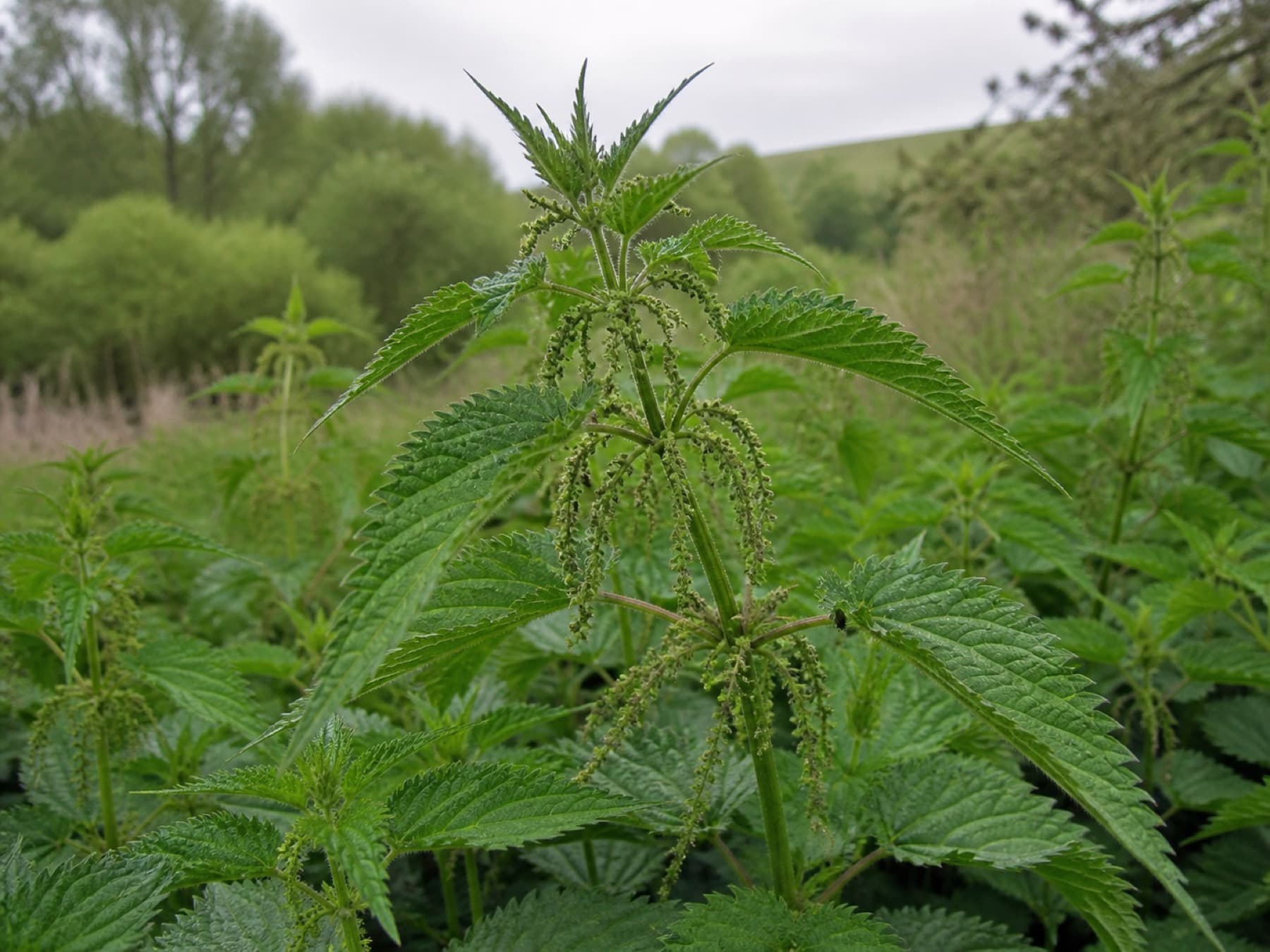
Nettle is a plant many people remember through the skin.
Brush an unprotected hand against the stem and it answers immediately. Yet the same plant has also been gathered as a spring vegetable, dried as an herbal material and dug for a root medicine with an entirely different purpose.
That is the first thing to understand about nettle:
One plant can yield different medicines. Nettle leaf and aerial herb are not interchangeable with nettle root. Neither is equivalent to the sting itself.
Precision does not make nettle less interesting. It reveals why this familiar plant deserves more than either miracle language or dismissal.
A Plant People Remember by Touch
Young nettle shoots have a long history as food. Above-ground material has a separate history in European household herbalism. Root preparations appear in modern regulatory monographs for lower urinary tract symptoms associated with benign prostatic hyperplasia. The stinging hairs belong to the plant's defence and produce another kind of exposure again.
An article that calls all of these simply "nettle" can sound confident while saying very little.
Throughout this profile, the material will be named:
- young leaf or shoot as food
- leaf when a source specifically studied leaf
- aerial herb when a monograph or preparation includes above-ground parts
- root and rhizome when the evidence concerns the underground material
- stinging hairs when discussing contact with the fresh plant
Botanical Identity
Accepted name: Urtica dioica L.
Family: Urticaceae
English names: stinging nettle, common nettle
Icelandic names: brenninetla, sérbýlisnetla
Life form: perennial, spreading through rhizomes as well as seed
The accepted species is Urtica dioica L. The Royal Botanic Gardens, Kew records it as native across a broad temperate range from Europe into Siberia and western China, with parts of north-western Africa, and includes Iceland in its native distribution. It is a rhizomatous perennial rather than one fixed stem appearing for a single season. (Kew Plants of the World Online)
ROLV/Urtekilden records the Icelandic names brenninetla and sérbýlisnetla. The second reflects the usual separation of male and female flowers onto different plants: the name dioica refers to "two houses." (ROLV/Urtekilden)
Typical features include:
- upright, often four-angled stems
- opposite leaves with conspicuously toothed margins
- pointed leaf tips and strong veins
- fine ordinary hairs mixed with specialized stinging hairs
- small greenish flowers carried in clusters from the leaf axils
- connected colonies arising from spreading underground rhizomes
These features are useful together, not alone. Leaf shape varies across the species. The amount of hair can vary. Young plants look different from flowering plants. Small nettle, Urtica urens, and non-stinging members of the mint family can confuse an inexperienced collector. Dead-nettles, Lamium species, often have more visible flowers and lack the true nettle sting, but that comparison is not a complete identification key.
Do not eat a wild plant because one photograph looks familiar. Use a regional flora, several diagnostic features and experienced local guidance when needed.
Why Nettle Stings
The sting is delivered by specialized hairs called trichomes. Each works like a tiny brittle needle. Contact breaks the tip and leaves a sharp edge capable of penetrating the outer skin and releasing irritating material.
Older explanations often reduce the sting to a familiar list of formic acid, histamine, acetylcholine and serotonin. Modern microscopy supports the mechanical syringe-like structure, but chemical studies suggest that sting chemistry is more variable and less completely settled than the simple list implies. Findings from other Urtica species should not automatically be assigned to Urtica dioica. (Fu et al., 2021)
The immediate result can include burning, itching, redness and raised wheals. That contact reaction is not the same exposure as drinking a prepared infusion or eating cooked leaves.
Blanching and thorough cooking collapse the mechanical sting. Appropriate drying and crushing also reduce it, but processing quality matters. Fresh raw material should not be treated casually merely because cooked nettle is food. (NCBI LiverTox: Stinging Nettle)
One Plant, Different Materials
The most useful question is not simply, "What does nettle do?"
It is:
Which nettle material, prepared how, for what purpose, and supported by what kind of evidence?
| Material | Typical preparation | Traditional or practical role | Evidence context |
|---|---|---|---|
| Young leaves and shoots | Cooked or blanched food | Seasonal edible green | Food tradition and compositional research |
| Leaf or aerial herb | Tea, powder, juice or defined extract | Minor urinary complaints, minor joint pain and seborrhoeic skin conditions | EMA traditional use; not established clinical efficacy |
| Root and rhizome | Defined oral preparations and extracts | Lower urinary tract symptoms associated with benign prostatic hyperplasia | Traditional use with preparation-specific human research |
| Seed or fruit | Traditional preparations | A separate, less-studied material | Tradition and emerging research; no established clinical use |
| Stinging hairs | Fresh contact or deliberate urtication | Plant defence and local contact reaction | Mechanistic evidence; only limited human investigation of urtication |
Official European documents make the distinction visible. The current nettle-herb monograph assesses Urtica dioica and Urtica urens herba, while the current root monograph separately assesses the same two species as radix. Neither document makes every preparation of either species equivalent. (EMA: Urticae herba, EMA: Urticae radix)
The Leaf as Food and Nutritive Herb
Young nettle leaves and shoots have been cooked as greens, added to soups and made into purées, breads and other foods across parts of Europe. A modern food review describes leaves as containing protein, minerals, carotenoids, fatty acids and phenolic compounds, but those words require context. (Grauso et al., 2022)
Composition is not one permanent number.
It changes with:
- soil and mineral availability
- location and climate
- plant age and harvest season
- leaf, stem or mixed aerial material
- fresh, cooked or dried state
- analytical method
A dried leaf powder has lost most of its water. Comparing its nutrient concentration directly with a fresh vegetable can therefore create an impressive but misleading result.
Nettle can reasonably be called a nourishing edible green. It does not need to be called a superfood.
Does Its Iron Treat Anaemia?
No. The presence of iron does not establish treatment of iron-deficiency anaemia.
A laboratory mineral value does not tell us:
- how much of the mineral is absorbed
- how much prepared nettle a person consumes
- whether tea extracts a clinically meaningful amount
- whether the deficiency is caused by low intake, blood loss, malabsorption or another condition
- whether the amount is sufficient to correct that deficiency
Nettle may contribute to a varied diet. It should not replace investigation of suspected anaemia or a treatment plan based on an identified cause.
Nordic Tradition and the Spring Tonic
Nettle's return in spring made it symbolically and practically important. Fresh green food reappeared after winter, and households used the plant in soup, porridge, tea, animal feed, fibre and local medicine.
ROLV/Urtekilden documents a wide Nordic tradition involving spring tonic use, urinary complaints, joints, skin, hair and many broader claims. It also preserves older language around "cleansing" and blood purification. (ROLV/Urtekilden)
That history matters. It shows how people understood the plant within seasonal food, household practice and older medical systems.
It does not automatically mean that nettle removes an undefined modern toxin from the blood. "Cleansing" was a traditional framework, not a laboratory endpoint. The responsible translation is to retain the history while asking which specific outcomes have actually been studied.
Leaf and Aerial Herb in Official Monographs
The European Medicines Agency's 2025 revised monograph covers the aerial herb of Urtica dioica and Urtica urens. Its accepted preparations include comminuted or powdered herb, expressed juices, liquid extracts, a tincture and a water-based dry extract. That range is exactly why the preparation should be stated. (EMA/HMPC nettle-herb monograph, 2025)
The monograph recognizes three traditional-use indications:
- relief of symptoms associated with minor urinary complaints, alongside sufficient fluid intake to increase urine
- relief of minor articular pain
- seborrhoeic skin conditions
Traditional-use status is not the same as well-established clinical efficacy. It means the European regulatory standard was met on the basis of long-standing use and plausible safety for specified products and contexts. The monograph itself states that these indications rely exclusively on long-standing use.
The urinary indication does not mean nettle treats urinary infection, kidney disease, kidney stones or oedema. Adequate fluid intake is part of the intended context, and the monograph does not recommend this use when reduced fluid intake has been medically advised.
Age limits differ by indication and preparation. Some specified preparations are not recommended below age 12; others, including the herb tea for urinary complaints and preparations for minor joint pain, are not recommended below 18 because adequate data are lacking. This is one reason a finished product's label matters more than a universal nettle dose.
Urinary complaints that worsen, or occur with fever, painful urination, spasm or blood in the urine, require assessment. Joint pain with swelling, redness or fever also needs medical evaluation. (EMA/HMPC nettle-herb monograph, 2025)
An older EMA page remains available for nettle leaf, Urticae folium. It is useful historical regulatory context, but it should not be silently substituted for the broader 2025 herb revision. Leaf and aerial herb are related terms, not automatic synonyms. (EMA: Urticae folium)
Root and Lower Urinary Tract Symptoms
Nettle root belongs in its own section because its best-known modern use is not the same as the food or herb story.
The EMA's 2025 root monograph covers root material from Urtica dioica and Urtica urens. It recognizes traditional use for relief of lower urinary tract symptoms related to benign prostatic hyperplasia, after serious conditions have been excluded by a doctor. (EMA/HMPC nettle-root monograph, 2025)
Lower urinary tract symptoms can include a weak stream, hesitation, frequent urination, urgency, incomplete emptying and waking at night to urinate. Similar symptoms can arise from different causes. Symptom improvement does not by itself show that:
- prostate tissue shrank
- disease progression changed
- urinary obstruction resolved
- PSA changed
- prostate cancer was excluded
The World Health Organization's older Radix Urticae monograph also describes root preparations for urinary symptoms associated with benign prostatic enlargement. It is historically important, but current EMA documents provide the more recent European regulatory assessment. (WHO Monographs on Selected Medicinal Plants, Volume 2)
What the Human Research Shows
A frequently cited 2005 randomized, double-blind trial enrolled 620 men with symptomatic benign prostatic hyperplasia and reported better symptom scores, urinary flow and residual urine outcomes with an Urtica dioica preparation than with placebo over six months. PSA and testosterone did not change. The publication also reported a modest change in prostate volume, but that single result should not be turned into the general claim that nettle "shrinks the prostate." The abstract does not describe the botanical authentication and extract chemistry with enough detail to generalize the result to arbitrary root tea or supplements. (Safarinejad, 2005)
Earlier reviews were more cautious. A broad phytotherapy review found reporting and methodological limitations that made the size and reliability of nettle's effect difficult to estimate. Later reviews describe a meaningful research base, but preparations vary and combination products cannot show what nettle root contributed on its own. (Wilt et al., 2000, Chrubasik et al., 2007)
The proportionate conclusion is:
Nettle root has a substantial tradition and a preparation-specific human research base for symptom support. That is not equivalent to curing benign prostatic hyperplasia, reversing obstruction or ruling out prostate cancer.
Fever, spasms, blood in the urine, painful urination or urinary retention require prompt medical assessment. Persistent or worsening symptoms should not be covered over with self-treatment.
Other Areas of Research
Blood Glucose
Human research exists, but it is heterogeneous. A 2020 meta-analysis of eight randomized trials involving 401 adults with type 2 diabetes found a reduction in fasting blood glucose, but not clear effects on insulin, insulin resistance or HbA1c. Variation between studies was high. A later meta-analysis reached more positive conclusions for some metabolic markers, while again reporting substantial heterogeneity and varied products. (Ziaei et al., 2020, Tabrizi et al., 2021)
This is promising but not settled. The studies do not justify replacing medication, changing a diabetes plan or assuming that nettle food, tea and every extract have the same effect.
Inflammation and Joint Symptoms
Laboratory studies show anti-inflammatory activity in particular extracts and models. The EMA accepts aerial herb for minor articular pain as a traditional use, not as a clinically proven anti-inflammatory treatment.
Intentional stinging, or urtication, has also been used historically for painful joints. A small controlled pilot study of nettle sting for chronic knee pain primarily established that a larger study was feasible. It does not justify encouraging people to irritate painful joints at home. (Randall et al., 2008)
Allergic Rhinitis
An older randomized trial of freeze-dried nettle reported a better global impression than placebo, while daily symptom diaries showed only a small difference. A later trial was small and had substantial dropout; both nettle and placebo groups improved, without convincing changes in key immune markers. That is mixed evidence, not proof of a "natural antihistamine." (Mittman, 1990, Bakhshaee et al., 2018)
Hair, Skin and Cancer
Nettle appears in traditional hair rinses and modern cosmetic products. Evidence for clinically meaningful hair growth in humans is not established.
The herb monograph's seborrhoeic-skin indication is based on long-standing use of specified aerial-herb preparations. It is not evidence that every nettle oil, shampoo or tea treats a skin condition.
Nettle extracts have affected inflammatory pathways and cancer cells in laboratory studies. Cell-culture cytotoxicity does not show that eating nettle, drinking tea or taking a supplement prevents or treats cancer in humans.
Preparation Changes the Plant
There is no single universal nettle preparation.
Cooked Food
Young leaves and shoots are blanched or cooked until the sting is gone. This is culinary exposure: a seasonal green within a meal.
Infusion
An infusion extracts water-soluble material from dried leaf or aerial herb. It does not reproduce every concentrated extract used in a trial, and a leaf infusion does not become root medicine because both carry the name nettle.
Dried Powder
Powder retains more whole material than a strained tea. Its concentration depends on dryness, plant part and serving size.
Tincture or Liquid Extract
Alcohol percentage and plant-to-liquid ratio change extraction. The EMA monograph lists several defined herb preparations; those definitions should not be collapsed into a generic drop count.
Root Preparation
Root tea, powdered root and standardized extracts are not automatically equivalent. Positive research on a defined extract cannot establish the effect of an arbitrary root product.
Use the plant part and preparation on the label. If either is absent, the product is not specific enough to borrow a specific evidence claim.
Harvesting, Identification and Storage
Wear gloves and cover exposed skin while gathering fresh nettle.
Harvest only after confident identification. Avoid roadsides, sprayed land, industrial sites, polluted waterways, animal-waste hotspots and any place where land history is unclear.
Young leaves and shoots are usually preferred for food because they are more tender. Timing varies with climate and regrowth. The common internet claim that nettle becomes "poisonous" after flowering is not supported by the regulatory or botanical sources used for this profile. Older material may be tougher, more fibrous and less pleasant to eat; that is not the same as a universal toxic threshold.
Process culinary nettle before eating. Blanch or cook it thoroughly enough to remove the mechanical sting. Keep raw material away from children and animals while processing.
For drying:
- spread clean aerial material in a thin layer
- use moving air and protect it from direct sun and damp
- dry fully before sealing
- store away from heat, moisture and light
- discard material with mould, persistent dampness or an unfamiliar smell
Harvest aerial growth selectively and leave enough plant to photosynthesize and support habitat. Root harvesting removes the perennial structure and is far more destructive. It should be approached as a separate act, not as an incidental extension of leaf gathering.
Safety: When to Pause or Seek Guidance
Fresh stinging hairs can produce pain, redness, itching and wheals. Allergic reactions are also possible.
For medicinal aerial-herb preparations, the EMA reports nausea, vomiting, diarrhoea, itching, rash and urticaria, with frequency unknown. Root preparations have been associated with nausea, heartburn, fullness, flatulence, diarrhoea and allergic skin reactions, also with unknown frequency. (EMA herb monograph, EMA root monograph)
LiverTox found no published reports of clinically apparent liver injury attributed to nettle leaf or root extracts as of its March 2023 update and rates nettle an unlikely cause. Few prospective studies monitored liver tests, so this bounded finding should not be enlarged into proof that every product is harmless. (NCBI LiverTox: Stinging Nettle)
Safety during pregnancy and breastfeeding has not been established for the medicinal herb preparations, and the EMA does not recommend them in the absence of sufficient data. Food use and concentrated medicinal products are different contexts, but pregnancy is not a good time to infer safety from tradition alone.
Children and adolescents are not one category across all preparations. The current herb monograph uses different age limits according to indication and preparation; the root monograph has no relevant use below age 18.
Urinary-flushing use requires adequate fluid. It is not appropriate where a clinician has advised reduced fluid intake. This may matter in some serious heart or kidney conditions, but the individual reason for fluid restriction should be handled by the treating professional.
The current EMA monographs report no medicinal interactions. That is not the same as proving that interactions are impossible. Generic online lists often warn about diabetes medicines, blood-pressure medicines, diuretics, anticoagulants or lithium without identifying the nettle part, preparation or documented case. A person using medicines with narrow safety margins should have the exact product assessed rather than rely on a copied universal list.
Product identity matters. Contamination, substitution, mould, undeclared blends and a label that says only "nettle" can change the risk more than the plant's reputation suggests.
Evidence Snapshot
This table summarizes the direction of the evidence. It is not a score and it does not make unlike preparations equivalent.
| Question | Material | Type of support | Proportionate conclusion |
|---|---|---|---|
| Edible young leaf | Cooked young leaf or shoot | Food tradition and compositional studies | A useful edible green; composition varies and does not prove treatment of deficiency. |
| Minor urinary complaints | Aerial herb in defined preparations | EMA traditional use | May support urinary flushing with sufficient fluid; not a treatment for infection or kidney disease. |
| Minor joint pain | Aerial herb in defined preparations | EMA traditional use | Long-standing use is recognised; strong clinical efficacy is not established. |
| Lower urinary tract symptoms | Root or root extract | EMA traditional use and mixed human evidence | Symptom support is plausible and preparation-specific; this does not cure BPH or exclude cancer. |
| Type 2 diabetes markers | Varied leaf or aerial-part products | Mixed meta-analyses of small heterogeneous trials | Promising but not reliable enough to replace or alter diabetes care. |
| Allergic rhinitis | Freeze-dried aerial material or extract | Small, mixed human trials | Not established as a natural antihistamine or allergy treatment. |
| Hair growth or cancer | Varied topical materials or laboratory extracts | Traditional, cosmetic or preclinical evidence | No established human treatment effect. |
| Deliberate urtication | Fresh stinging hairs on skin | Historical practice and a small pilot trial | Not supported as a safe home treatment for painful joints. |
Plant Lab Label
Identity
Urtica dioica L., family Urticaceae.
Material
State whether the material is young food leaf, medicinal leaf, aerial herb, root and rhizome, seed or fresh stinging hair.
Preparation
Cooked food, infusion, powder, juice, tincture, liquid or dry extract, or a separately defined root preparation.
Tradition
Strong European and Nordic food and household-herbal tradition, with a separate root tradition for urinary symptoms.
Evidence
Supported traditional use for defined herb and root preparations; mixed preparation-specific human evidence in several areas.
Safety
Fresh contact stings. Medicinal products can cause gastrointestinal or allergic reactions, and urinary uses have specific warning contexts.
Sustainability
Leaf harvest can be selective; root harvest removes the perennial structure and is substantially more destructive.
Final Field Note
Nettle is not one vague remedy.
It is a spring food when young shoots are cooked.
It is an aerial herbal material when a defined tea, powder, juice or extract is used.
It is a different medicine when the root is prepared for lower urinary tract symptoms.
It is a plant defence when fresh hairs enter the skin.
Those stories can belong to one species without becoming interchangeable.
Precision does not weaken herbal tradition. It stops a nourishing leaf from borrowing a root trial, a root extract from borrowing the familiarity of soup, and a laboratory result from becoming a promise to a person.
Meet the plant.
Name the part.
Name the preparation.
Then ask what the evidence can honestly carry.
That is where respect begins.
Continue the Plant Lab Thread
- Open the Materia Medica Library
- Use the Single-Plant Method
- Learn Botanical Names
- Explore Plant Parts
- Explore Tea, Infusion and Decoction
- Read Self-Heal / Heal-All
- Read Morgunfrú / Calendula
- Read Blóðberg / Icelandic Wild Thyme
- Return to Plant Lab
Sources and Further Reading
- Royal Botanic Gardens, Kew: Urtica dioica L.
- ROLV / Urtekilden: Urtica dioica
- EMA: Urticae herba landing page and current documents
- EMA/HMPC: European Union herbal monograph on Urtica dioica L.; Urtica urens L., herba, Revision 1
- EMA: Urticae radix landing page and current documents
- EMA/HMPC: European Union herbal monograph on Urtica dioica L.; Urtica urens L., radix, Revision 1
- World Health Organization: Radix Urticae, WHO Monographs on Selected Medicinal Plants, Volume 2
- Grauso et al.: Urtica dioica as a functional food
- Safarinejad: randomized trial in benign prostatic hyperplasia
- Wilt et al.: phytotherapy for benign prostatic hyperplasia
- Chrubasik et al.: review of Urticae radix
- Ziaei et al.: systematic review and meta-analysis in type 2 diabetes
- Tabrizi et al.: meta-analysis of metabolic profiles in type 2 diabetes
- Mittman: randomized trial in allergic rhinitis
- Bakhshaee et al.: nettle extract in allergic rhinitis
- Fu et al.: structural and chemical profile of stinging trichomes
- Randall et al.: controlled pilot study of nettle sting for chronic knee pain
- NCBI LiverTox: Stinging Nettle