Sometimes the medicine is not stimulation, but protection.
Marshmallow root does not announce itself with bitterness, heat or a dramatic aroma. Dried pieces can look pale and almost plain. Add water, however, and the material changes. The liquid becomes softer, thicker and more slippery. That physical change is the beginning of the medicine.
Marshmallow is a useful plant for learning a larger herbal lesson: the name on the jar is only part of the identity. Plant part, preparation, solvent, temperature, time and product quality all shape what reaches the body.
This profile centres the root. The leaves and flowers belong to the same plant, but they are not interchangeable footnotes. We will meet them briefly, then return to the preparation that makes marshmallow root distinctive.
Botanical Identity and Names
The accepted botanical name is Althaea officinalis L. The species belongs to the mallow family, Malvaceae. Kew describes it as a perennial native across much of Europe and parts of northern Africa and temperate Asia. (Kew Plants of the World Online)
The Icelandic name is læknastokkrós. It should not be confused with garðabrúða, the Icelandic name used for valerian, Valeriana officinalis. Common names travel easily between languages; botanical names make that travel safer. (Íðorðabankinn: læknastokkrós, Lystigarður Akureyrar: garðabrúða)
The L. after the species name is the standard author abbreviation for Carl Linnaeus, who published the name. It is not part of the species epithet and is not italicized.
Marshmallow can also be confused with ornamental mallows or products sold only as "mallow." When buying or documenting the herb, look for:
- Althaea officinalis
- the plant part, usually root or leaf
- whether the material is cut, powdered or extracted
- the preparation and solvent where relevant
- a traceable supplier and batch
Identity comes before use.
The Root as Material
The European Pharmacopoeia definition used in the EMA assessment covers the dried, peeled or unpeeled, whole or cut root of Althaea officinalis. Root pieces are typically pale, fibrous and light. Powdered root loses many of the visual clues available in cut material, which makes supplier quality and documentation more important. (EMA assessment report, 2016, WHO monograph)
The official quality discussion includes a swelling index. This is not a wellness score. It is a pharmacognostic measure of how much a defined amount of powdered material expands under specified conditions. It helps characterize a root valued for water-binding constituents. (EMA assessment report, 2016, Rownaghi et al., 2024)
That value can vary with:
- plant genetics and growing conditions
- harvest timing
- peeling and processing
- particle size
- drying and storage
- the ratio of plant material to liquid
- water quality, temperature and contact time
The root is not a fixed packet of one active ingredient. It is a changing biological material that must be identified and prepared.
Mucilage: What the Water Reveals
Mucilage is a practical umbrella term for water-attracting and water-swelling plant polysaccharides. In marshmallow root, these complex carbohydrates contribute to the slippery, viscous character that appears when the root is hydrated. (WHO monograph, Rownaghi et al., 2024)
The root also contains starch, pectic substances and many other constituents. Saying "marshmallow contains mucilage" is therefore useful but incomplete. The preparation contains a mixture, and the mixture changes with the process.
Mucilage is not the same as oil. It does not dissolve into water in the simple way that sugar does. Its polymers hydrate, disperse and form a structured liquid. Researchers can measure properties such as swelling, viscosity and rheology, but a laboratory value does not by itself tell us how a person will feel or whether a symptom will improve.
Still, the visible transformation matters. It explains why water is not merely a carrier in this plant. Water helps create the form in which the root has traditionally been used.
A Local Soothing Mechanism
Marshmallow root is commonly described as a demulcent: a substance used to soothe irritated mucous membranes through local contact. The strongest version of this idea is modest. A hydrated preparation may create a viscous, water-rich layer at surfaces it directly touches, changing friction, moisture and sensory irritation for a time.
In-vitro studies with marshmallow polysaccharides and defined extracts have explored adhesion to epithelial cells, cell viability and signalling. These experiments offer plausible mechanisms. They do not prove that a cup, capsule or syrup will repair tissue, cure cough or treat gastrointestinal disease. (Deters et al., 2010, Bonaterra et al., 2022)
The boundaries are important:
- a swallowed preparation does not form an airtight seal
- it does not coat the lungs
- local soothing is not the same as treating an infection
- symptom relief is not proof that the cause has been removed
- laboratory cell responses are not clinical outcomes
Protection here means a local, preparation-dependent possibility, not a promise that the plant shields the whole body.
Preparation Is Part of the Identity
A tincture, tea, cold macerate, syrup, dry extract and capsule may all carry the same botanical name while delivering very different experiences and chemical profiles.
Cold aqueous macerate
- Material and solvent
- Dried, cut or comminuted root with water
- Why it differs
- Favours hydration and swelling of water-soluble polysaccharides; it is a central traditional and official preparation concept for the root.
- Important boundary
- It is a fresh, water-rich preparation, not a sterile or shelf-stable product. The EMA monograph says the macerate should be used immediately.
Hot infusion
- Material and solvent
- Root prepared with hot water
- Why it differs
- Produces a water-based preparation, but temperature and process can change texture and the extracted profile.
- Important boundary
- It should not be treated as compositionally identical to a cold macerate. Heat does not justify the simplistic claim that mucilage is destroyed.
Syrup
- Material and solvent
- A defined macerate or extract combined with product-specific excipients
- Why it differs
- Can change viscosity, contact time and palatability.
- Important boundary
- Sugar, alcohol and other excipients vary. A commercial syrup is not interchangeable with homemade tea.
Aqueous extract
- Material and solvent
- A defined water extract, often concentrated or dried
- Why it differs
- Can provide a standardized, preparation-specific material.
- Important boundary
- Evidence for one named extract does not automatically transfer to every root product.
Hydroalcoholic extract
- Material and solvent
- A solvent-specific liquid extract
- Why it differs
- Selects a different chemical profile; some official preparations use low-strength ethanol.
- Important boundary
- It is not simply a stronger version of a mucilage-rich water preparation. Alcohol content and age restrictions matter.
Powder or capsule
- Material and solvent
- Dry, comminuted root
- Why it differs
- Offers a convenient dry format.
- Important boundary
- Hydration, local contact and serving instructions differ from liquid preparations.
| Preparation | Material and solvent | Why it differs | Important boundary |
|---|---|---|---|
| Cold aqueous macerate | Dried, cut or comminuted root with water | Favours hydration and swelling of water-soluble polysaccharides; it is a central traditional and official preparation concept for the root. | It is a fresh, water-rich preparation, not a sterile or shelf-stable product. The EMA monograph says the macerate should be used immediately. |
| Hot infusion | Root prepared with hot water | Produces a water-based preparation, but temperature and process can change texture and the extracted profile. | It should not be treated as compositionally identical to a cold macerate. Heat does not justify the simplistic claim that mucilage is destroyed. |
| Syrup | A defined macerate or extract combined with product-specific excipients | Can change viscosity, contact time and palatability. | Sugar, alcohol and other excipients vary. A commercial syrup is not interchangeable with homemade tea. |
| Aqueous extract | A defined water extract, often concentrated or dried | Can provide a standardized, preparation-specific material. | Evidence for one named extract does not automatically transfer to every root product. |
| Hydroalcoholic extract | A solvent-specific liquid extract | Selects a different chemical profile; some official preparations use low-strength ethanol. | It is not simply a stronger version of a mucilage-rich water preparation. Alcohol content and age restrictions matter. |
| Powder or capsule | Dry, comminuted root | Offers a convenient dry format. | Hydration, local contact and serving instructions differ from liquid preparations. |
This table is a comparison, not a home dosing guide. For a medicine or commercial product, follow the preparation-specific label or monograph. For a fresh water preparation, clean equipment, potable water and immediate use matter because water also supports microbial growth. The EMA monograph specifically says its macerate should be used immediately. (EMA herbal monograph, 2016, WHO monograph)
The familiar claim that hot water "destroys the mucilage" is too blunt. Heat, time and agitation can change extraction, viscosity and degradation, but they do not turn every polysaccharide off at a single temperature. The honest question is narrower: which preparation was studied or traditionally used for this purpose?
Nordic Tradition and ROLV
The Norwegian herbal reference ROLV documents marshmallow as a long-used medicinal and food plant and gives the Icelandic name læknastokkrós. Its monograph discusses root and leaf, with cold water preparation emphasized for the root. (ROLV / Urtekilden)
This is valuable regional context, but a traditional monograph is not automatically a current safety standard. ROLV also carries broad indications and permissive statements that should not be copied without checking them against official monographs and clinical evidence.
WholeRootLabs uses regional sources to preserve language, practice and plant history. We use the EMA and other current professional references when pregnancy, children, dosage forms, red flags and medicine use are involved.
Tradition deserves attention. It also deserves careful translation into the present.
What the EMA Monograph Actually Recognizes
The European Medicines Agency recognizes marshmallow root for two traditional-use indications: (EMA: Althaeae radix, EU herbal monograph, 2016)
- symptomatic relief of oral or pharyngeal irritation with an associated dry cough
- symptomatic relief of mild gastrointestinal discomfort
"Traditional use" has a specific regulatory meaning. It means the use is considered plausible and has been documented over a long period, while the available clinical-trial evidence is not sufficient for a well-established-use conclusion.
As of August 2026, the EMA hub still lists the 2016 European Union herbal monograph as the current final monograph. A review addendum was published in 2025 without a replacement final monograph. (EMA document hub, EMA review addendum, 2025)
The official preparations are not one universal marshmallow product. They include comminuted root, macerates and defined liquid or dry extracts. Minimum ages vary by indication and dosage form. Some mouth-and-throat preparations have a tradition of use from age three, while the gastrointestinal indication is for adolescents and adults, and ethanol-containing extracts carry stricter limits.
This is why "marshmallow is suitable for children" is not a responsible standalone sentence. The exact product, indication, alcohol content, age and instructions matter.
The monograph advises professional review if mouth, throat or cough symptoms persist beyond one week, or gastrointestinal symptoms beyond two weeks. Breathing difficulty, fever or purulent sputum require earlier medical attention.
Dry Cough: Evidence and Limits
Marshmallow root has a coherent traditional role when the problem is irritation with a dry cough. That wording does not include every cough.
The EMA assessment describes a small placebo-controlled study in 63 adults with cough associated with ACE-inhibitor medication. A marshmallow preparation appeared to reduce cough scores, but the product was insufficiently described and medication-related cough has a specific cause. This does not support quietly changing a prescribed medicine or generalizing the result to respiratory disease. (EMA assessment report, 2016)
Two uncontrolled studies included roughly 900 children using syrups or drops. Without a comparison group, such studies can describe tolerability and reported change but cannot establish that marshmallow caused improvement. Surveys of named marshmallow products also report favourable user experiences, yet surveys remain vulnerable to expectation, selection and recall effects. (EMA assessment report, 2016, Fink et al., 2018)
The practical line is clear:
- dry irritation is different from wet or productive cough
- a soothing syrup does not diagnose the cause
- cough with shortness of breath, chest pain, blood, high fever or serious deterioration needs appropriate care
- a persistent cough deserves assessment even if a soothing preparation feels helpful
Marshmallow may change how irritation feels. That is not the same as treating asthma, pneumonia, reflux, allergy or a medication adverse effect.
Mild Gastrointestinal Discomfort Is Not "Gut Healing"
The second EMA traditional indication is the symptomatic relief of mild gastrointestinal discomfort. It is intentionally restrained. (EMA herbal monograph, 2016)
A hydrated, viscous preparation may alter local sensation and contact in the mouth, throat and upper digestive tract. Laboratory work on epithelial cells and polysaccharides offers mechanistic questions worth studying. Human evidence does not establish that marshmallow root heals ulcers, repairs a "leaky gut," treats inflammatory bowel disease or resolves the cause of recurrent abdominal pain.
Those conditions are not interchangeable with mild discomfort. Pain that is severe, persistent or accompanied by bleeding, black stool, vomiting, fever, marked weight loss, dehydration or difficulty swallowing needs professional assessment.
The root can be respected without turning a local demulcent tradition into a claim about whole-body repair.
Leaf, Flower and Food History
Marshmallow leaf contains mucilage too, but the leaf and root are different herbal materials. The leaf has its own proportions, texture, traditional preparations and official history. Evidence or instructions for the root should not be transferred automatically to the leaf.
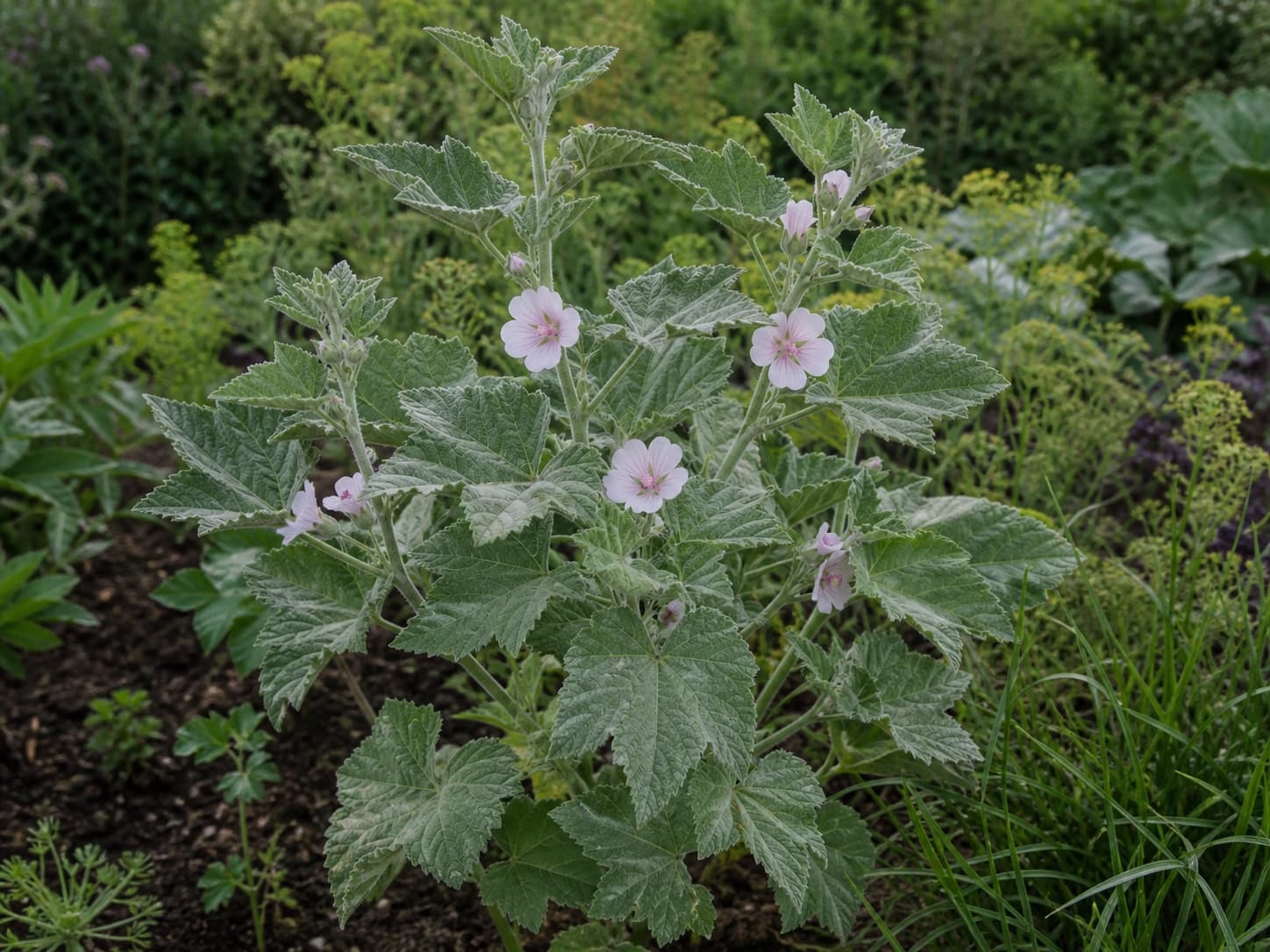
The pale pink flowers help identify the living plant and have appeared in local food and herbal traditions. Young leaves and shoots have also been eaten in some places.
The plant's best-known food story belongs to the root. Historical marshmallow confection used a preparation of the root with sweeteners and other ingredients. Modern marshmallows generally use gelatin or other gelling agents instead of Althaea officinalis. The shared name records a lineage; it does not make today's sweet a herbal preparation. (Cambridge University Botanic Garden, WHO monograph)
Growing, Harvest and Responsibility
Marshmallow is a tall perennial with softly hairy grey-green leaves and pale flowers. It is associated with damp ground, river margins, salt marshes and other moist habitats, though cultivation conditions vary by climate and soil. (Kew Plants of the World Online, Cambridge University Botanic Garden)
Root harvest is different from gathering flowers. Lifting a root removes the plant or seriously damages its ability to continue. That makes cultivated, traceable supply the better default for regular use. Wild harvest should never be assumed appropriate merely because a plant appears locally abundant.
For a garden-grown plant:
- confirm identity before use
- know the history of the soil and whether it may contain contaminants
- avoid harvesting plants exposed to sprays, runoff or other pollution
- plan for propagation or replacement before lifting roots
- document the plant part and date
For a wild population:
- check local law, land access and harvesting permission
- do not collect beside roads or from sprayed or polluted ground
- avoid root harvest where the plant is scarce, protected or difficult to identify
- leave the wider population and habitat intact
- choose cultivated, traceable material when responsible wild harvest is uncertain
The root may be the material of interest, but the living plant and its habitat still matter.
Quality, Storage and Microbial Reality
Good dried marshmallow root should be correctly identified, dry, reasonably clean and free from visible mould, insects, unusual dampness and foreign matter. A sweet or neutral earthy smell can be normal; a musty smell or soft, damp clumping is not a detail to ignore.
Cut root allows more visual assessment than fine powder. Powder is not automatically poor quality, but substitution, contamination and deterioration are harder to detect by sight.
Keep dried material in a clean, dry, clearly labelled container away from moisture and excessive heat. Use the supplier's storage period rather than inventing a universal shelf life.
Water changes the risk profile. A fresh macerate is not preserved simply because the plant is traditional. Neither boiling water nor refrigeration turns a home preparation into a sterile pharmaceutical product. Follow an authoritative preparation or product instruction and discard anything with unexpected odour, fermentation, mould or other signs of deterioration.
Safety, Medicines and Who Needs More Care
The formal contraindication is hypersensitivity to marshmallow root or the product's ingredients.
Pregnancy and breastfeeding safety have not been established, and the EMA monograph does not recommend use in the absence of sufficient data. This is one place where a current official monograph should outweigh a more permissive traditional reference. (EMA herbal monograph, 2016, EMA assessment report, 2016)
Children require preparation-specific decisions. Age limits differ between comminuted root, syrups, solid forms, liquid extracts, indications and alcohol-containing products. A qualified professional or the authorized product information is the right place to check.
Because hydrated mucilage could theoretically delay the absorption of medicines taken orally, the monograph keeps a spacing precaution: do not take marshmallow root from half an hour to one hour before or after other oral medicines. Direct evidence for a clinically important interaction is limited, so this is a precaution rather than proof that every medicine is affected. (EMA herbal monograph, 2016, EMA assessment report, 2016)
"No interactions reported" does not mean "no interactions possible." Product excipients matter too. Syrups may contain substantial sugar; liquid extracts may contain alcohol; multi-herb products introduce additional ingredients and risks.
Seek timely help for breathing difficulty, swelling of the face or throat, severe rash, fever with worsening cough, purulent sputum, blood, severe abdominal pain, dehydration or other serious symptoms. A soothing plant should never become a reason to wait through danger.
Evidence Map
Irritation of the mouth or throat with associated dry cough
- Main evidence
- Long-standing traditional use, EMA assessment, limited and preparation-specific human observations
- WholeRoot reading
- A credible traditional indication with a plausible local mechanism, but limited controlled clinical evidence.
Mild gastrointestinal discomfort
- Main evidence
- Long-standing traditional use recognized by the EMA
- WholeRoot reading
- A symptom-level traditional indication. It does not establish treatment of ulcers, inflammatory disease or a damaged intestinal barrier.
Local soothing or protective action
- Main evidence
- Pharmacognosy, physicochemical work and in-vitro studies
- WholeRoot reading
- Biologically plausible at contacted surfaces; laboratory findings are not proof of a clinical outcome in people.
Use in children
- Main evidence
- Product-specific traditional use and uncontrolled observational studies
- WholeRoot reading
- No blanket rule. Minimum ages depend on indication, dosage form and alcohol content, so the specific monograph or label must be checked.
Delayed absorption of oral medicines
- Main evidence
- Theoretical concern retained as an official precaution; direct proof is limited
- WholeRoot reading
- Treat spacing as a precaution, not as a demonstrated interaction with every medicine.
Gut healing, immune boosting or systemic anti-inflammatory effects
- Main evidence
- Little or no relevant human evidence for marshmallow root preparations
- WholeRoot reading
- Not established. These claims go beyond the traditional indications and the available clinical evidence.
| Question or claim | Main evidence | WholeRoot reading |
|---|---|---|
| Irritation of the mouth or throat with associated dry cough | Long-standing traditional use, EMA assessment, limited and preparation-specific human observations | A credible traditional indication with a plausible local mechanism, but limited controlled clinical evidence. |
| Mild gastrointestinal discomfort | Long-standing traditional use recognized by the EMA | A symptom-level traditional indication. It does not establish treatment of ulcers, inflammatory disease or a damaged intestinal barrier. |
| Local soothing or protective action | Pharmacognosy, physicochemical work and in-vitro studies | Biologically plausible at contacted surfaces; laboratory findings are not proof of a clinical outcome in people. |
| Use in children | Product-specific traditional use and uncontrolled observational studies | No blanket rule. Minimum ages depend on indication, dosage form and alcohol content, so the specific monograph or label must be checked. |
| Delayed absorption of oral medicines | Theoretical concern retained as an official precaution; direct proof is limited | Treat spacing as a precaution, not as a demonstrated interaction with every medicine. |
| Gut healing, immune boosting or systemic anti-inflammatory effects | Little or no relevant human evidence for marshmallow root preparations | Not established. These claims go beyond the traditional indications and the available clinical evidence. |
The evidence is strongest when the claim stays close to the preparation, the contacted surface and the traditional indication. It weakens rapidly when marshmallow is asked to become a systemic cure-all.
Closing Thought
Marshmallow teaches through texture.
The root meets water and changes what contact feels like. That is quieter than stimulation and narrower than cure, but it is not insignificant.
The lesson is not that every irritated surface needs marshmallow. It is that support can sometimes mean reducing friction, restoring moisture and giving a sensitive boundary a gentler encounter with the world.
Sometimes the medicine is not a push.
Sometimes it is protection, precisely prepared and honestly bounded.
Continue Through WholeRootLabs
- Plant Lab: Start Here
- Materia Medica Library
- Herbal Medicine Without the Hype
- Botanical Names: How to Know Which Plant You Actually Have
- Which Part of the Plant?
- Tea, Infusion and Decoction
- Tinctures Without the Mystery
- The Single-Plant Method
Sources and Further Reading
- Kew Science, Plants of the World Online: Althaea officinalis L.
- European Medicines Agency: Althaeae radix overview and document hub
- EMA: Final European Union herbal monograph on Althaea officinalis L., radix (2016)
- EMA: Final assessment report on Althaea officinalis L., radix (2016)
- EMA: Addendum to the assessment report on Althaea officinalis L., radix (2025)
- World Health Organization: WHO Monographs on Selected Medicinal Plants, Volume 2
- ROLV: Legestokkrose (Althaea officinalis)
- Íðorðabankinn: læknastokkrós
- Cambridge University Botanic Garden: Althaea officinalis
- Deters et al. (2010): Marshmallow root extract and polysaccharides in epithelial-cell models
- Fink et al. (2018): User-reported experience with marshmallow root extracts for dry cough
- Mahboubi (2020): Review of Althaea officinalis in traditional medicine and modern phytotherapy
- Bonaterra et al. (2022): In-vitro work on a marshmallow-root-containing dry extract
- Rownaghi et al. (2024): Physicochemical study of extraction from marshmallow root