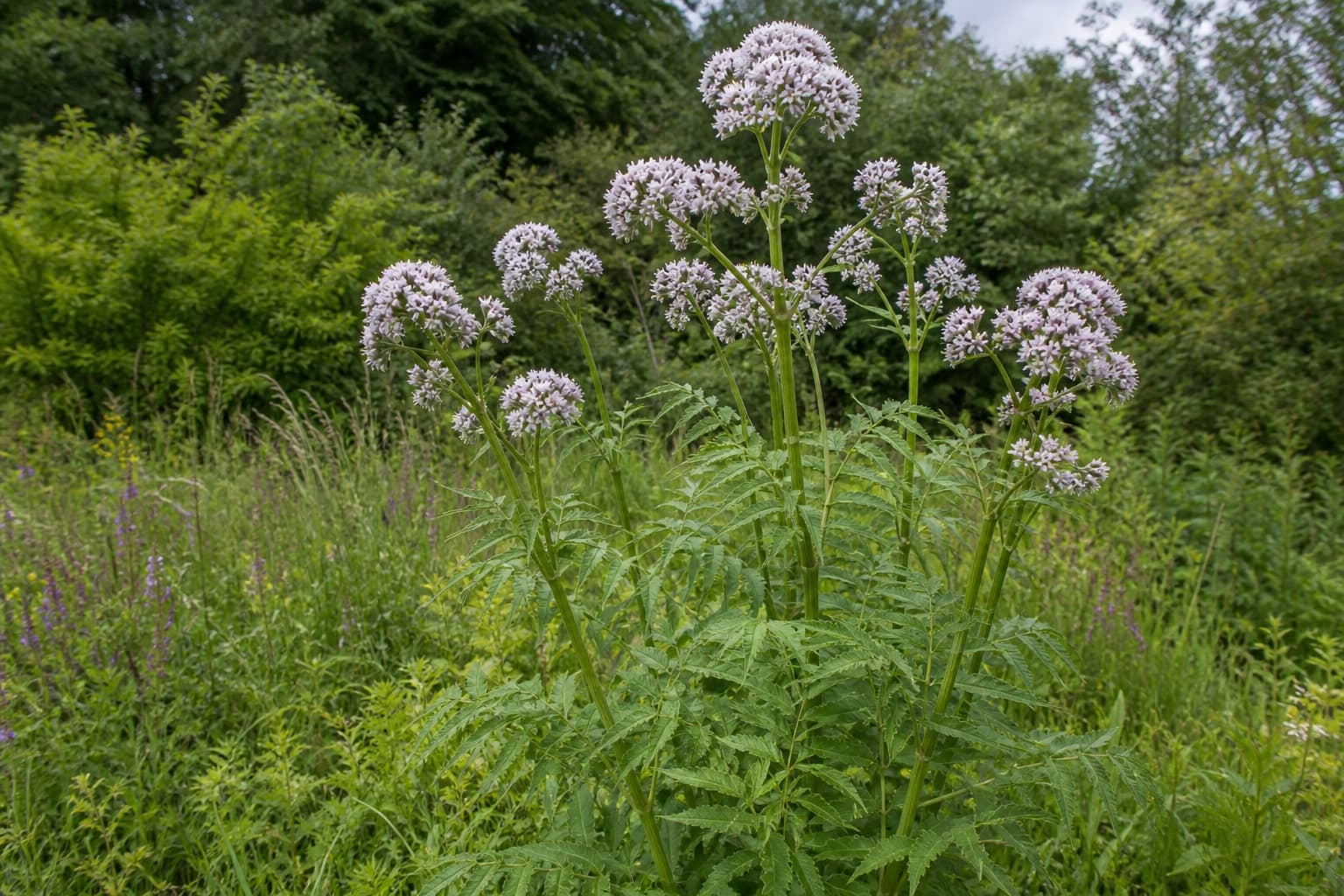
Valeriana officinalis L. — garðabrúða
Some medicinal plants arrive politely.
Dried valerian root does not.
Open a well-sealed jar and the room may fill with a dark, earthy, almost animal smell. People have compared it to old socks, strong cheese and several things best left outside. The comparison is memorable. It is not a quality test.
The smell can shift with drying, age and storage. It does not prove species, freshness, strength or clinical effect. A powerful aroma and a powerful medicine are not the same claim. (EMA assessment report, 2016, Bos et al., 2012)
Valerian sits between two familiar stories. One treats it as a gentle traditional ally for tension and sleep. The other sells it as "nature's Valium."
Neither is precise enough.
Rest does not always begin with sedation. Sometimes it begins when the system is finally allowed to loosen its grip. That is an editorial metaphor, not a measurement of the nervous system. The evidence underneath it belongs to particular roots, extracts, populations and outcomes.
This profile keeps those roots attached.
Botanical Identity and Icelandic Context
The accepted species is Valeriana officinalis L., currently placed by Kew in the honeysuckle family, Caprifoliaceae. Older books may place it in Valerianaceae. It is a perennial native from Europe into north-western Iran, with opposite pinnate leaves and branched clusters of small pale flowers. (Kew Plants of the World Online)
The Icelandic name used here is garðabrúða. Icelandic records describe it mainly as a garden plant that can escape cultivation. That matters because Iceland also has hagabrúða, a closely related valerian whose name and taxonomy have not always been handled consistently in older sources. A casual Icelandic label is therefore not enough for confident identification. (Náttúrufræðistofnun Íslands, Íðorðabankinn)
Valerian and læknastokkrós, marshmallow, share the species epithet officinalis: Valeriana officinalis and Althaea officinalis. This historical word appears in the botanical names of many plants associated with medicinal use. It does not imply that the plants are related or interchangeable; their genera, families and medicinal materials are different.
For a living plant, use the whole botanical picture: leaves, stem, flowers, habitat and origin. For purchased material, look for a traceable supplier, accepted botanical name, plant part and batch information.
A bag of brown root fragments cannot be authenticated by smell or a photograph alone.
What Valerianae radix Actually Means
The medicinal material in the European monograph is Valerianae radix: the dried underground parts of Valeriana officinalis, including the rhizome, roots and stolons. The material may be whole or comminuted. This is wider than the everyday word "root," but much narrower than "anything from a valerian plant." (EMA herbal monograph, 2016, EMA assessment report, 2016)
Keep these apart:
- fresh underground material and dried medicinal root
- rhizome, roots and stolons and the flowering aerial plant
- cut root and fine powder
- tea, tincture and dry extract
- water extract and hydroalcoholic extract
- whole root and distilled essential oil
- valerian alone and a fixed combination with hops, passionflower or lemon balm
- an isolated constituent and the complete preparation
This distinction is not editorial fussiness. Solvent, ratio, drying and processing change what reaches the finished product. A plant name is not a standardized intervention.
The Unmistakable Smell and Its Limits
Freshly harvested valerian root can smell different after it has been dried. The EMA assessment describes the characteristic odour and notes that isovaleric acid can arise as constituents change during storage. Analytical work also shows that unstable valepotriates can degrade over time. (EMA assessment report, 2016, Bos et al., Journal of Pharmacy and Pharmacology, 2012)
That supports a modest conclusion:
Odour is information, but not identity, dose or potency.
An unexpectedly musty, damp, fermented or contaminated smell still deserves attention. So do visible mould, insects, moisture or a damaged package. But a stronger classic valerian smell does not prove a stronger clinical effect, and a milder smell does not automatically prove weak material.
Let the nose notice.
Do not ask it to run the laboratory.
A Complex Root, Not One Magic Molecule
Valerian root contains a changing mixture that can include volatile oil components, valerenic acids and related sesquiterpenes, lignans, amino acids and unstable iridoid compounds called valepotriates. Composition varies across plant material, cultivation, genetics, processing and extraction. (Raj et al., 2023, EMA assessment report, 2016)
Valerenic acids can serve as analytical markers in defined products. A marker helps describe and control material. It does not automatically identify the one molecule responsible for an effect, and more marker does not automatically mean a clinically better product.
Laboratory and animal studies suggest that several valerian constituents may interact with GABA-related signalling and other neural targets. That is a plausible mechanism story, not a complete demonstrated human mechanism. Valerian is not diazepam, and a laboratory connection to GABA does not make "nature's Valium" a scientific description. (EMA assessment report, 2016, NCCIH, updated 2025)
Valepotriates deserve similar restraint. They are chemically interesting and unstable. Their degradation during processing and storage does not support a simple story in which they are either the entire sedative action or a universal danger hidden in ordinary valerian tea.
Calming Is Not the Same as Sedation
Everyday language collapses several different questions into one word: relaxing.
Mild nervous tension
- What it describes
- The narrower regulatory wording used for a mild, everyday state of tension.
- What it does not prove
- It is not a diagnosis of generalized anxiety, panic, depression or trauma.
Calming or relaxation
- What it describes
- A subjective easing of tension, restlessness or effort.
- What it does not prove
- It does not necessarily mean sleepiness, impaired alertness or successful treatment.
Sedation
- What it describes
- Reduced arousal or alertness that may affect performance and safety.
- What it does not prove
- Sedation is not a synonym for healthy sleep, and more sedation is not automatically better.
Sleepiness
- What it describes
- The felt tendency or readiness to fall asleep.
- What it does not prove
- Feeling sleepy does not prove longer sleep, fewer awakenings or deeper sleep.
Sleep quality
- What it describes
- Often a person's own rating of how well they slept or how restored they feel.
- What it does not prove
- A subjective improvement is different from objective change measured by actigraphy or polysomnography.
Anxiolysis
- What it describes
- A clinical reduction in anxiety, normally tested with defined populations and outcomes.
- What it does not prove
- Traditional calming language and mild nervous tension do not establish treatment of an anxiety disorder.
Insomnia disorder
- What it describes
- Persistent difficulty sleeping with daytime consequences, assessed in clinical context.
- What it does not prove
- It is not the same as one difficult night or an occasional delay in falling asleep.
| Term | What it describes | What it does not prove |
|---|---|---|
| Mild nervous tension | The narrower regulatory wording used for a mild, everyday state of tension. | It is not a diagnosis of generalized anxiety, panic, depression or trauma. |
| Calming or relaxation | A subjective easing of tension, restlessness or effort. | It does not necessarily mean sleepiness, impaired alertness or successful treatment. |
| Sedation | Reduced arousal or alertness that may affect performance and safety. | Sedation is not a synonym for healthy sleep, and more sedation is not automatically better. |
| Sleepiness | The felt tendency or readiness to fall asleep. | Feeling sleepy does not prove longer sleep, fewer awakenings or deeper sleep. |
| Sleep quality | Often a person's own rating of how well they slept or how restored they feel. | A subjective improvement is different from objective change measured by actigraphy or polysomnography. |
| Anxiolysis | A clinical reduction in anxiety, normally tested with defined populations and outcomes. | Traditional calming language and mild nervous tension do not establish treatment of an anxiety disorder. |
| Insomnia disorder | Persistent difficulty sleeping with daytime consequences, assessed in clinical context. | It is not the same as one difficult night or an occasional delay in falling asleep. |
This vocabulary matters when reading a study. A person reporting "better sleep" may mean they felt more satisfied in the morning. A device may show no clear change in total sleep time. Both observations can be recorded honestly without being identical.
The same applies to tension. A gentle reduction in ordinary nervous strain is not evidence that an herb treats generalized anxiety disorder, panic or severe psychological distress.
Preparation Changes the Intervention
The 2016 EMA monograph remains the current adopted single-herb monograph while a periodic review process begun in 2025 is still ongoing. It does not place every valerian preparation in one category. (EMA document hub)
Root tea or infusion
- Material
- Cut or comminuted dried Valerianae radix prepared with water
- Evidence status
- Included among EMA traditional-use preparations for mild mental stress and to aid sleep.
- Important boundary
- It is not the same intervention as a standardized dry extract, and extract trial results do not transfer automatically.
Tincture or liquid extract
- Material
- Root extracted with a specified alcohol-water solvent and product-specific ratio
- Evidence status
- Several forms appear in the EMA traditional-use group, with solvent and ratio defined separately.
- Important boundary
- Two bottles labelled valerian may differ substantially in solvent, concentration, alcohol content and serving instructions.
Specific hydroalcoholic dry extract
- Material
- A dry root extract made with the extraction range defined in the EMA monograph
- Evidence status
- The preparation category carrying EMA well-established-use status for mild nervous tension and sleep disorders.
- Important boundary
- That status belongs to the defined extract category, not to every capsule, tea or tincture bearing the plant name.
Other dry or water extract
- Material
- A product-specific root extract with its own solvent and ratio
- Evidence status
- May fall under traditional use or have product-specific evidence, depending on the exact preparation.
- Important boundary
- Dry extract is a dosage-form description, not proof that it matches the well-established preparation.
Valerian essential oil
- Material
- Volatile oil distilled from underground material
- Evidence status
- Assessed separately from Valerianae radix in regulatory and chemical documents.
- Important boundary
- Essential-oil chemistry, exposure and safety cannot be substituted for whole-root evidence.
Combination product
- Material
- Valerian with hops, passionflower, lemon balm or other ingredients
- Evidence status
- Some combinations have separate monographs or product-specific trials.
- Important boundary
- A result from a fixed combination cannot tell us what valerian alone contributed.
| Preparation | Material | Evidence status | Important boundary |
|---|---|---|---|
| Root tea or infusion | Cut or comminuted dried Valerianae radix prepared with water | Included among EMA traditional-use preparations for mild mental stress and to aid sleep. | It is not the same intervention as a standardized dry extract, and extract trial results do not transfer automatically. |
| Tincture or liquid extract | Root extracted with a specified alcohol-water solvent and product-specific ratio | Several forms appear in the EMA traditional-use group, with solvent and ratio defined separately. | Two bottles labelled valerian may differ substantially in solvent, concentration, alcohol content and serving instructions. |
| Specific hydroalcoholic dry extract | A dry root extract made with the extraction range defined in the EMA monograph | The preparation category carrying EMA well-established-use status for mild nervous tension and sleep disorders. | That status belongs to the defined extract category, not to every capsule, tea or tincture bearing the plant name. |
| Other dry or water extract | A product-specific root extract with its own solvent and ratio | May fall under traditional use or have product-specific evidence, depending on the exact preparation. | Dry extract is a dosage-form description, not proof that it matches the well-established preparation. |
| Valerian essential oil | Volatile oil distilled from underground material | Assessed separately from Valerianae radix in regulatory and chemical documents. | Essential-oil chemistry, exposure and safety cannot be substituted for whole-root evidence. |
| Combination product | Valerian with hops, passionflower, lemon balm or other ingredients | Some combinations have separate monographs or product-specific trials. | A result from a fixed combination cannot tell us what valerian alone contributed. |
The practical label questions are simple:
- Does it name Valeriana officinalis?
- Does it say root or Valerianae radix?
- Is the material whole, cut, powdered or extracted?
- If extracted, what are the solvent and extraction ratio?
- Is it a single-herb product or a mixture?
- Does the evidence being quoted match this preparation?
If those details are missing, the front-of-pack promise cannot replace them.
Tradition and the Nordic Record
The Norwegian herbal reference ROLV presents valerian as a long-used Nordic and European plant associated with nervous tension, restlessness and sleep, and it records practical traditions around root preparations and their distinctive character. (ROLV: Valeriana officinalis)
That traditional record is useful. It tells us that modern interest did not begin with a supplement label. It also shows how widely herbal practice has stretched the plant across muscular, digestive, menstrual, respiratory, cardiovascular and emotional complaints.
The width of a tradition is not the width of established clinical evidence.
WholeRootLabs therefore keeps the Nordic thread and narrows the medical claim. Valerian has a substantial traditional place around tension and sleep. It is not presented here as an established treatment for panic, inflammatory bowel disease, asthma, hypertension, chronic pain or the long list of conditions collected across older herbal texts.
ROLV also contains older claims that valerian does not impair driving, preserves REM sleep and is broadly non-addictive. Current official safety wording and newer reviews do not support repeating those claims without qualification. The EMA warning on driving takes priority here, and possible withdrawal after chronic exposure remains a signal rather than a reason for blanket reassurance or alarm.
Tradition stays on the page.
So do its boundaries.
What the EMA Monograph Actually Says
EMA uses two distinct regulatory routes.
Well-established use applies to a defined group of hydroalcoholic dry extracts. The monograph recognizes them for the relief of mild nervous tension and sleep disorders. This conclusion is preparation-specific and draws on a regulatory assessment of literature, product history and clinical material.
Traditional use covers a broader group of root preparations, including comminuted root and several water, alcohol and dry extracts. These are recognized for relief of mild symptoms of mental stress and to aid sleep, based on long-standing use and plausibility rather than sufficient clinical-trial evidence for well-established use. (EMA herbal monograph, 2016, EMA assessment report, 2016)
This is why two apparently conflicting statements can both be accurate:
- EMA recognizes well-established use for certain extracts.
- Broad reviews find insufficient evidence that valerian products treat insomnia.
They are not asking exactly the same question of exactly the same material.
The monograph also says the assessed effect may be gradual and that valerian is not suitable as an acute intervention in that context. It discusses continued use over a limited period for the defined medicinal products. That wording should not be turned into a universal home regimen or an instruction to continue through adverse effects.
Sleep Evidence: Why the Answers Differ
Valerian sleep trials have used different species documentation, root preparations, solvents, extraction ratios, schedules, populations and outcome measures. Some enrolled people with insomnia. Others enrolled generally healthy adults who reported poor sleep. Some asked how sleep felt. Others measured latency, awakenings or sleep architecture.
Older reviews found a possible subjective signal but warned about inconsistent methods, poor reporting, variable products and publication bias. A 2006 review noted possible improvement in a dichotomous self-report of sleep quality while finding no consistent quantitative benefit. A 2010 meta-analysis also found a qualitative signal amid substantial heterogeneity. (Bent et al., 2006, Fernández-San-Martín et al., 2010)
A 2015 systematic review of herbal medicines found insufficient evidence and no significant valerian benefit across its efficacy measures. The 2024 valerian umbrella review included eight systematic reviews and concluded that there was no evidence of efficacy for treating insomnia. It found a possible subjective sleep-quality signal, but not one demonstrated through quantitative or objective measurements; the underlying studies were scarce, heterogeneous and generally low quality. (Leach & Page, 2015, Valente et al., 2024)
The American Academy of Sleep Medicine therefore suggests that clinicians not use valerian for sleep-onset or sleep-maintenance insomnia in adults. The recommendation is graded weak because the evidence base itself is limited, not because valerian was proven dramatically harmful. (AASM guideline, 2017)
The honest synthesis is narrow:
Some people may report better subjective sleep with some valerian preparations. Evidence does not support presenting valerian as an established treatment for chronic insomnia, and it does not guarantee faster sleep, fewer awakenings, more deep sleep, preserved REM sleep or no next-day impairment.
Persistent insomnia deserves assessment. Major guidelines place cognitive behavioural therapy for insomnia among the first-line treatments for chronic insomnia in adults. (AASM behavioural-treatment guideline, 2021)
Mild Nervous Tension Is Not an Anxiety Disorder
"Mild nervous tension" is deliberately modest language.
It may describe feeling wound up, unable to settle or carrying ordinary strain into the evening. It does not quietly expand into generalized anxiety disorder, panic attacks, depression, trauma or severe distress.
NCCIH concludes that there is not enough evidence to determine whether valerian is useful for anxiety, depression, stress or other conditions. Small trials and product-specific findings can generate questions, but they do not justify a broad statement that valerian treats anxiety. (NCCIH, updated 2025)
The distinction protects both the reader and the plant.
It keeps a modest traditional role from becoming a medical promise.
Not Necessarily a One-Night Herb
Valerian is often marketed like a switch: take it, wait, sleep.
The EMA assessment is less cinematic. For the defined medicinal products, it describes a gradual effect and says the herb is not suitable for acute intervention. A disappointing one-night trial therefore does not necessarily answer the same question as a preparation studied over repeated use. (EMA herbal monograph, 2016)
That does not create an obligation to persist.
Stop if the preparation causes worsening uneasiness, unexpected activation, excessive dullness, gastrointestinal symptoms or another concerning response. Seek appropriate help when sleep problems persist, impair daytime life or arrive with breathing pauses, severe mood symptoms, dangerous sleepiness or other warning signs.
Gradual onset is not proof of eventual success.
It is a limit on what an acute "knockout" claim can honestly promise.
When Calming Feels Activating
Some people report excitability, uneasiness or vivid dreams with valerian. Current institutional summaries recognize these as possible adverse experiences, but reliable incidence and predictors are not established. (NCCIH, updated 2025, NIH ODS fact sheet)
Practitioner traditions sometimes connect activating responses with constitution, dose or older stored root. These observations may be useful prompts for investigation. They are not dependable rules.
An activating response does not mean the herb has identified a secret imbalance or is "working in the way the body needs."
It means the response is not the intended one.
Stop, reassess the product and context, and do not increase the amount in pursuit of calm.
Growing, Harvesting, Drying and Storage
Valerian is a perennial plant of moist meadows, stream margins and cultivated gardens across much of its native range. A mature plant can form a substantial underground crown. Harvesting that medicinal material removes or seriously disturbs the plant, so cultivated and traceable supply is the responsible default for regular use. (Kew Plants of the World Online, ROLV)
For home-grown material:
- confirm the species before use
- know the site's soil and contamination history
- avoid plants exposed to roadside pollution, runoff or sprays
- plan for division, propagation or replacement before lifting the underground crown
- keep the botanical name, plant part and harvest date with the material
For purchased material, ask for the botanical name, underground plant part, country or source, batch details and storage instructions. Cut root offers more visual information than fine powder, though neither can guarantee identity by sight.
Drying and storage can change volatile compounds and unstable constituents. The exact effect depends on temperature, humidity, time, particle size and the material studied, so there is no honest universal rule that "older is stronger" or "stronger smelling is better." (Raj et al., 2023, Bos et al., 2012)
Keep dried root dry, clearly labelled and protected from moisture, excessive heat and contamination. Follow a reliable supplier's storage period rather than inventing a shelf life from aroma alone.
Safety: Calm Does Not Mean Consequence-Free
The EMA monograph says valerian may impair the ability to drive and use machines. Anyone affected should not drive or operate machinery. This is the safer current wording, even when an older traditional source sounds more reassuring. (EMA herbal monograph, 2016)
Reported effects can include headache, digestive upset, mental dullness, excitability, uneasiness and vivid dreams. The EMA monograph specifically lists gastrointestinal symptoms such as nausea and abdominal cramps with unknown frequency. Exact likelihood varies by source and preparation, and absence from a short trial is not proof of long-term safety. (EMA herbal monograph, 2016, NCCIH, updated 2025)
Do not casually combine valerian with alcohol, benzodiazepines, sedating antihistamines, opioids, sleep medicines, anaesthetics or other sedating herbs. The main concern is plausible additive impairment; this should not be exaggerated into proof of a specific interaction with every medicine. Tell the surgical or anaesthesia team about herbal products rather than inventing a universal stopping interval.
Safety during pregnancy and breastfeeding is not established, and EMA does not recommend use in the absence of sufficient data. The monograph's adult and adolescent use does not create a blanket rule for children under 12. Product form, alcohol content and authorised information matter. (EMA herbal monograph, 2016, NCCIH, updated 2025)
Short-term use appears generally tolerated, but long-term safety remains uncertain. Withdrawal-like symptoms have been reported after abrupt cessation following chronic use; the evidence does not establish how common this is or make valerian equivalent to benzodiazepines. (EMA assessment report, 2016, NCCIH, updated 2025)
Rare liver-injury reports exist. Some involve multi-ingredient products, and causality can be difficult to assign. This is a signal for careful attribution, not evidence that ordinary valerian use commonly damages the liver. Stop and seek prompt care for jaundice, dark urine, severe itching or marked upper-abdominal symptoms. (LiverTox, updated 2020)
Evidence Snapshot
Defined hydroalcoholic dry extracts
- Main evidence
- EMA well-established-use assessment based on a preparation-specific regulatory evidence set
- WholeRoot reading
- A legitimate but narrow conclusion. It should be named precisely rather than shortened to 'valerian works.'
Other root preparations
- Main evidence
- Long-standing use and EMA traditional-use assessment, with wide variation in solvent, ratio and dosage form
- WholeRoot reading
- Tradition supports plausibility and continuity of use, not equivalence with standardized extracts.
Chronic insomnia in adults
- Main evidence
- AASM recommends against valerian; recent umbrella reviews find no convincing evidence of efficacy
- WholeRoot reading
- Valerian should not be presented as an established treatment for chronic insomnia disorder.
Subjective sleep quality
- Main evidence
- Some older reviews and the 2024 umbrella review identify a possible self-reported signal
- WholeRoot reading
- Possible, but not consistently confirmed by quantitative or objective sleep measurements.
Mild nervous tension
- Main evidence
- EMA indication for specific extracts and traditional wording for other preparations; limited modern disorder-level evidence
- WholeRoot reading
- Keep the claim mild and contextual. It is not evidence for treating anxiety disorders.
GABA-related action
- Main evidence
- Laboratory and animal work involving several constituents and targets
- WholeRoot reading
- A plausible part of the mechanism story, not a complete proven mechanism in people and not equivalence to benzodiazepines.
Activating or uneasy response
- Main evidence
- Recognized in institutional safety summaries and practitioner reports, without reliable predictors
- WholeRoot reading
- Possible individual variation. Stop and reassess rather than treating activation as a special sign of benefit.
Long-term safety and abrupt withdrawal
- Main evidence
- Short-term use appears generally tolerated; long-term data are limited and withdrawal is described mainly through reports
- WholeRoot reading
- Do not call valerian universally non-addictive or equate a rare signal with common benzodiazepine-style withdrawal.
| Question or claim | Main evidence | WholeRoot reading |
|---|---|---|
| Defined hydroalcoholic dry extracts | EMA well-established-use assessment based on a preparation-specific regulatory evidence set | A legitimate but narrow conclusion. It should be named precisely rather than shortened to 'valerian works.' |
| Other root preparations | Long-standing use and EMA traditional-use assessment, with wide variation in solvent, ratio and dosage form | Tradition supports plausibility and continuity of use, not equivalence with standardized extracts. |
| Chronic insomnia in adults | AASM recommends against valerian; recent umbrella reviews find no convincing evidence of efficacy | Valerian should not be presented as an established treatment for chronic insomnia disorder. |
| Subjective sleep quality | Some older reviews and the 2024 umbrella review identify a possible self-reported signal | Possible, but not consistently confirmed by quantitative or objective sleep measurements. |
| Mild nervous tension | EMA indication for specific extracts and traditional wording for other preparations; limited modern disorder-level evidence | Keep the claim mild and contextual. It is not evidence for treating anxiety disorders. |
| GABA-related action | Laboratory and animal work involving several constituents and targets | A plausible part of the mechanism story, not a complete proven mechanism in people and not equivalence to benzodiazepines. |
| Activating or uneasy response | Recognized in institutional safety summaries and practitioner reports, without reliable predictors | Possible individual variation. Stop and reassess rather than treating activation as a special sign of benefit. |
| Long-term safety and abrupt withdrawal | Short-term use appears generally tolerated; long-term data are limited and withdrawal is described mainly through reports | Do not call valerian universally non-addictive or equate a rare signal with common benzodiazepine-style withdrawal. |
The pattern is consistent: evidence becomes clearer when the exact root material, solvent, extract, population and outcome remain visible.
It becomes less trustworthy each time one of those details disappears.
Closing: Loosening the Grip
Valerian root announces itself before the evidence has said a word.
The work is to resist letting aroma become certainty.
This plant has a real traditional history, a preparation-specific place in European regulation and a modest, inconsistent human evidence base. Those truths can share a page.
Valerian does not need to become a botanical sleeping pill to remain interesting.
It asks a quieter question:
What changes when tension is not forced away, but given enough room to loosen?
Sometimes nothing dramatic happens.
Sometimes rest arrives without spectacle.
The root is memorable. The claim should still be measured.
Continue Through WholeRootLabs
- Plant Lab: Start Here
- Materia Medica Library
- Sleep Hub: Start Here
- Nervous System Hub: Start Here
- Herbal Medicine Without the Hype
- Botanical Names: How to Know Which Plant You Actually Have
- Which Part of the Plant?
- Tea, Infusion and Decoction
- Tinctures Without the Mystery
Sources and Further Reading
- Kew Science, Plants of the World Online: Valeriana officinalis L.
- Náttúrufræðistofnun Íslands: garðabrúða
- Íðorðabankinn: garðabrúða
- European Medicines Agency: Valerianae radix overview and current document hub
- EMA: European Union herbal monograph on Valeriana officinalis L., radix (2016)
- EMA: Assessment report on Valeriana officinalis L., radix and aetheroleum (2016)
- ROLV: legevendelrot (Valeriana officinalis)
- NCCIH: Valerian — Usefulness and Safety, updated May 2025
- NIH Office of Dietary Supplements: Valerian — Health Professional Fact Sheet
- Sateia et al. (2017): AASM clinical practice guideline for pharmacological treatment of chronic insomnia
- Edinger et al. (2021): AASM guideline for behavioural and psychological treatments of chronic insomnia
- Valente et al. (2024): Does valerian work for insomnia? An umbrella review
- Leach and Page (2015): Herbal medicine for insomnia — systematic review and meta-analysis
- Bent et al. (2006): Valerian for sleep — systematic review and meta-analysis
- Fernández-San-Martín et al. (2010): Effectiveness of valerian on insomnia
- Raj et al. (2023): Chemical diversity of wild and cultivated common valerian
- Bos et al. (2012): Storage-related valepotriate degradation
- LiverTox: Valerian