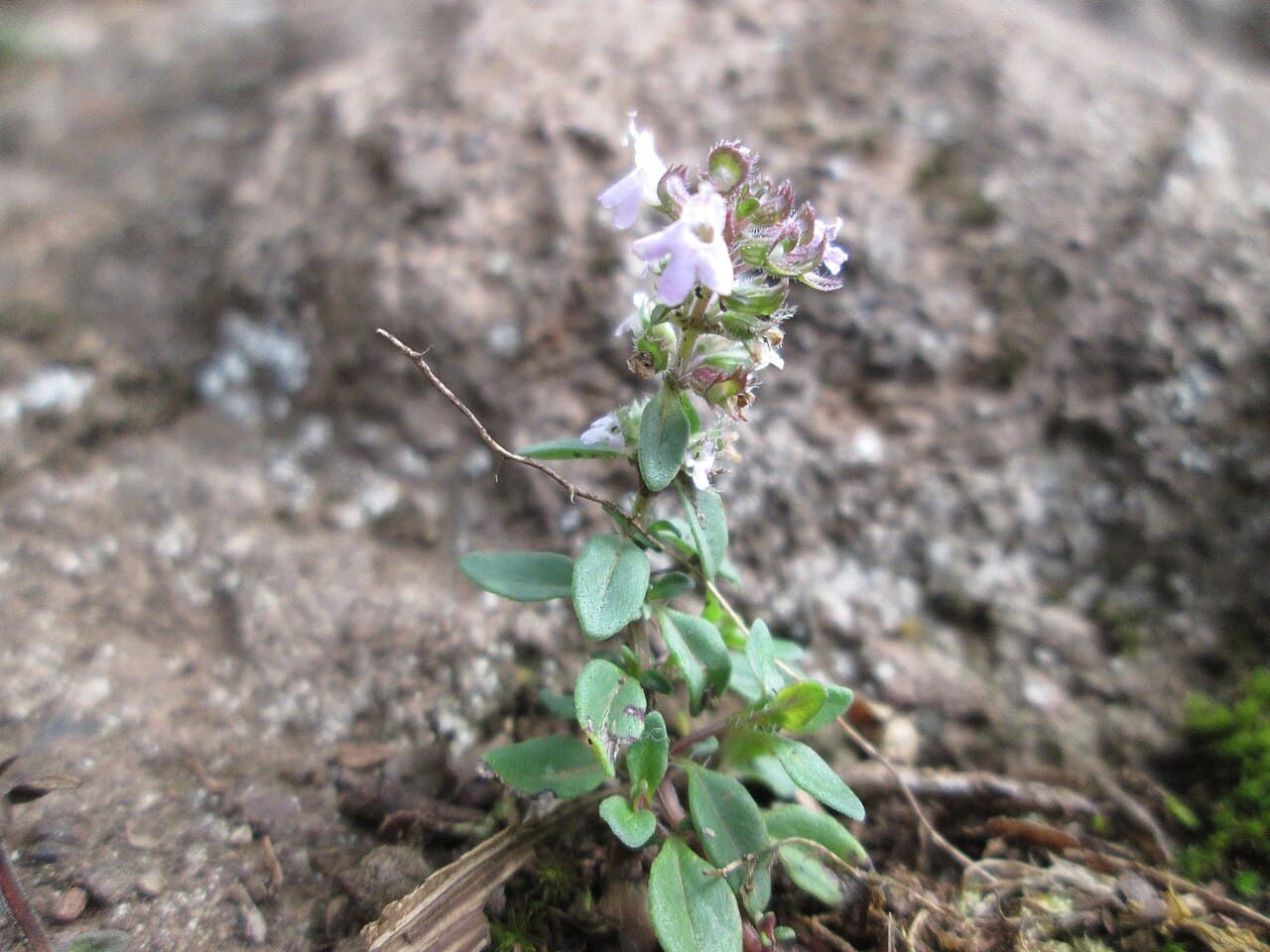
Blóðberg / Icelandic Wild Thyme
Thymus praecox Opiz
Blóðberg does not wait for rich garden soil.
It spreads through:
- dry heath
- gravel
- sand
- rocky slopes
- cracks between stones
A low mat of tiny leaves releases a surprisingly strong aroma when touched.
Then the flowers arrive: small, purple-red and crowded together above the stone.
In Iceland, blóðberg has lived in several worlds at once:
- wildflower
- household tea
- culinary herb
- scent for rooms and clothing
- traditional remedy
- part of the landscape itself
Its traditional reputation overlaps with wild thyme and garden thyme.
Its botanical identity and chemistry do not allow us to treat them as one universal herb.
Blóðberg is an aromatic Icelandic thyme with a rich local tradition, unusual essential-oil chemistry and very limited direct human research.
At a Glance
| Icelandic name | Blóðberg |
|---|---|
| Species | Thymus praecox Opiz |
| Icelandic subspecies usage | T. praecox subsp. arcticus |
| Current Kew treatment | T. praecox subsp. britannicus |
| Family | Lamiaceae |
| Life form | Low perennial subshrub |
| Part traditionally used | Flowering above-ground shoots |
| Taste | Aromatic, mildly bitter and somewhat astringent |
| Common preparations | Food, covered infusion, older water preparations, tincture |
| Direct human evidence | Very limited |
| Main research warning | Evidence from garden thyme is not automatically blóðberg evidence |
| Main safety distinction | Herb and essential oil are not interchangeable |
The Name Problem
Icelandic botanical sources identify blóðberg as:
Thymus praecox subsp. arcticus (Durand) Jalas
Kew currently places that name as a synonym under:
Thymus praecox subsp. britannicus (Ronniger) Holub
For WholeRootLabs, use:
Primary article name: Thymus praecox Opiz
Icelandic botanical usage: Thymus praecox subsp. arcticus (Durand) Jalas
Current Kew treatment: Thymus praecox subsp. britannicus (Ronniger) Holub
This keeps the profile understandable while preserving the name readers will encounter in Icelandic floras and older research.
It Is Not the Same as Every Wild Thyme
The names wild thyme, creeping thyme and mother of thyme may refer to several related taxa.
Commonly confused or compared species include:
- Thymus praecox
- Thymus serpyllum
- Thymus pulegioides
- Thymus vulgaris
- Thymus zygis
ROLV's profile concerns Thymus serpyllum, called kryptimian or smatimian in Norwegian. ROLV also notes that Nordic T. praecox subsp. arcticus has similar traditional properties and has been used in its place in Iceland.
That makes ROLV relevant context.
It does not make the two species chemically or clinically identical.
Identification
Blóðberg is a low, spreading perennial that forms loose mats.
Look for the complete combination of:
- creeping, rooting shoots
- short upright flowering branches
- small opposite leaves
- square or nearly square flowering stems
- hairs arranged mainly along two sides of the stem
- dense flower clusters at the ends of shoots
- purple-red, pinkish or occasionally pale flowers
- strong aromatic scent, especially around flowering
The leaves are usually small, broadly spoon-shaped to inversely egg-shaped, and hairy toward the lower margins. Icelandic sources place flowering mainly in summer.
Habitat
Blóðberg is common throughout Iceland from lowland areas into the highlands.
It typically grows in:
- dry heath
- gravelly ground
- sand
- sunny slopes
- lava fields and rocky ground
- other dry, well-drained places
What Does Not Confirm It
Do not identify blóðberg from:
- purple flowers alone
- aroma alone
- ground-hugging growth alone
- one photograph
- an identification app without botanical confirmation
The Thymus genus contains difficult and variable species groups.
Which Part Is Used?
The traditional herbal material is generally the:
flowering above-ground shoots
This includes:
- leaves
- flowers
- tender upper stems
For a WholeRoot record, state:
Thymus praecox, flowering above-ground parts
Do not reduce that automatically to:
leaf
and do not describe it as:
whole plant
unless roots and all other structures are genuinely included.
Aroma and Taste
Blóðberg is:
- strongly aromatic
- warming in culinary character
- mildly bitter
- sometimes slightly astringent
The scent can resemble thyme, oregano or other mint-family aromatics, but it should not be expected to smell exactly like commercial garden thyme.
This is one reason the plant deserves its own profile.
Icelandic Tradition
Historical Icelandic records describe blóðberg as both tea and household aromatic.
Older sources mention:
- tea or longer water preparations
- use during colds and coughs
- digestive complaints
- fatigue or recovery after alcohol
- scenting homes
- placing the herb in clothing chests
The same records also attach it to a wide range of folk uses that modern evidence does not establish.
This material should be presented as:
documented Icelandic folk tradition
not as a modern treatment guide.
The value of the record is that it shows:
- how the plant was prepared
- where it fitted into household life
- which themes returned repeatedly
- how broadly medicinal plants were once interpreted
It does not verify every historical claim.
Nordic Herbal Tradition
ROLV connects wild-thyme tradition mainly with two practical areas.
Respiratory Tradition
The herb has traditionally been used when colds or coughs involved:
- mucus
- chest congestion
- irritated airways
- difficult expectoration
Digestive Tradition
It has also been used traditionally for:
- sluggish digestion
- intestinal gas
- cramping
- reduced appetite
WholeRootLabs should phrase this carefully:
Blóðberg shares a Nordic tradition with related wild thymes, particularly around respiratory and digestive comfort. Direct clinical confirmation for the Icelandic taxon remains limited.
Preparation Bench
Culinary Use
Blóðberg can be used as an aromatic herb in:
- soups
- stews
- sauces
- vegetable dishes
- meat or fish seasoning
- herb salts
- tea blends
Culinary use is the simplest place to meet the plant.
It allows the user to learn:
- aroma
- bitterness
- intensity
- how heat changes the flavor
without immediately turning the herb into a treatment claim.
Covered Infusion
A covered infusion is a practical preparation for dried flowering above-ground parts.
Record:
- botanical identity
- plant part
- weight
- water volume
- infusion time
- covered or uncovered
- final aroma and taste
Covering helps retain heat and aromatic vapor.
Do not assume that a blóðberg infusion is equivalent to a standardized Thymus vulgaris medicinal tea.
Historical Longer Water Preparations
Older Icelandic sources sometimes describe blóðberg being prepared in water for a longer period.
That historical method should be documented, but prolonged boiling may alter or drive off volatile aromatic constituents.
A longer preparation is therefore not automatically a stronger or better version of the infusion.
Tincture
A tincture can extract a different constituent balance from water alone.
A useful tincture label should state:
- Thymus praecox
- flowering above-ground parts
- fresh or dried
- plant-to-liquid ratio
- ethanol percentage
- extraction method
There is no well-established universal tincture ratio or alcohol percentage specifically validated for Icelandic blóðberg.
Gargle or Rinse
Related thyme traditions include cooled water preparations for the mouth and throat.
Treat this as traditional use rather than established clinical treatment.
Home infusions are not sterile.
They should not replace appropriate evaluation of:
- severe throat swelling
- breathing difficulty
- persistent high fever
- worsening infection
- inability to swallow fluids
Essential Oil Is a Separate Preparation
Blóðberg herb and blóðberg essential oil should never be presented as interchangeable.
The essential oil is:
- highly concentrated
- chemically variable
- obtained through distillation
- far removed from the concentration in an ordinary tea
A safety history for culinary or tea use cannot automatically establish safety for:
- swallowing the oil
- applying it undiluted
- using it around infants
- repeated high-concentration inhalation
EMA's thyme-oil assessment concerns oils from Thymus vulgaris and T. zygis, not Icelandic blóðberg. It nevertheless illustrates why essential-oil products require separate assessment.
What Is in Icelandic Blóðberg?
An analysis of essential oil from T. praecox subsp. arcticus growing in Iceland found linalyl acetate as the dominant component in the studied material.
Smaller components included compounds such as:
- beta-caryophyllene
- germacrene D
- beta-bisabolene
- nerolidol
- other oxygenated sesquiterpenes
This is interesting because many commercial thyme oils are associated more strongly with:
- thymol
- carvacrol
- p-cymene
- gamma-terpinene
The Icelandic sample therefore did not resemble a simple copy of common thymol-rich garden thyme oil.
One Study Does Not Define Every Patch
Research on T. praecox subsp. arcticus from the British Isles found substantial essential-oil polymorphism between plants and populations.
This means the Icelandic linalyl-acetate result should not become:
All Icelandic blóðberg contains exactly the same essential-oil profile.
Composition may vary with:
- genetics
- location
- soil
- climate
- flowering stage
- harvest timing
- drying
- distillation
- storage
The correct conclusion is:
Blóðberg can have a distinctive volatile profile, and chemical variation is part of the species complex.
What the Research Actually Shows
Evidence Snapshot
| Evidence area | Current picture |
|---|---|
| Icelandic traditional use | Well documented |
| Culinary use | Established |
| Chemical analysis | Direct but limited |
| Laboratory research on T. praecox | Some |
| Direct human trials on Icelandic blóðberg | Very limited or absent |
| Human research on other thyme species | Available but not automatically transferable |
| Essential-oil safety specific to blóðberg | Insufficiently characterized |
Respiratory Evidence
EMA recognizes defined preparations of Thymus vulgaris and Thymus zygis herb for traditional use with productive coughs associated with colds.
That monograph does not directly cover Icelandic Thymus praecox.
Clinical studies of thyme products have also commonly involved:
- T. vulgaris
- combinations with ivy
- combinations with primrose
- defined commercial syrups or extracts
Therefore:
Reasonable statement
Related thyme species and defined thyme products have a long respiratory tradition and some human evidence.
Overstated claim
Icelandic blóðberg tea has direct clinical confirmation for bronchitis.
Digestive Evidence
ROLV records a Nordic wild-thyme tradition involving:
- gas
- cramping
- sluggish digestion
- appetite
Modern literature on related thyme species includes laboratory and preclinical work, but it does not establish a specific clinical claim for Icelandic blóðberg tea.
The appropriate WholeRoot position is:
Digestive use belongs clearly to related wild-thyme tradition, but direct clinical evidence for Icelandic blóðberg remains insufficient.
Antimicrobial and Antioxidant Claims
Many Thymus extracts and essential oils inhibit microbes or influence antioxidant assays in laboratory experiments.
These studies may help investigate:
- chemical constituents
- food preservation
- extraction
- possible mechanisms
- future applications
They do not prove that:
- blóðberg tea improves bacterial infection
- the essential oil can replace appropriate antimicrobial care
- drinking the herb produces the concentrations used in laboratory tests
- higher antioxidant assay activity improves human health
Laboratory activity is evidence of laboratory activity.
The route to human usefulness remains another question.
WholeRoot Evidence Verdict
Reasonably Supported
- Blóðberg is a widespread native Icelandic aromatic plant.
- It has a documented Icelandic history as tea, spice and household aromatic.
- Flowering above-ground parts are the relevant traditional material.
- Its essential oil can contain substantial linalyl acetate and diverse terpenes.
- Chemical variation within the taxon is significant.
Plausible but Uncertain
- Use as a comforting aromatic tea during mild colds.
- Traditional digestive use.
- Use as a cooled gargle or rinse.
- Similarity to selected traditional applications of T. serpyllum.
Not Established
- Treatment of bronchitis, asthma or pneumonia.
- Replacement of antibiotics.
- Treatment of influenza.
- Reliable antifungal treatment in humans.
- Universal immune boosting.
- That every blóðberg population has the same chemistry.
- That blóðberg essential oil is interchangeable with standard thyme oil.
- That research on T. vulgaris proves effects of T. praecox.
Safety
Culinary amounts and occasional ordinary tea use have a long history.
Direct modern safety data specific to Icelandic T. praecox remain limited.
Stop or Avoid When
- the species is uncertain
- the plant came from a contaminated site
- an allergic reaction appears
- the preparation causes persistent stomach irritation
- symptoms worsen or become severe
- the product contains undisclosed essential oil
- the label does not identify the species or plant part
Defined medicinal thyme products made from T. vulgaris or T. zygis may cause stomach complaints and should not be used by people allergic to thyme or other members of the Lamiaceae family. This is a reasonable cautionary comparison, but it is not a blóðberg-specific clinical monograph.
Pregnancy, Breastfeeding and Children
There is not enough preparation-specific information to assume that concentrated blóðberg products are appropriate during:
- pregnancy
- breastfeeding
- infancy
- early childhood
Food use is not equivalent to:
- strong tincture
- concentrated extract
- essential oil
- prolonged medicinal use
Keep those categories separate.
Harvesting
For aromatic herb use, harvest selected flowering above-ground shoots from a clean and abundant patch.
Best practice:
- confirm the plant before cutting
- harvest away from traffic and sprayed land
- avoid dog-walking strips
- leave the roots in the ground
- take from several plants rather than stripping one mat
- leave flowers for pollinators
- leave enough growth for recovery
- dry promptly with good airflow
- protect the dried herb from heat, light and moisture
Blóðberg grows slowly in exposed habitats even when it appears locally abundant.
A mat covering a rock is not an invitation to lift the entire mat.
Growing Blóðberg
Blóðberg suits:
- sunny sites
- well-drained mineral soil
- gravel gardens
- rock gardens
- dry slopes
- containers with excellent drainage
Growing it at home offers:
- known site history
- easier identification
- cleaner harvesting
- reduced pressure on wild patches
- repeated sensory study
Avoid rich, wet soil that forces the plant into conditions unlike its natural habitat.
A Single-Plant Study
Question
How does infusion time change the aroma and taste of blóðberg?
Material
- confirmed Thymus praecox
- dried flowering above-ground parts
- one batch
- clean water
Keep Constant
- plant weight
- water volume
- vessel
- water temperature
- covered preparation
Change One Variable
Compare:
- a shorter infusion
- a longer infusion
Record
- aroma
- bitterness
- astringency
- color
- mouthfeel
- remaining aroma in the plant material
Do Not Conclude
This study cannot establish:
- antimicrobial effectiveness
- treatment of cough
- ideal medicinal dose
- essential-oil composition
- superiority of one preparation
It teaches how your material behaves in water.
Plant Lab Label
Identity
Thymus praecox Opiz.
Icelandic usage:
T. praecox subsp. arcticus.
Material
Flowering above-ground parts.
Preparation
Food, covered infusion, historical longer water preparation, tincture or separately assessed essential oil.
Tradition
Strong Icelandic and Nordic tradition involving tea, respiratory comfort, digestion and household aroma.
Evidence
Direct chemical evidence; limited direct human evidence.
Safety
Ordinary herb use and concentrated essential oil must remain separate.
Sustainability
Widespread but slow-growing; harvest above-ground shoots selectively and leave mats rooted.
Final Field Note
Blóðberg is easy to recognize as part of Iceland.
That does not make it chemically simple.
One patch may smell soft and floral.
Another may lean sharper and more thyme-like.
One old book may call it a remedy for nearly everything.
One modern paper may analyze only its distilled oil.
One regulatory monograph may discuss a related species entirely.
The job of the Materia Medica is to keep those layers from collapsing into each other.
Blóðberg is:
- a native plant
- a food and spice
- a traditional household herb
- an aromatic water preparation
- a chemically variable member of the thyme genus
- a plant with more tradition than direct clinical evidence
That is already enough.
It does not need borrowed proof from garden thyme.
It does not need every laboratory result turned into a health promise.
Meet it where it grows.
Learn its scent.
Name the material.
Prepare it clearly.
And let Icelandic blóðberg be its own plant.
Continue the Plant Lab Thread
- Open the Materia Medica Library
- Use the Single-Plant Method
- Learn Botanical Names
- Explore Plant Parts
- Explore Tea, Infusion and Decoction
- Read Tinctures Without the Mystery
- Read Self-Heal / Heal-All
- Read Stinging Nettle
- Return to Plant Lab
Sources and Further Reading
- Flora Islands / Lystigarður Akureyrar: Thymus praecox
- ROLV / Urtekilden: Kryptimian — Thymus serpyllum
- Royal Botanic Gardens, Kew: Plants of the World Online — Thymus praecox
- Royal Botanic Gardens, Kew: Plants of the World Online — Thymus praecox subsp. britannicus
- NordGen Cultivation Manual: Thymus praecox subsp. arcticus
- The essential oil from Thymus praecox ssp. arcticus growing in Iceland
- Essential oil polymorphism of Thymus praecox subsp. arcticus on the British Isles
- European Medicines Agency: Thymi herba
- European Medicines Agency: Thymi aetheroleum