Chamomile arrives with a reputation before it reaches the cup.
It is pictured beside pillows, folded blankets and promises of instant calm. Its small white flowers look familiar enough to feel self-explanatory. Yet the word chamomile can refer to different species, and a household infusion is not the same preparation as a standardized extract, a skin cream or a distilled essential oil.
The familiar flower deserves the same precision as a stronger-looking plant.
Gentle does not mean inactive.
German chamomile can be a warm drink, a traditional digestive herb, a localized skin or mouth preparation and the source material for concentrated products. Each form creates a different exposure. Each claim needs to stay with the preparation that actually supports it.
Botanical Identity and the Name Problem
Accepted name: Matricaria chamomilla L.
Common scientific synonyms: Matricaria recutita L.; Chamomilla recutita (L.) Rauschert
Family: Asteraceae
English names: German chamomile, chamomile
Icelandic name: kryddbaldursbrá
The Royal Botanic Gardens, Kew accepts Matricaria chamomilla L. as the botanical name. European herbal documents and many clinical papers use Matricaria recutita, while some Nordic sources use Chamomilla recutita. These are names attached to the same species rather than three interchangeable kinds of chamomile. (Kew Plants of the World Online, ROLV / Urtekilden)
The author abbreviation L. refers to Carl Linnaeus, who published the name. It is part of botanical authorship, not part of the italicized two-word species name.
German chamomile is not Roman chamomile, Chamaemelum nobile. Both belong to the daisy family and both appear in teas and aromatic products, but they are different species with different monographs, chemistry and research. A label saying only “chamomile” leaves an important question unanswered.
Identification and Lookalikes
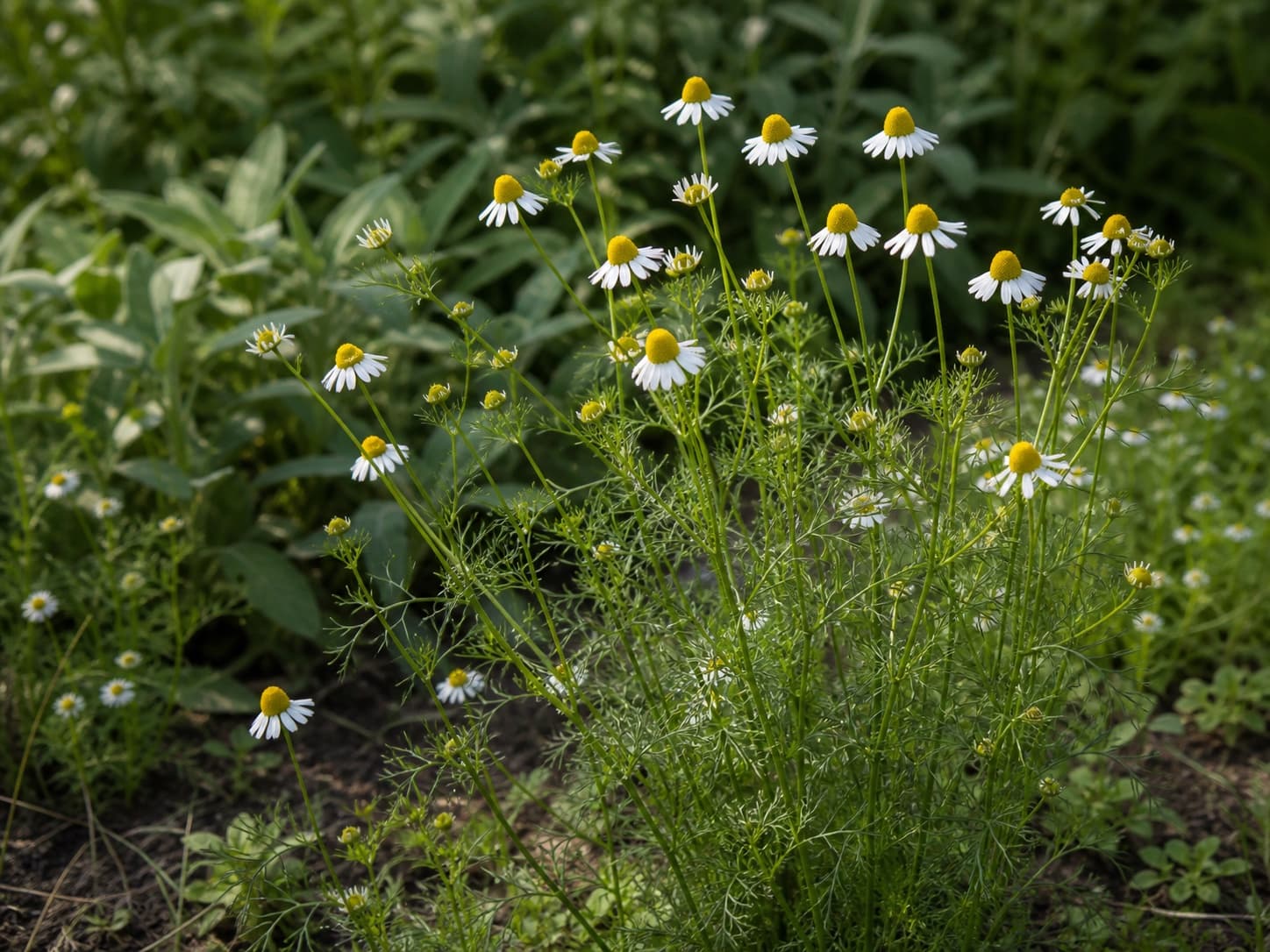
German chamomile is an aromatic annual with upright, branching stems. Its leaves are finely divided into narrow, almost threadlike segments. The flower heads carry white ray florets around a raised yellow centre. As the head matures, the white rays may angle downward.
One useful identifying feature is hidden inside the yellow centre: the receptacle becomes conical and hollow. Scentless mayweed, Tripleurospermum inodorum, can look similar at a glance but lacks the same strong apple-like aroma and has a solid receptacle. Pineappleweed, Matricaria discoidea, is aromatic and closely related, but its heads lack the showy white rays.
Look for the pattern together:
- finely divided leaves
- branching annual growth
- aromatic flower heads
- white rays around a yellow centre
- a raised, hollow receptacle in a mature head
No single photograph is a complete identification method. Hybrid ornamental daisies, regional mayweeds and plants outside Iceland can widen the field of lookalikes. Confirm a wild plant with a regional flora and several diagnostic features before gathering it for food or medicine.
What Part Is Used — and Why Preparation Changes It
The recognized medicinal material is the flower head, usually collected as it opens and dried promptly. The material includes the yellow disc florets, white ray florets and receptacle. Leaves and stems may occur in commercial material, but they are not the primary medicinal flower drug assessed in the European monograph.
Preparation determines which constituents are present, in what concentration and through which route they meet the body.
| Preparation | Material | Evidence context | Important boundary |
|---|---|---|---|
| Infusion | Dried German chamomile flower heads | Household tea and several EMA traditional-use preparations | A cup of tea is not equivalent to a standardized oral extract. |
| Standardized oral extract | A defined flower extract with a stated manufacturing method | The preparation used in the better-known anxiety trials | Results belong to the studied extract and dose, not every tea or capsule. |
| Mouth rinse or gargle | A defined flower infusion or liquid preparation | Traditional mouth and throat use; small clinical studies in oral mucositis | Do not swallow concentrated rinses or delay assessment of persistent lesions. |
| Cream, compress or bath preparation | Flower infusion, tincture or defined extract in a topical base | Traditional use for minor skin irritation and small superficial wounds | Home preparations are not sterile and do not belong in deep or infected wounds. |
| Steam inhalation | Hot water with chamomile flower material | Traditional relief of common-cold symptoms | Steam can burn. This is comfort care, not treatment of infection or breathing difficulty. |
| Essential oil | Distilled volatile fraction | A concentrated and chemically distinct aromatic material | It is not chamomile tea. Ingestion and undiluted use should not be inferred from flower tradition. |
Water draws some polar constituents into an infusion. A hydroalcoholic extract can produce a different chemical profile. A cream changes concentration and route. Distillation captures volatile compounds and also changes some of them through heat.
This is why a sleep study using a capsule cannot be cited as proof for a cup of tea, and why the traditional use of a flower infusion cannot establish that swallowing essential oil is appropriate.
For a wider foundation, see Tea, Infusion and Decoction and Tinctures Without the Mystery.
Inside the Flower: Chemistry Without the Magic-Molecule Story
Chamomile flower contains many compounds rather than one active ingredient.
Its non-volatile fraction includes flavonoids and related compounds. Apigenin and apigenin glycosides are often emphasized in laboratory discussions. Its volatile fraction can include alpha-bisabolol, bisabolol oxides and related terpenes. Matricin in the plant material can be transformed during steam distillation into chamazulene, the blue compound associated with some German chamomile essential oils.
That last detail matters. A bright blue oil does not mean the fresh flower contained a pool of ready-made chamazulene. Processing helped create the measured product.
Laboratory and animal research explores anti-inflammatory, antispasmodic, antimicrobial and nervous-system mechanisms. Such findings can help explain why a traditional use is plausible or identify questions worth testing. They do not establish that drinking chamomile tea produces a treatment-level concentration in a human tissue.
The chemistry also varies with:
- cultivar and growing conditions
- harvest timing
- proportion of true flower heads to other plant matter
- drying temperature and storage
- extraction solvent and ratio
- age and oxidation of the finished product
“Contains apigenin” is therefore a description, not a clinical conclusion.
Traditional Medicine: Digestion, Skin and Calm
Chamomile has a long place in European household and professional herbal traditions. ROLV/Urtekilden documents uses around digestive discomfort, cramping, skin and mucosal irritation, colds, restlessness and sleep, along with baths, compresses, rinses and inhalation. (ROLV / Urtekilden)
Tradition carries several kinds of information at once. It records preparation methods, sensory qualities, household access and repeated observations. It can also preserve broad theories and claims that modern studies have never tested.
The responsible question is not whether tradition is “true” or “false.” It is more specific:
- Which preparation was used?
- For which kind of symptom?
- Was the purpose comfort, self-care or treatment?
- What evidence now exists beyond long-standing use?
- Where does delay create risk?
Chamomile does not lose its history when those questions are asked. Its history becomes easier to use honestly.
What the EMA Monograph Actually Supports
The European Medicines Agency classifies the flower preparations in its monograph as traditional herbal medicinal products for several areas of use. Traditional-use registration means the use is considered plausible from long-standing experience and can be used safely under specified conditions. It does not mean robust clinical efficacy has been demonstrated. (EMA: Matricariae flos, EU herbal monograph)
The monograph covers defined preparations for:
- symptomatic treatment of minor gastrointestinal complaints such as bloating and minor spasms
- relief of common-cold symptoms
- minor ulcers and inflammation of the mouth and throat
- minor inflammation of the skin, including sunburn, superficial wounds and small boils
- irritation of skin and mucosa in the anal and genital region, after serious conditions have been excluded
These are bounded indications. “Minor” matters. “Symptomatic relief” matters. So do route, age limits, duration and the instruction to seek care when symptoms worsen or persist.
The monograph does not certify chamomile as a cure for infection, irritable bowel syndrome, anxiety disorders, insomnia, eczema, cancer or hormonal imbalance.
Digestion: Strong Tradition, Thinner Trial Base
Digestive comfort is among chamomile’s most established traditional roles. Warm flower infusions have been used for fullness, gas and minor cramping. The EMA recognition reflects that long use.
The modern clinical evidence is less substantial than the tradition might suggest. Some studies involve combinations containing chamomile alongside other herbs. A positive result from a multi-herb colic or diarrhoea product cannot reveal how much, if any, came from chamomile alone. NCCIH therefore describes the evidence across specific conditions as insufficient for a reliable rating of clinical usefulness. (NCCIH: Chamomile)
This leaves a proportionate position:
Chamomile flower tea can belong to low-risk self-care for occasional mild digestive discomfort in an appropriate adult. It should not be presented as a proven treatment for persistent pain, repeated vomiting, gastrointestinal bleeding, significant weight loss, dehydration, severe diarrhoea or symptoms in a young infant.
Comfort and diagnosis are different jobs.
Calm and Anxiety: The Extract Is Not the Teacup
Chamomile’s calm reputation has some human research behind it, but the preparation must stay visible.
A 2009 randomized trial enrolled 61 adults with mild-to-moderate generalized anxiety disorder and compared a standardized oral Matricaria recutita extract with placebo for eight weeks. The study reported a modest but statistically significant difference on its main anxiety measure. It was small and studied capsules, not tea. (Amsterdam et al., 2009)
A later two-phase study first gave 179 adults with moderate-to-severe generalized anxiety disorder a pharmaceutical-grade extract. Ninety-three responders entered a 26-week randomized continuation phase. Relapse occurred in 15.2 percent of those continuing chamomile and 25.5 percent of those switched to placebo, but the primary relapse comparison was not statistically significant. Symptom scores remained lower in the chamomile group. (Mao et al., 2016)
That pattern is promising without being conclusive. The studies were conducted by one research programme, used a specific high-dose standardized extract and involved diagnosed anxiety. Larger independent trials are needed.
It would be inaccurate to translate the findings into “chamomile tea treats anxiety.” A warm infusion may still provide a pause, familiar scent and a repeatable transition out of the day. Those are meaningful experiences. They are not the same claim as clinical treatment of generalized anxiety disorder.
Sleep: Comfort, Signal and Uncertainty
Chamomile is one of the most familiar evening herbs, but familiarity has outrun the sleep evidence.
A small randomized pilot in adults with chronic primary insomnia found no significant benefit from a standardized extract on the main measures of total sleep time, sleep efficiency, sleep latency or night waking. Some daytime measures moved, but the trial was not evidence of a reliable insomnia treatment. (Zick et al., 2011)
Later reviews have combined small studies involving different populations, products and outcomes. Some report improvement in self-rated sleep quality or night waking, while results for duration, efficiency and daytime functioning remain inconsistent. Heterogeneity and small samples limit confidence. (Hieu et al., 2019, 2024 systematic review and meta-analysis)
The cup can still serve an evening ritual.
Preparing it marks a boundary. Warmth, scent and repetition may help the day feel finished. But people with persistent insomnia, sleep apnoea symptoms, severe daytime sleepiness or major changes in sleep need more than a calming label.
Explore that distinction in Herbs and Sleep: A Gentle Introduction, the Gentle Herbal Sleep Tea Guide and The Evening Ritual.
Mouth, Throat, Skin and Wound-Related Uses
The EMA monograph includes traditional local uses for minor inflammation of the mouth and throat and minor skin inflammation. Preparations include rinses, gargles, creams, compresses, washes, baths and steam applications depending on the indication.
Oral mucositis during cancer treatment has also been studied. A 2022 systematic review identified six randomized trials involving 492 participants; four reported a benefit, but products, concentrations and clinical settings varied. A separate small trial of a three-percent oral gel did not find a significant difference in pain between groups, although severe mucositis appeared less frequent. (Systematic review, randomized trial)
This is a potential adjunct, not a home instruction for oncology care. Cancer treatments can change immunity, bleeding risk and oral tissue. The oncology team should approve the exact product.
For skin and wounds, boundaries are equally important:
- home infusions and infused oils are not sterile
- deep, puncture, heavily contaminated or infected wounds need appropriate care
- spreading redness, fever, severe pain, pus or impaired healing need assessment
- products used near the eyes can irritate them
- an allergic rash can be mistaken for the condition being treated
Chamomile may belong around a minor irritation. It should not make a serious problem look small.
Chamomile as Ritual
Not every useful part of chamomile has to be a pharmacological claim.
A ritual can coordinate several ordinary signals:
- water is heated
- a screen is set aside
- scent enters the room
- hands hold warmth
- attention narrows to one task
- the transition is repeated often enough to become familiar
These signals can support rest even when the herb does not function as a sleeping drug. The distinction protects both the ritual and the evidence.
A simple evening practice can begin with one correctly identified flower tea, a quiet place and enough time to notice whether the routine actually suits you. Avoid turning it into a stack of sedating products. More ingredients make both benefit and adverse reactions harder to interpret.
The free practice comes first: reduce stimulation, create a repeatable boundary and let the cup be one part of the transition rather than the whole solution.
Growing, Harvesting, Drying and Storage
German chamomile is an annual that prefers open light and reasonably well-drained ground. It can self-seed when some flower heads are left to mature. Rich soil is not required, and excessive feeding can produce weak, leafy growth.
For a small home crop:
- sow shallowly because the small seeds need light to germinate
- keep the seedbed gently moist rather than waterlogged
- thin crowded seedlings so air can move through the plants
- harvest only after identity is secure
- leave some flowers for pollinators and seed
ROLV recommends gathering newly opened flower heads in dry weather and drying them promptly at a low temperature, no higher than about 35°C. Thin layers, shade and moving air help protect aroma and reduce mould risk. (ROLV / Urtekilden)
Store fully dried heads away from moisture, heat and direct light. Discard material that smells musty, feels damp or shows mould. A faded batch is not restored by using more of it.
Wild or naturalized stands should not be treated as limitless. Gather selectively, avoid contaminated roadsides and sprayed ground, and know the local rules before collecting.
Safety: Gentle, Not Risk-Free
Chamomile tea in ordinary food amounts is generally considered low risk for many adults. Medicinal use, concentrated products and vulnerable groups need a more careful frame. (NCCIH: Chamomile)
Allergy
German chamomile belongs to the Asteraceae family. People allergic to ragweed, mugwort, chrysanthemums, daisies or related plants may be more likely to react. Reactions can range from contact dermatitis and oral itching to rare anaphylaxis.
Severe reactions have been reported after internal or mucosal exposure. A classic case described an eight-year-old boy with pollen sensitization who developed anaphylaxis after chamomile tea. One case does not establish a common outcome, but it proves that “gentle” cannot mean allergy-free. (Subiza et al., 1989)
Stop and seek urgent help for breathing difficulty, throat tightness, faintness or rapidly spreading swelling.
Adverse effects and reporting gaps
Possible adverse effects include nausea, dizziness, gastrointestinal discomfort, drowsiness and skin reactions. A 2025 systematic review found that adverse-event reporting was missing or incomplete in many chamomile trials. Among 2,896 trial participants receiving chamomile, reported events were usually mild and self-limited, while published case reports contained several allergic reactions, including anaphylaxis. Absence of reported allergy in a trial is not proof that it cannot occur. (Systematic review)
Pregnancy, breastfeeding and infants
Reliable safety data in pregnancy and breastfeeding are limited. LactMed notes that direct information on chamomile components in human milk and effects in breastfed infants is lacking. That uncertainty is more important for medicinal doses, extracts and essential oil than for an occasional food-like exposure, but it is not a basis for declaring every form safe. (LactMed: Chamomile)
Infants should not receive chamomile products simply because a combination colic product was studied. Product identity, allergy, contamination, dosing and the reason for crying all matter.
Medicines and interactions
A frequently repeated warning involves warfarin. It is based partly on a case report of a 70-year-old woman who developed serious bleeding while using warfarin and chamomile tea and lotion. The case cannot prove causation and included other clinical complexity. (Segal and Pilote, 2006)
A tiny controlled study in eight healthy adults found no meaningful acute change in prothrombin time after one chamomile tea or extract exposure. It did not study warfarin users, repeated dosing or people at high bleeding risk. (Controlled pilot study)
The honest conclusion is neither “dangerous with every medicine” nor “no interaction.” People using anticoagulants, sedatives or medicines with narrow safety margins should have the exact chamomile product reviewed. Do not stop or adjust prescribed medicine because of an herbal article.
Essential oil deserves a separate caution. It is concentrated, chemically distinct and not a substitute for flower tea. Do not ingest it or apply it undiluted based on the safety reputation of an infusion.
Evidence Snapshot
The table below keeps use, preparation and certainty together.
| Question | Preparation studied or used | Type of support | Proportionate conclusion |
|---|---|---|---|
| Mild digestive complaints | Defined flower teas and preparations | EMA traditional use and long-standing practice | A proportionate traditional use; modern condition-specific trials remain limited. |
| Generalized anxiety disorder | A specific pharmaceutical-grade oral extract | Small randomized trials and open-label follow-up | Promising extract-specific evidence, but not proof that ordinary tea treats an anxiety disorder. |
| Insomnia or sleep quality | Varied teas, extracts and populations | Small heterogeneous trials and mixed reviews | The evening ritual may be useful; a reliable treatment effect for insomnia is not established. |
| Mouth and throat irritation | Defined rinses and gargles | EMA traditional use; small localized studies | Reasonable for minor symptoms with clear limits and appropriate assessment when symptoms persist. |
| Oral mucositis during cancer care | Topical gels or mouth rinses | Several small randomized trials with varied products | Potential adjunctive benefit, but oncology teams should approve the exact product and timing. |
| Minor skin irritation or superficial wounds | Defined topical flower preparations | EMA traditional use and limited clinical research | Not a substitute for sterile wound care or assessment of infection, burns or deep injury. |
| Infant colic or childhood diarrhoea | Multi-herb products in much of the research | Combination-product studies | The effect of chamomile alone cannot be isolated; infant use needs professional guidance. |
| Broad claims such as detox, immunity or hormone balance | Usually unspecified | Marketing, tradition or preclinical findings | Not established clinical uses of chamomile. |
Plant Lab Label
Identity
Matricaria chamomilla L., with Matricaria recutita and Chamomilla recutita as common scientific synonyms. Family Asteraceae.
Material
Fresh or dried flower heads. State when a product is an extract, topical preparation or essential oil.
Preparation
Infusion, defined oral extract, rinse, gargle, cream, compress, bath, inhalation or distilled oil. These forms are not interchangeable.
Tradition
Strong European and Nordic tradition around mild digestive discomfort, skin and mucosal care, colds, calm and evening use.
Evidence
EMA traditional-use recognition for defined minor complaints; promising but preparation-specific anxiety evidence; mixed and limited sleep evidence; small localized trials for oral and skin uses.
Safety
Generally low risk in ordinary tea amounts for many adults, but Asteraceae allergy can be serious. Pregnancy, breastfeeding, infants, concentrated products and possible medicine interactions need extra care.
Sustainability
An annual that can be cultivated from seed. Harvest flower heads selectively, leave some for insects and seed, and dry promptly.
Final Field Note
Chamomile does not need to be made stronger than it is.
Its quiet strength lies in specificity.
The correctly identified flower can become a household infusion.
A defined extract can enter a clinical trial.
A rinse can meet the mouth without becoming a sleeping remedy.
A distilled oil can carry volatile chemistry without borrowing the safety of tea.
Gentle does not mean inactive.
It means the plant can be approached without drama and still deserve attention to species, preparation, evidence and risk.
Name the flower.
Name the form.
Keep the claim the same size as the evidence.
Then let the ritual remain simple.
Continue the Plant Lab Thread
- Open the Materia Medica Library
- Use the Single-Plant Method
- Learn Botanical Names
- Explore Plant Parts
- Explore Tea, Infusion and Decoction
- Read Herbs and Sleep
- Read Stinging Nettle
- Read Morgunfrú / Calendula
- Return to Plant Lab
Sources and Further Reading
- Royal Botanic Gardens, Kew: Matricaria chamomilla L.
- ROLV / Urtekilden: Chamomilla recutita
- EMA: Matricariae flos landing page and current documents
- EMA/HMPC: European Union herbal monograph on Matricaria recutita flower
- EMA/HMPC: Assessment report on Matricaria recutita flower and essential oil
- NCCIH: Chamomile — Usefulness and Safety
- Amsterdam et al.: randomized trial of chamomile extract for generalized anxiety disorder
- Mao et al.: long-term chamomile extract in generalized anxiety disorder
- Zick et al.: chamomile extract for chronic primary insomnia
- Hieu et al.: systematic review of chamomile for sleep quality and anxiety
- 2024 systematic review and meta-analysis of chamomile and sleep
- Systematic review of chamomile for oral mucositis
- Randomized trial of chamomile oral gel in chemotherapy-related mucositis
- Systematic review of adverse events associated with chamomile
- Subiza et al.: anaphylaxis after chamomile tea
- Segal and Pilote: warfarin interaction case report
- Controlled pilot study of chamomile tea, extract and coagulation measures
- LactMed: Chamomile