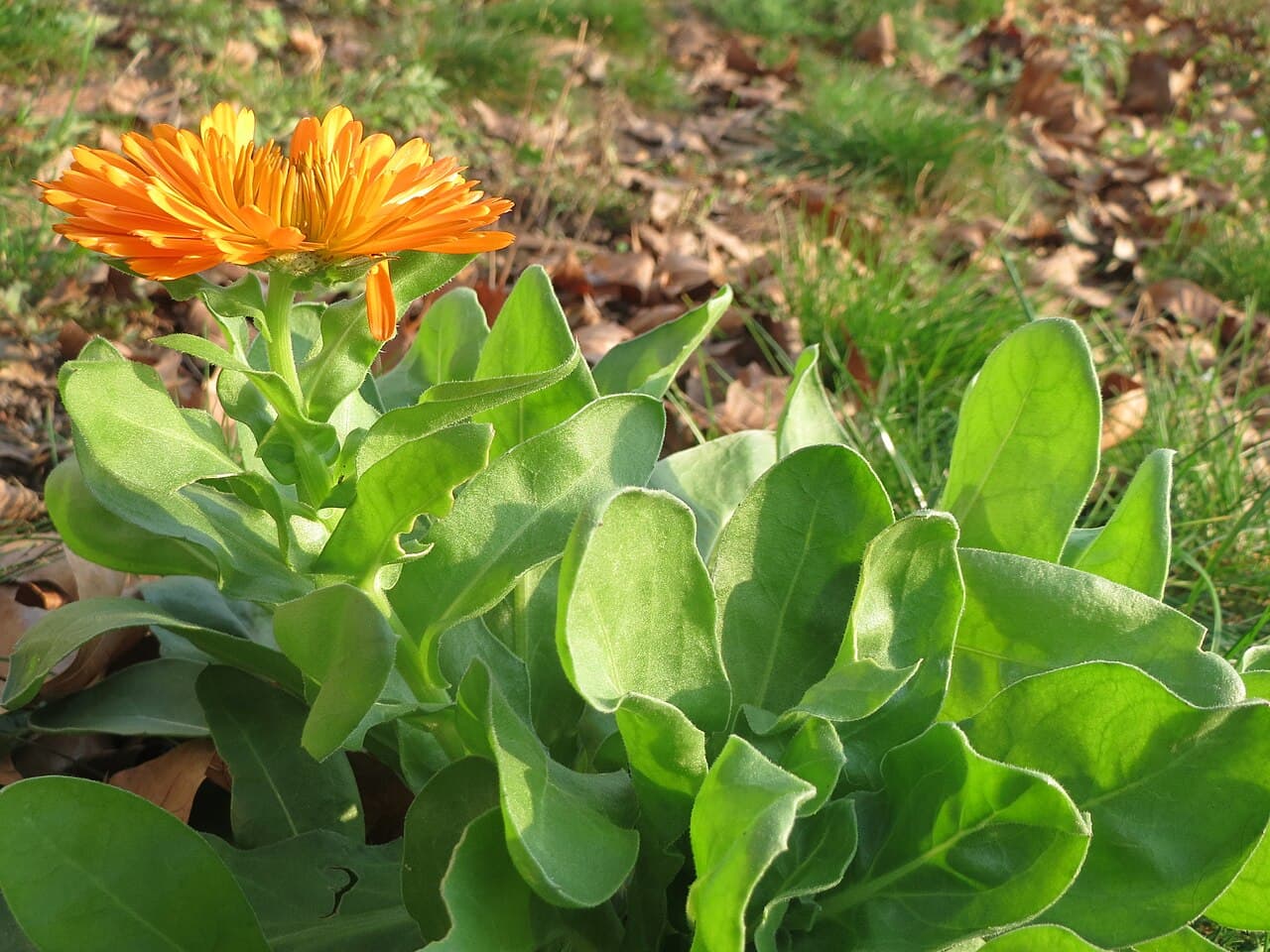
Morgunfrú / Calendula
Calendula officinalis
Morgunfrú rarely looks medicinal in the serious, bark-and-roots sense of the word.
It looks cheerful.
Orange or golden flower heads open above soft green leaves and continue appearing whenever the older flowers are picked.
That brightness has helped turn calendula into:
- garden flower
- edible decoration
- fabric and food colour
- cosmetic ingredient
- infused oil
- salve
- traditional wound herb
It has also encouraged marketing claims far larger than the evidence.
A grounded summary is simpler:
Calendula is a well-established traditional flower preparation for minor skin inflammation, superficial wounds and irritated mouth or throat tissues. Human research is promising in some wound settings, but results vary by product and condition.
At a Glance
| Botanical name | Calendula officinalis L. |
|---|---|
| Family | Asteraceae |
| Icelandic name | Morgunfrú |
| English names | Calendula, pot marigold |
| Life cycle | Annual or short-lived perennial |
| Medicinal material | Flower material: Calendulae flos |
| Taste | Mildly bitter, slightly sharp or resinous |
| Main traditional preparations | Infusion, rinse, wash, tincture, oil extract, cream and salve |
| Strongest traditional theme | Minor skin inflammation and superficial wounds |
| Human evidence | Limited and mixed, with encouraging findings in some defined products |
| Main caution | Asteraceae allergy or contact sensitivity |
| Important distinction | Infusion, tincture, oil and salve are different preparations |
Botanical Identity
Accepted name: Calendula officinalis L.
Family: Asteraceae — the daisy family
Botanical author: L., the standard abbreviation for Linnaeus. This is part of formal botanical naming, not a second plant name.
Kew currently accepts Calendula officinalis as a species native to the western Mediterranean region and now introduced widely through cultivation. It is usually grown as an annual, although it may behave as a short-lived perennial in suitable climates.
ROLV records the Icelandic name Morgunfrú and places the species in Asteraceae.
Not Every “Marigold” Is Calendula
The English word marigold can create confusion.
Pot marigold is:
Calendula officinalis
Other garden plants commonly called marigolds may belong to:
Tagetes
These are different genera.
A packet saying only:
Marigold
is not enough for medicinal identification.
Look for:
Calendula officinalis L.
The botanical name matters more than the orange colour.
Identification
Morgunfrú is a branching herb that commonly reaches around 30–60 centimetres.
Look for:
- upright, branching stems
- alternate leaves
- soft, slightly fleshy or sticky leaves
- oblong to spoon-shaped leaf form
- yellow to deep orange flower heads
- central disc florets surrounded by ray florets
- curved, irregular and often boat-shaped fruits
- a distinctive resinous or slightly unusual scent
Cultivars vary greatly.
Some have:
- single flower heads
- densely double heads
- pale yellow flowers
- deep orange flowers
- unusually large heads
ROLV notes that flower colour and form vary substantially among cultivated varieties.
What Does Not Confirm It
Do not identify medicinal calendula from:
- orange petals alone
- the word marigold
- one close-up photograph
- a garden-centre colour label
- a dried petal blend with no species name
Confirm the species and source before preparing it.
Which Part Is Used?
The medicinal material is generally called:
Calendulae flos
This refers to defined flower material from Calendula officinalis.
European pharmacopoeial descriptions include dried, fully opened flower material separated from the receptacle, including preparations consisting primarily of the ray florets. Exact commercial specifications can therefore differ.
ROLV distinguishes between:
- flower heads
- flowers with the involucral structure
- flowers without it
- isolated outer ray florets
and recommends drying the flower material gently, at temperatures no higher than approximately 35°C.
Whole Head or Petals?
This matters.
A whole flower head may include:
- ray florets
- central disc florets
- green involucral bracts
- receptacle
A bag of decorative “petals” may contain mainly:
- ray florets
These materials overlap.
They are not structurally identical.
The greener and more resinous portions of the flower head may contribute a different constituent balance from isolated decorative petals.
A useful label should state:
- whole flower heads
- flower material
- ray florets
- fresh or dried
- preparation type
“Calendula” alone remains incomplete.
Taste and Character
Morgunfrú flower material is commonly described as:
- mildly bitter
- slightly sharp
- faintly aromatic
- resinous
- somewhat drying
ROLV describes the traditional energetic character as bitter, sharp, slightly cooling and dry.
The taste is not usually dramatic.
It can disappear easily in a large blend.
That makes calendula visually prominent while remaining preparation-wise almost anonymous.
Study it alone at least once.
Traditional Use
ROLV preserves a broad traditional-use history for calendula, including internal, external, cosmetic and household applications. WholeRootLabs should not convert that entire list into modern claims.
The strongest recurring traditions are narrower.
Skin and Minor Wounds
Calendula flower preparations have traditionally been used for:
- minor skin inflammation
- superficial cuts and scrapes
- irritated or chapped skin
- mild sunburn
- small burns after initial cooling
- minor local swelling
- dry or cracked skin
EMA concludes that calendula flower preparations may be used traditionally for minor skin inflammation and as an aid in the healing of minor wounds. The conclusion is based on long-standing use rather than established clinical efficacy.
Mouth and Throat
Cooled liquid preparations have traditionally been used for minor inflammation of:
- the mouth
- gums
- throat
EMA also recognises this as a traditional-use category for defined calendula flower preparations.
Food and Colour
The ray florets have been used to add:
- colour to salads
- colour to rice or soups
- decoration to bread and cakes
- visual warmth to tea blends
Food use provides a gentle way to meet the plant.
It does not establish the safety or effectiveness of concentrated extracts.
Preparation Bench
Covered Infusion
A water infusion may be used traditionally as:
- tea
- cooled mouth rinse
- gargle
- skin wash
- compress liquid
Record:
- flower material
- weight
- water volume
- steeping time
- covered or uncovered
- intended route
A home infusion is not sterile.
Prepare small amounts and use them promptly.
Tincture
Calendula tinctures may be prepared from fresh or dried flower material.
A useful label should state:
- botanical name
- exact flower material
- fresh or dried
- plant-to-liquid ratio
- ethanol percentage
- extraction method
Tincture should not be treated as concentrated tea.
The solvent and constituent profile differ.
Infused Oil
Calendula oil is generally a fixed carrier oil containing extracted flower constituents.
It is not calendula essential oil.
A controlled oil preparation should record:
- dry or fresh flower material
- plant-to-oil ratio
- carrier oil
- extraction method
- temperature
- duration
- filtration
- final volume
- date and batch
The EMA monograph includes defined oil extracts and ointments among traditional calendula preparations, showing that oil-based products are established forms—but not that every homemade jar is equivalent to a defined medicinal product.
Salve
A salve usually combines:
- calendula-infused oil
- wax or another thickener
- optional additional ingredients
The salve is a new preparation.
Its quality depends on both:
- the original oil extract
- the final formula
A large percentage of wax can create a firm salve while diluting the amount of infused oil applied.
Texture is not potency.
Cream
A cream contains both water and oil phases.
That makes it more vulnerable to microbial growth than a simple anhydrous salve.
A safe cream requires:
- clean manufacturing
- a suitable emulsifier
- effective preservation
- appropriate packaging
- realistic shelf life
Do not convert a kitchen oil into a water-containing cream and assume vitamin E will preserve it.
Vitamin E is primarily an antioxidant.
It is not a broad-spectrum antimicrobial preservative.
Why Dried Flowers Are Usually Easier in Oil
Fresh flowers contain water.
Introducing water into oil can increase the risk of:
- microbial growth
- cloudiness
- separation
- fermentation
- shortened shelf life
This does not mean every traditional fresh-flower oil is impossible.
It means moisture must be controlled deliberately.
For an accessible home method, fully dried material is generally easier to manage and reproduce.
Use flower material that is:
- genuinely dry
- free from mould
- clean
- correctly identified
- stored away from moisture before use
Do not trust the outside of a flower head alone.
The centre can remain damp after the outer ray florets feel dry.
What Calendula Can—and Cannot—Do for a Wound
Reasonable Scope
A defined calendula preparation may have a role in supporting care of:
- minor superficial wounds
- uncomplicated scrapes
- mild skin irritation
- dry or chapped intact skin
Not a Kitchen-Salve Project
Do not rely on homemade calendula products for:
- deep wounds
- puncture wounds
- animal or human bites
- heavily contaminated wounds
- severe burns
- wounds with retained material
- rapidly spreading redness
- increasing heat or swelling
- pus or foul odour
- loss of sensation
- exposed deeper structures
- wounds that repeatedly reopen
- non-healing ulcers
Oil and salve can also trap:
- dirt
- heat
- moisture
- microbes
inside an inadequately cleaned wound.
The first requirement is not calendula.
It is understanding the wound.
Burns: Cool First
Do not place oil or salve immediately on a fresh thermal burn.
Oil-based products can retain heat against the skin.
The immediate priority is appropriate cooling and assessment of severity.
ROLV similarly cautions against placing calendula oil directly onto a fresh burn and instead describes a cooled water preparation as the more suitable traditional first step.
A severe, extensive, deep or sensitive-location burn requires more than an herbal preparation.
Main Constituents
Calendula flower material contains several broad constituent groups, including:
- triterpene alcohols and their esters
- triterpenoid saponins
- flavonoids
- carotenoids
- polysaccharides
- polyacetylenes
- small amounts of volatile oil
Orange flower colour is associated with carotenoid pigments, while yellow cultivars may contain a different pigment balance. ROLV gives triterpenes, flavonoids, carotenoids, polysaccharides and small quantities of volatile compounds among the main groups.
These groups help explain why calendula is studied.
They do not establish that every preparation delivers them in the same amounts.
A water infusion, tincture and oil extract select different fractions.
What the Research Actually Shows
Evidence Snapshot
| Evidence area | Current picture |
|---|---|
| Traditional topical use | Strong and formally recognised |
| Laboratory and animal research | Substantial |
| Minor wounds | Promising but product-specific |
| Chronic wounds | Limited and inconsistent |
| Radiation dermatitis | Mixed trial results |
| Internal medicinal use | Much less established |
| Homemade infused oil | Not equivalent to tested clinical products |
| Long-term interaction evidence | Limited |
Wound-Healing Research
A 2019 systematic review examined 14 animal and human studies of calendula flower extracts for wound healing.
The review found encouraging signals in:
- inflammation resolution
- granulation tissue formation
- some acute wounds
- selected chronic-wound measurements
However, products, wounds and study methods varied considerably, making broad conclusions difficult.
A later randomised controlled trial involving acute hand wounds tested a standardized calendula extract during healing by secondary intention. This supports investigation of calendula in a defined wound setting, but the result cannot be transferred automatically to homemade tea, oil or salve.
Radiation Dermatitis
One well-known trial in people receiving radiotherapy for breast cancer found less grade-two-or-higher dermatitis with a defined calendula ointment than with trolamine.
Another randomised trial found no significant advantage over standard Sorbolene care and was underpowered for its main comparison.
The correct conclusion is:
Some calendula products have shown benefit in selected radiation-skin studies, but the evidence is inconsistent and does not validate every calendula cream.
Laboratory Findings
Calendula extracts have shown activities related to:
- inflammation
- fibroblast behaviour
- angiogenesis
- microbial growth
- antioxidant assays
in laboratory and animal models.
These findings may support plausible mechanisms.
They do not prove that calendula:
- disinfects a serious wound
- replaces antibiotics
- proves eczema resolution
- reliably resolves fungal infection
- prevents scarring
- regenerates damaged tissue universally
Laboratory activity remains laboratory evidence.
WholeRoot Evidence Verdict
Reasonably Supported
- Calendula officinalis is the correct medicinal species.
- Flower material is the primary herbal substance.
- Calendula has a long topical tradition for minor skin inflammation and superficial wounds.
- Defined flower preparations are recognised for traditional skin, wound, mouth and throat use.
- Some human studies show promising wound-related outcomes.
Plausible but Uncertain
- Supportive use of a well-made calendula oil or salve for uncomplicated dry or mildly irritated skin.
- Use of cooled infusion as a traditional rinse or wash.
- Added value in certain defined wound-care products.
Not Established
- Treatment of infected wounds.
- Reliable treatment of eczema, acne or fungal disease.
- Prevention of every scar.
- Replacement of clinical wound care.
- That orange cultivars always produce clinically superior extracts.
- That edible petals and standardized flower extracts have equivalent effects.
- That every calendula salve contains a meaningful extract.
Safety
Calendula is generally regarded as well tolerated in traditional external use.
The most important known caution is allergy.
Asteraceae Sensitivity
People sensitive to members of Asteraceae may react to calendula.
The family also includes plants such as:
- chamomile
- yarrow
- arnica
- ragweed
- echinacea
- dandelion
Contact sensitisation to Asteraceae-containing herbal products, including calendula, has been documented.
Stop use when a product causes:
- increasing redness
- itching
- swelling
- blistering
- spreading rash
- worsening irritation
Do not automatically interpret these signs as “healing.”
Pregnancy and Breastfeeding
EMA does not recommend medicinal calendula use during pregnancy or lactation when adequate safety data are absent.
This statement concerns medicinal preparations.
It should not be silently stretched into claims about:
- occasional culinary garnish
- concentrated tincture
- nipple cream
- oral capsules
- essential oil
Each preparation requires its own evaluation.
Children
EMA’s traditional-use framework restricts defined calendula skin preparations to children over six years and mouth or throat preparations to those over twelve years.
That does not create a universal dosing rule for homemade products.
It shows that age and route matter.
Patch Testing Has Limits
Testing a small amount on intact skin may help reveal immediate local irritation.
It cannot guarantee:
- no delayed allergy
- safety on broken skin
- safety of repeated use
- safety of every ingredient in a formula
- microbial quality
A reaction may come from:
- calendula
- carrier oil
- beeswax
- fragrance
- essential oil
- preservative
- another herb
- contamination
Always read the whole formula.
Harvesting
Harvest flower material from:
- correctly identified plants
- unsprayed gardens
- clean growing sites
- dry flowers after surface moisture has lifted
Avoid harvesting:
- immediately after rain
- from roadside beds
- from treated ornamental displays
- from mouldy plants
- from flowers carrying visible disease
ROLV describes repeated flower production through summer and gentle drying at low temperature.
Whole Heads or Ray Florets?
Decide before harvesting.
Whole Flower Heads
Advantages:
- faster harvest
- includes broader flower-head material
- useful for many oil and tincture traditions
Considerations:
- slower drying
- centre can retain moisture
- more green material
Ray Florets
Advantages:
- faster drying
- bright colour
- useful in food and decorative blends
Considerations:
- narrower material
- time-consuming harvest
- may not match whole-head preparations
Record which material you used.
Growing Morgunfrú
Morgunfrú is one of the most accessible medicinal plants to cultivate.
It generally prefers:
- sun
- workable, well-drained soil
- moderate watering
- regular flower picking
Removing flower heads encourages continued flowering.
Leave some mature heads when seed is wanted.
The curved fruits vary in size and form even within one flower head, which can surprise growers expecting a packet of tidy identical seeds.
Why Grow It?
Home cultivation provides:
- known species
- known spray history
- repeated harvest
- pollinator value
- fresh observation
- easy seed saving
- less dependence on powdered commercial material
A bright garden plant can also be serious botanical training.
A Single-Plant Study
Question
How do isolated ray florets and whole flower heads differ in water?
Material
- confirmed Calendula officinalis
- one growing source
- completely dried material
Prepare
Use the same:
- plant weight
- water volume
- vessel
- temperature
- steeping time
Compare:
- ray florets
- whole flower-head material
Observe
- colour
- aroma
- bitterness
- resinous character
- mouthfeel
- sediment
What This Can Show
- sensory differences
- handling differences
- extraction colour
- how plant-part definition changes the cup
What It Cannot Show
- which preparation heals wounds better
- exact constituent concentrations
- clinical effectiveness
- ideal medicinal dose
Plant Lab Label
Identity
Calendula officinalis L.
Material
Clearly state:
- whole flower heads
- defined flower material
- isolated ray florets
Preparation
Infusion, rinse, tincture, oil extract, cream or salve.
Tradition
Strong topical tradition involving minor skin inflammation, superficial wounds and irritated mouth or throat tissues.
Evidence
Promising but mixed human wound evidence; substantial preclinical research.
Safety
Generally well tolerated, with Asteraceae allergy and contact sensitivity as the main recognised cautions.
Sustainability
Easy to cultivate and repeatedly harvest; leave flowers for insects and seed production.
Final Field Note
Morgunfrú is often sold as though the yellow colour itself heals skin.
The real plant is more interesting.
It asks us to distinguish:
- Calendula from other marigolds
- ray florets from whole flower heads
- food from medicine
- tea from tincture
- infused oil from essential oil
- salve from cream
- minor wounds from serious wounds
- traditional use from clinical proof
Calendula deserves its place in the herbal cabinet.
Not because it repairs everything.
Because it is:
- accessible
- cultivable
- preparation-rich
- traditionally important
- supported by plausible research
- honest enough to study without inflating it into a miracle
Grow it.
Learn the flower head.
Dry it properly.
Name the preparation.
And never allow a beautiful orange salve to answer questions that only the label, the wound and the evidence can answer.
Continue the Plant Lab Thread
- Open the Materia Medica Library
- Use the Single-Plant Method
- Learn Botanical Names
- Explore Plant Parts
- Explore Tea, Infusion and Decoction
- Read Tinctures Without the Mystery
- Read Self-Heal / Heal-All
- Read Blóðberg / Icelandic Wild Thyme
- Read Stinging Nettle
- Return to Plant Lab
Sources and Further Reading
- ROLV / Urtekilden: Ringblomst — Calendula officinalis
- Royal Botanic Gardens, Kew: Plants of the World Online — Calendula officinalis
- European Medicines Agency: Calendulae flos
- World Health Organization: WHO monographs on selected medicinal plants, Volume 2
- A systematic review of Calendula officinalis extract for wound healing
- Phase III randomized trial of Calendula officinalis compared with trolamine for acute dermatitis during breast cancer radiotherapy
- Randomized trial of calendula cream for radiation-induced dermatitis